
Category: Art & Creative Practise
-

state of the art – a couple of self portraits
I painted a self-portrait every year for a series called “State of the Art,” but stopped because I didn’t want to seem narcissistic. But what artist isn’t? The 2021 piece reflects the ongoing impacts of the Covid-19 crisis, carrying a “this is not me” sentiment similar to Magritte’s famous pipe. Looking back at older works…
-

better this time – I think
After I decided yesterday to throw away a piece of work I painted the basic idea of that work in a completely different version and I’m relatively satisfied with the result.
-

it don’t come easy
I often paint until a subconscious voice tells me to let go. It becomes difficult when a picture has good parts but does not feel finished. In this recent work, I was satisfied with the sky and the foreground, but not the rest. These areas create a strong tension of opposites—a Daoist balance of yin…
-

trying landscapes again
I took a break from my calligraphy-oriented work and made 2 studies for landscape paintings, which from my point of view have some good aspects.
-

Painted-Calligraphy
I consider traditional Chinese calligraphy one of the most challenging art forms. It requires years of diligent practice. While no living artist can truly match the ancient masters, the goal is to honor their ideas while conveying modern content. Blending traditional calligraphy with gestural painting relies heavily on the tension of opposites—the Daoist balance of…
-
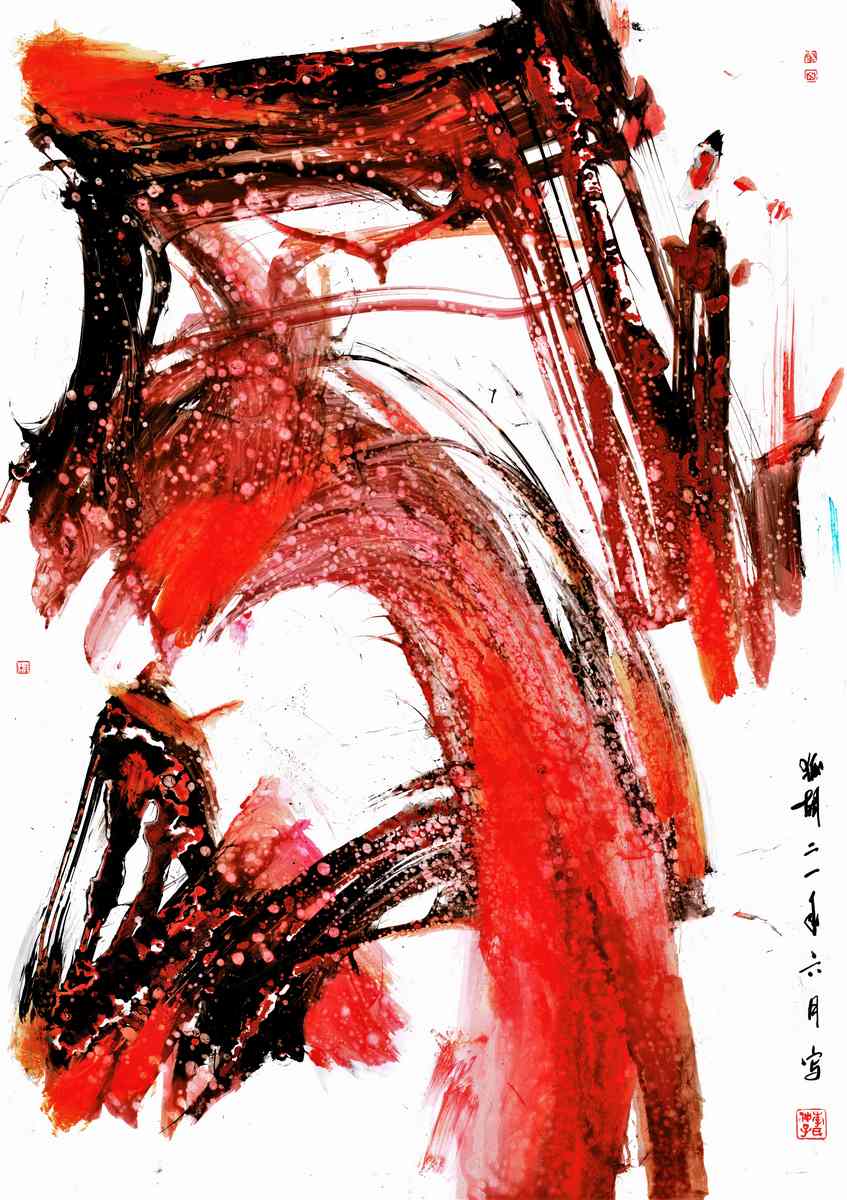
power, elegance and savageness
The question of beauty is becoming more central to my work. Painting beautiful pictures was never my primary concern, but I have to focus on it now. Creating something beautiful without appearing compliant is a good compromise, an idea that shapes my upcoming series of dragons. In sharp contrast, I am working on another series…
-

gestural painting a step further
I have been painting a lot lately, bringing psychological concepts into my “gestural abstraction” series. While some might call it gestural surrealism, I prefer to avoid strict categories. My goal is to trigger peculiar emotional sensations. What a person sees in an abstract picture depends on the viewer, but emotions themselves are not entirely abstract.…
-

gestural painting, subconsciousness and archetypes
Decades after my last portrait in 1989, I started a new chapter with abstract gestural painting. I used my existing skills but added a focus on the subconscious and Carl Gustav Jung’s archetypal ideas. I am fascinated by comparing this Western psychoanalytic approach with traditional Chinese painting theories. My recent works blend these two distinct…
-

almost thrown away
I have a few binders of old work I originally planned to throw away. Because I mostly work on series driven by a strict concept, I sort out any piece that does not fit. This portrait is from a 1988 series. Revisiting it after many years, I am glad I kept it. It represents a…
-

if sharks were people
I want to offer a homage to Berthold Brecht, an author who has always been important to me. In his short story “If sharks were people,” Brecht explores the dark realities of power masked by care and illusion. My new painting, “If sharks were blossoms,” is a tribute to this narrative. The work relies on…
-

burning down the snow
The painting evolved into “Burning down the snow.” I engaged with surrealism again after many years, and those influences are obvious here. I am not sure if the painting is a complete success, but it has strong ideas. I wanted to provoke doubt in the viewer by contrasting photorealistic associations with abstract, random spots. This…
-
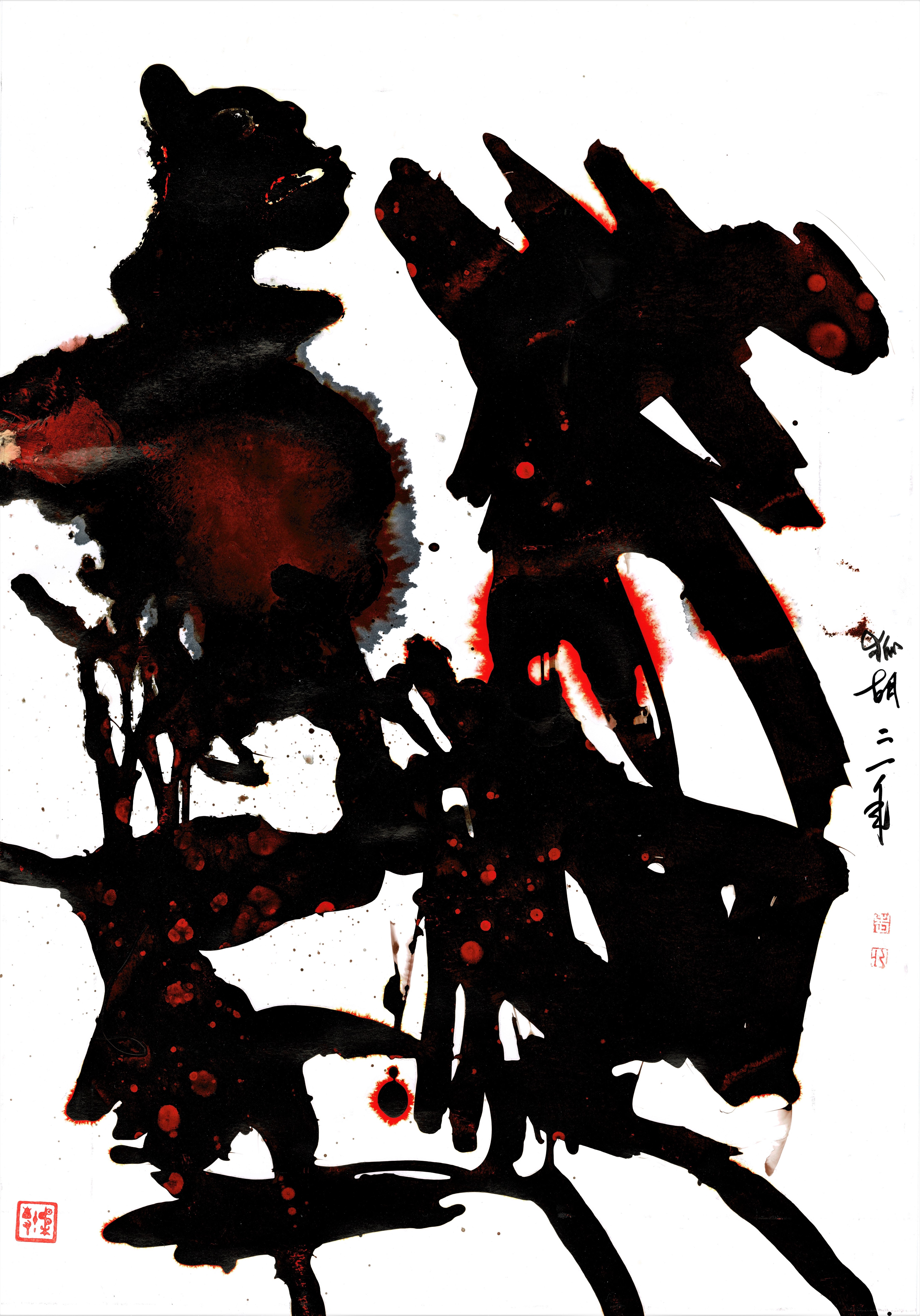
white black red
White, black, and red give this picture its title. As in most of my work, ideas from Chinese painting and calligraphy flow into this piece. A crucial aspect of East Asian art is the importance of the non-represented—the white space or nothingness. The premise is to respect the black but adore the white. Western viewers…
-

triptych finished
I finished a new triptych titled “A Mountain.” These abstract works deal with the subject of mountains and caves. The structure is based on the archaic Chinese character for mountain, which depicts three peaks. This theme relies heavily on the tension of opposites—the Daoist balance of yin and yang—contrasting the solid, towering peaks with the…
-

nude drawing
I finally started to enjoy life drawing. For a long time, I made no progress with nude painting because I clung too much to the style of a great Austrian draftsman I still admire, Fritz Martinz. I was not the only one who struggled to escape his dominance. Later, I changed my style completely. This…
-

abstract landscape artwork
I took up and continued a basic idea from a recent work, “painting away pain.” This new abstract landscape is more transparent and airier, yet it contains more structured elements. This creates a clear tension of opposites—the Daoist balance of yin and yang—contrasting the light, ethereal spaces with firm, grounding structures. Here are some details…
-

paint away pain
Yesterday was a black day marked by severe pain and a stock market crash. A painkiller did not help much, so I decided to paint the pain away. Expecting little, I used a botched sheet that still had some good ideas. Listening to Schubert sonatas played by Alfred Brendel distracted me for hours. The result…
-
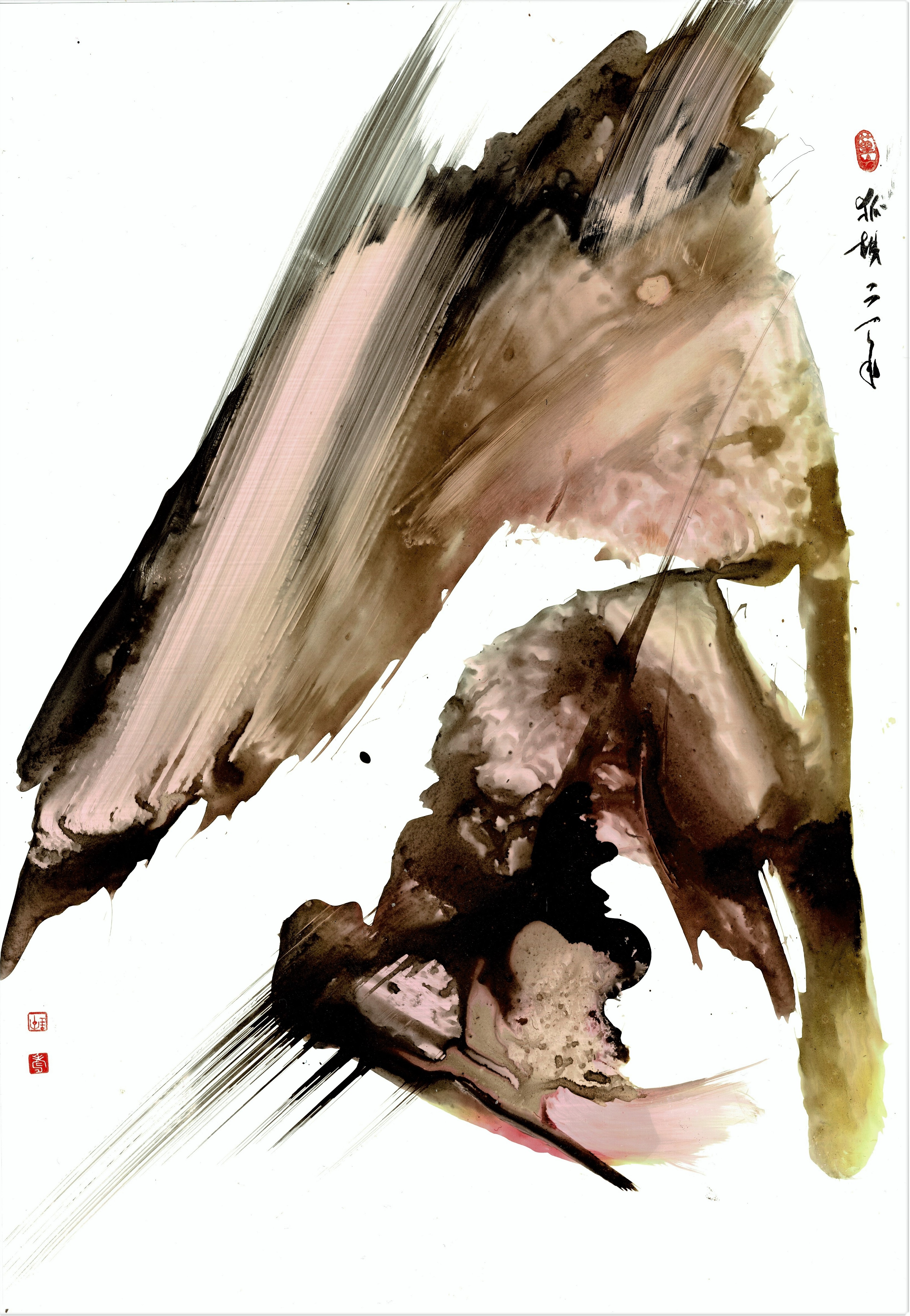
another couple of new works
Last weekend was another very productive one. I am working on a couple of series and was able to finish some work which can be added now. Like these painting of withered flowers, landscape, stones and abstract composition.
-

a couple of new works
Last weekend was very productive, and I am satisfied with the new works I am presenting today. The foundation of these pieces remains the principles of Chinese calligraphy and painting. One sheet takes a provocative approach, featuring Chinese text that translates to: “If you are looking for a deeper meaning in this painting, you are…
-

a step forward
For decades I have painted figurative. Almost 2 years ago I started to develop myself into abstract painting. Even if I haven’t found a definitive style, I’m pretty happy with my progress like this rocks and stones painting.
-
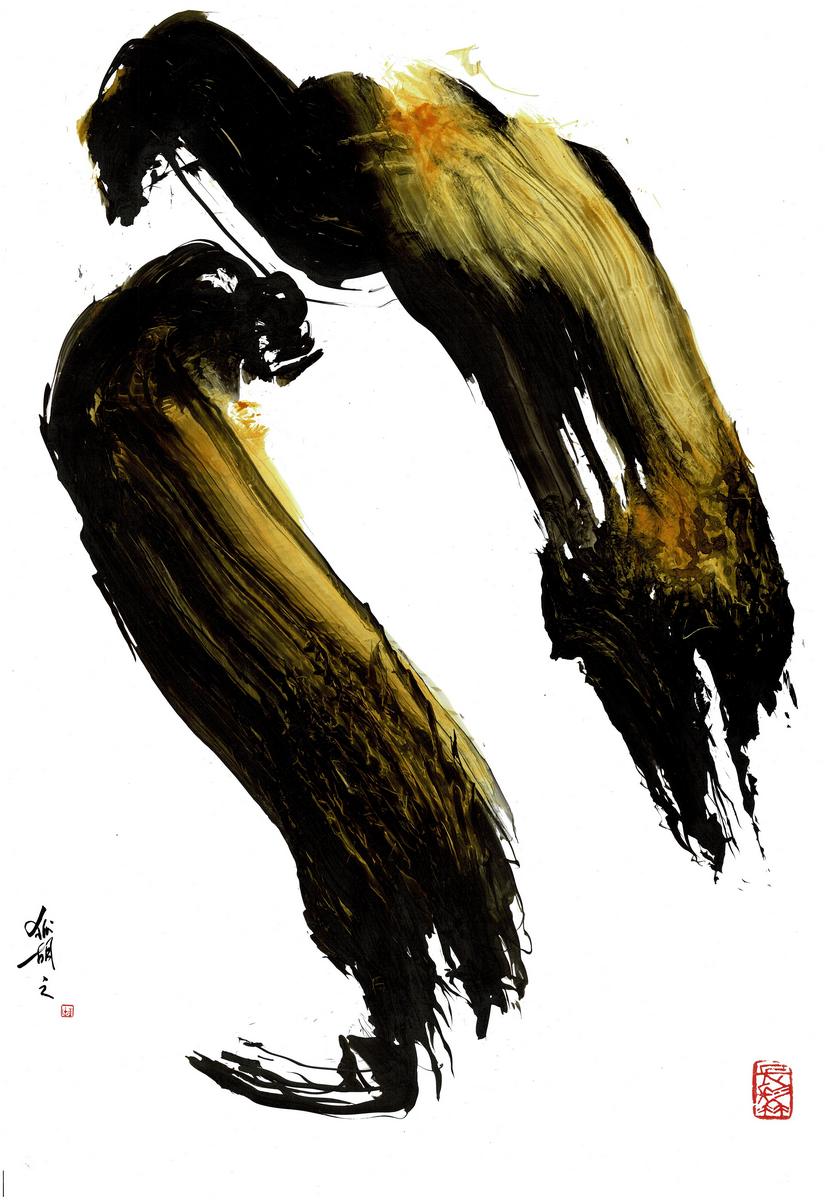
a couple of new works added
I have added new works to my current series of gestural paintings. Created in A3 format using ink on paper, these pieces continue to be shaped by the ideas and principles of traditional Chinese calligraphy. This approach relies on a clear tension of opposites—the Daoist balance of yin and yang—contrasting spontaneous, fluid brushstrokes with the…
-

Easter Contribution
Easter is approaching, and I made a small piece for it. I overwrote an old Albrecht Dürer chromolithography from 1506 with a Mao slogan: “Do the publishing work seriously.” This combination might seem confusing, but it comments on recent political developments and media campaigns in China. The artwork relies on a sharp tension of opposites—a…
-

Another Work after Huang Binhong – 黄宾虹
My Chinese colleagues were impressed by a recent painting of mine, and a well-known painter added his calligraphy to it. This is a great honor. Many ancient Chinese pictures feature inscriptions by other artists. Western art lovers often wonder about the many seals on these works. Most are collector’s seals that show who owned the…
-

Recent Work: Day 7/7 the last one
Abstract painting of autumn in my garden. This is the final example with work for the past 2-3 weeks.
-

Recent Work: Day 6/7 new bookmarks
Some more bookmarks. There are still lots of dried blossoms and leaves from last spring and autumn and I could do quite a few more of these.
-
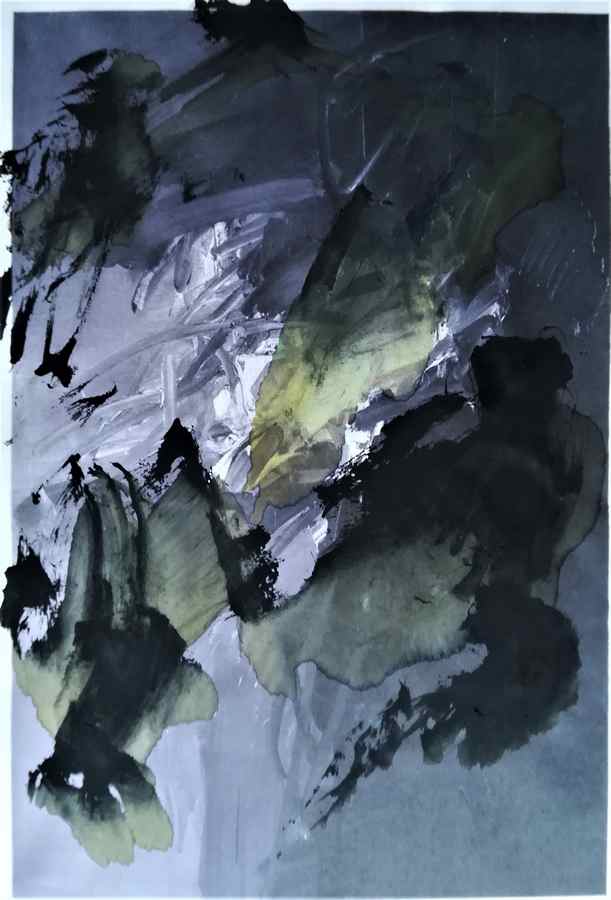
Recent Work: Day 5/7 Surrealism
With painters like Max Ernst, the world of painting opened up for me. Now I have painted an homage to Max Ernst. “The Triumph of Surrealism” from 1937.
-

Recent Work: Day 4/7 gestural calligraphy
In the gestural calligraphy series, principles of traditional calligraphy are used to make random formations appear as if they were calligraphy.
-

Recent Work: Day 3/7 blossom and calligraphy
Smaller painting with a single blossom and traditional Chinese calligraphy
-

Recent Work: Day 2/7 with explanation
Mao Zedong slogan on old, decorative Romanian invoice from 1932
-

Recent Work: Day 1/7
Painted calligraphy by writing various poems by Tang Yin (唐寅 1470–1524) on top of each other.
-

A few rays of sunshine for your weekend
After my old love for “The Blue Rider” flared up again and after a long beautiful walk through the Vienna Woods, this picture was then taken.
-
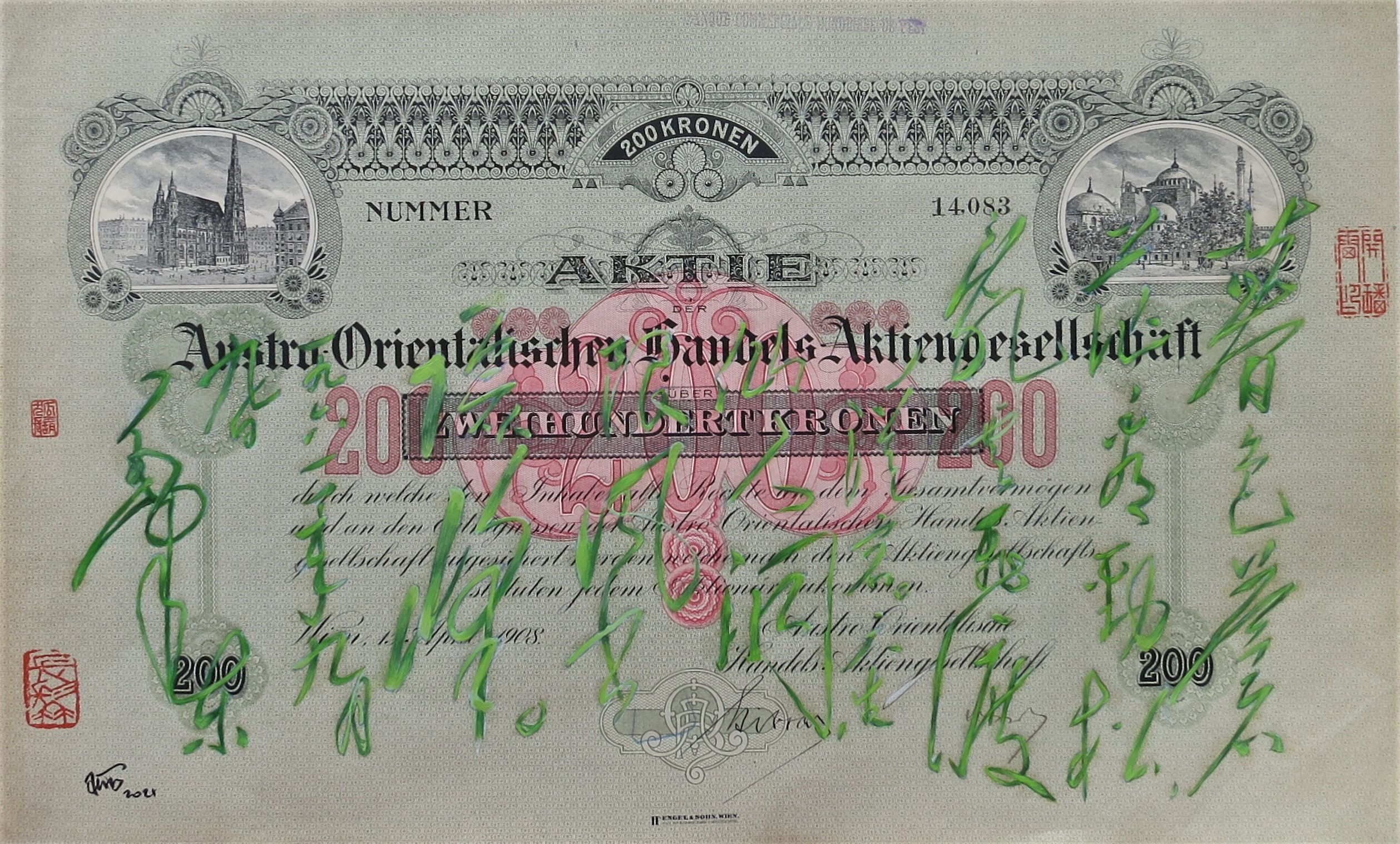
New work – with an explanation
This piece uses an old, worthless stock certificate from the Austro-Orientalische Handels AG. A stock is the ultimate symbol of capitalism. It features Art Nouveau vignettes of St. Stephen’s Cathedral and the Hagia Sofia, representing past Western and Islamic empires. I overwrote this document with Chinese calligraphy by Mao Zedong. The work relies on a…
-

withered leaves and blossoms
withered leaves and blossoms used for artworks, on paper, mixed media or just as bookmarks.
-

just blossoms and buds
In Chinese painting, opposites play an important role: emptiness – existing, calm – movement, strength – weakness, etc. In a small series, I tried to capture and express some of these ideas.
-

early woodcuts
A few examples of my earliest woodblocks as turn from Surrealism to Expressionism.
-
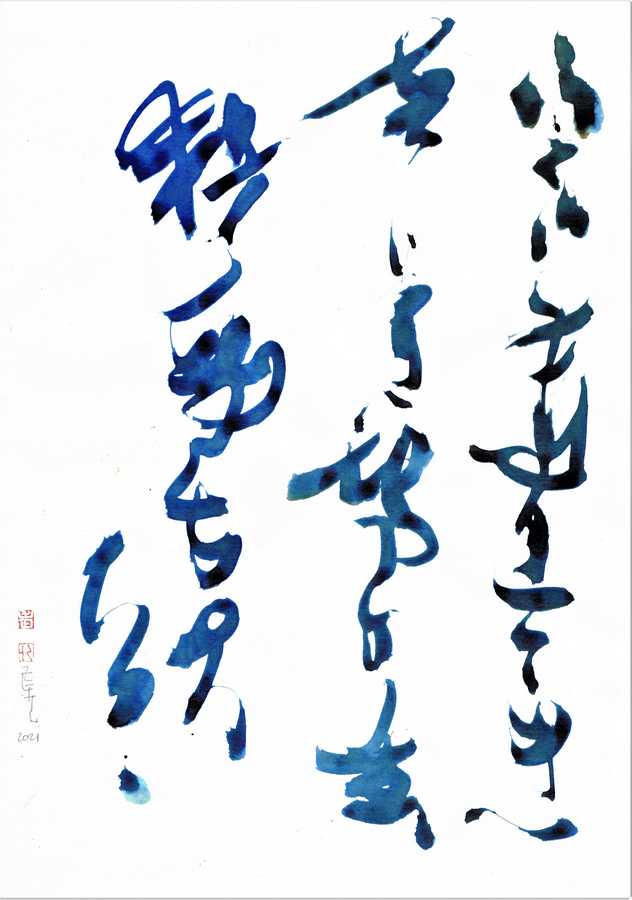
Your opinion please!
asking for your opinion on my new calligraphy work
-

Bookmarks – my love for old leaves
After I hadn’t painted for a long time due to my job, I started to sniff it again about a year ago. In order to regain my sensitivity as quickly as possible, I collected withered leaves and then blossoms and flowers in spring. The first thing I did with it were bookmarks.
-
The Principle of the Balance in Chinese Painting
In the first part of “The Essence of Chinese Painting,” I explore the fundamental principle of dynamic balance. Unlike Western art, which relies on a static scale, Chinese painting uses a dynamic scale. This approach contrasts heavy, visible brushstrokes with the powerful counterweight of empty space. Whether in a single character or Ma Yuan’s one-corner…
-

protective masks in 1980 in beijing
Oil painting “Protective masks in Beijing” from 1980. It shows people with protective masks in front of the “democracy wall”.
-

student prank with Wang Ziwu 王子武
During my time at the academy in Beijing, I recommended the then-unknown Xi’an painter Wang Ziwu. He was invited and, despite being shy, painted an excellent portrait of me. The next day, he gifted me and my Australian colleague Claire two paintings. As a prank, I painted a copy of Claire’s picture and swapped it…