
Yunnan Spring Greetings (IV)
“Every day an adventure, every day a joy.” It might sound a bit cliché, but here, one experience really does chase the next. We actually cancelled our planned trip to Mangshi (芒市) because Heshun and its surroundings simply have too much to offer. A couple we are friends with drove all the way from Beijing, accompanied by another couple, just to see us. After a proper reunion feast, we set off the next day to find seven historic bridges.

Seven Ancient Bridges Trip
Bridges have always fascinated me, primarily because they connect. This observation has even shaped my outlook on life.
At the very first bridge, we ran into a problem—we were hopelessly lost in an extremely remote area. Then we met an 83-year-old woman. She immediately offered to show us the way – it was a long walk. I was the first foreigner she had ever seen, but she wasn’t shy in the slightest. We chatted away, with each of us understanding only half of what the other said.

This encounter led to this photo, which is already one of my favorites of the trip.

Engineering without Nails
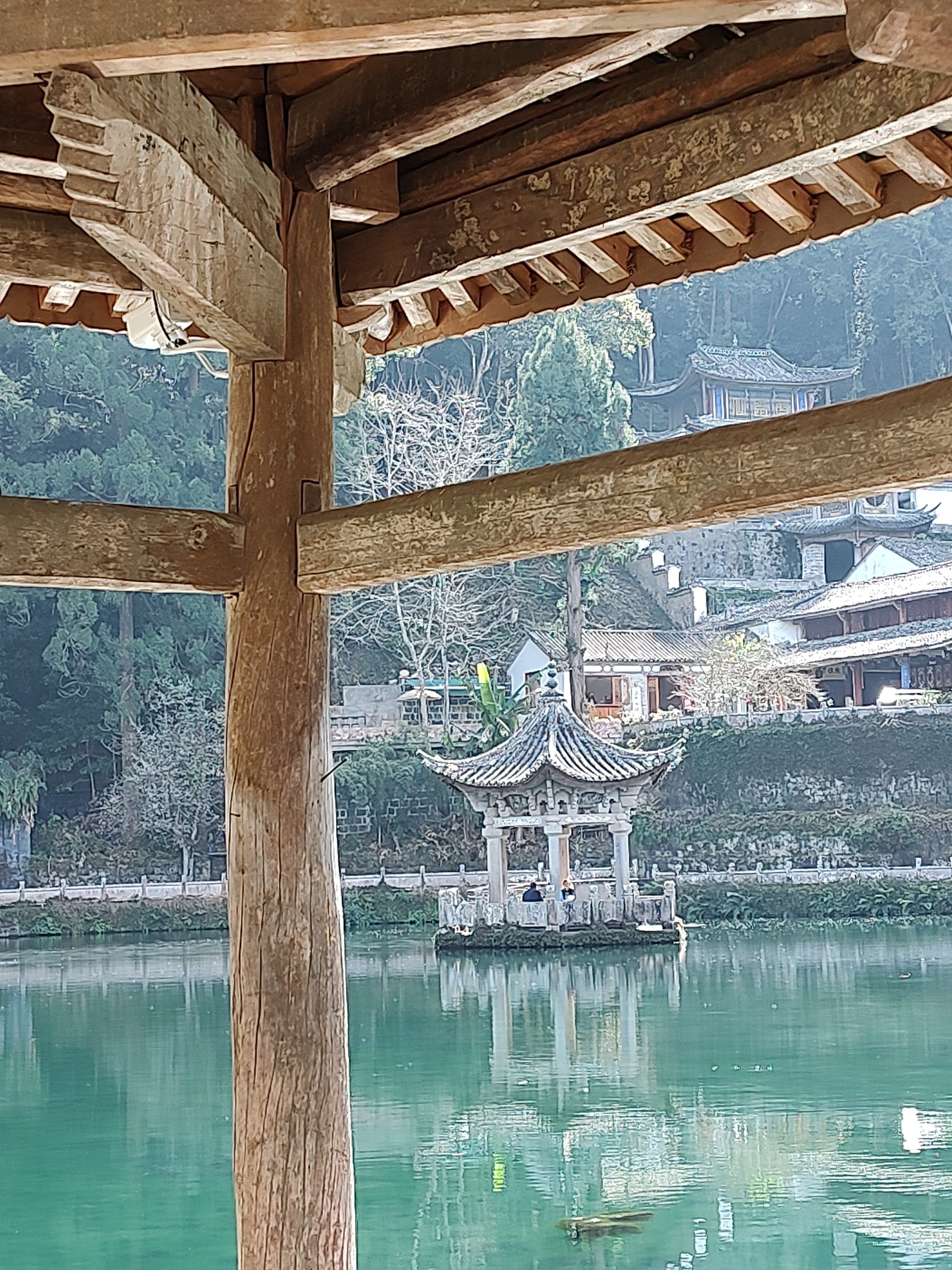
The bridges we visited were all built around the mid-18th century. They appear fragile or dilapidated from a distance, but once you step inside, you are surprised by how intact they remain. The historic wooden bridges we visited appear fragile or dilapidated from a distance, but once you step inside, you are surprised by how solid many of them remain. Their timber structures demonstrate the remarkable skill of traditional Chinese carpentry.


They rely on traditional mortise-and-tenon joints (sunmao, 榫卯), which allow wooden elements to be joined without relying primarily on metal fasteners. More than simple crossings, these covered bridges also provide sheltered spaces where people can stop, rest and gather. They are not just crossings, but “Wind and Rain Bridges”—sheltered spaces meant for the community to gather.

Some photos from that area.


The Daoist Heights: Yunfeng Shan
Next, a few words on the impressive Yunfeng Shan.


Yunfeng Shan, or “Cloud Peak Mountain,” is a sacred Daoist site near Tengchong (腾冲), famous for its temples perched dramatically on the steep mountain peak. For centuries, pilgrims have climbed the mountain to reach its sacred buildings. The physical ascent itself seems particularly fitting in a Daoist setting: the path follows the mountain rather than overcoming it, gradually leaving the everyday world below.
Accessing the temple is an adventure in itself. A shuttle bus and a cable car take you quite high up, but then 676 steps await you. That might not sound like much, but the final third is extremely steep and draining, especially combined with the high altitude. The reward for the effort is a fantastic 360° view—and a slight sunburn.


After this fifth exhausting mountain climb, it has become clear: we need to shift down a gear.


The Extinct Volcanoes and Hot Springs of Tengchong
The region around Tengchong (腾冲) is dotted with numerous hot springs—some reaching temperatures high enough to boil eggs. The charming landscape, shaped by extinct volcanoes, is best experienced from the basket of a hot air balloon.


A traditional pavilion reflected in calm water near Heshun in Yunnan, photographed during a journey through historic bridges, Daoist sites and the landscape around Tengchong.


The Kingdom of Camellias
Yunnan is widely revered as the “Kingdom of Camellias” (山茶花), hosting over 35 endemic species and more than 500 distinct cultivated varieties. The most celebrated among them is the Camellia reticulata (滇山茶), a symbol of the province known for its resilient beauty and massive, intricate blooms that have been cherished here for over a millennium.


More Yunnan Spring Greetings: Part I – Spring Greetings · Part II – Just Shaxi · Part III – Density, Depth, Tradition and Authenticity · Part IV – Every Day an Adventure · Part V – Pure Dao · Part VI – Along the Tea Road · Part VII – South of the Clouds · Part VIII – Customs, Traditions and Religion · Part IX – Buddha’s Light · Part X – Afterthoughts on the Yunnan Journey
Related articles: Wu Wei: Effortless Action in Daoism and Chinese Painting | Daoist Talks | Doors Between Worlds – China and Austria
Explore Art & Writing
Art Portfolio → Featured Artworks → Arts & Philosophy Journal → All Articles
Explore Asian Art Essays for writing on Chinese painting, calligraphy, aesthetics and art history.
Available Artworks
Original works are available on FriedrichZettl.com and Saatchi Art


Leave a Reply