
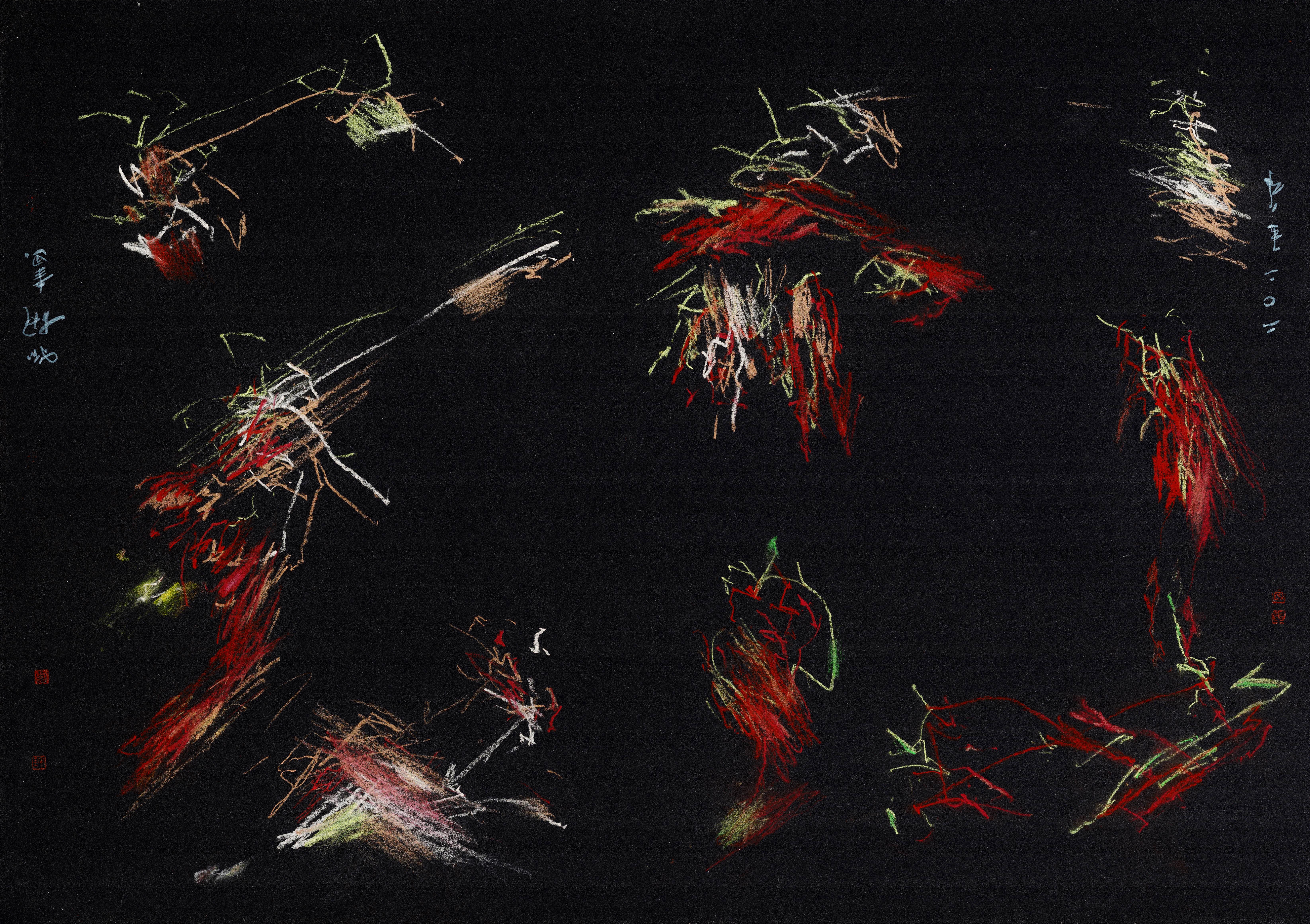
A Transition from Monochrome to Color.
Nothingness in Color is a series of contemporary ink paintings that continues a visual and philosophical experiment that began with my Journey to the Zen Master. The earlier works embraced monochrome, with black and white dominating the visual field. The next step was to introduce color while retaining the essential principles of reduction, emptiness and balance.
This new series continues my exploration of contemporary ink art, while introducing color into a visual language previously dominated by black and white.
Like many artists, I find it increasingly difficult to concentrate amid a constant flood of noise, misinformation and global crises. Painting becomes a way of returning to silence.
Returning to painting became, in this context, both a creative challenge and a way of regaining focus.
The Evolution of Nothingness in Color
Although it wasn’t the first image in the series, I want to begin with it. Despite its imperfections, it serves as the ideal entry point for today’s exploration. Initially conceived as a fleeting, ambiguous sketch, it unexpectedly led to an intriguing direction—one that allowed me to introduce color seamlessly into a new, evolving series without sacrificing the elements that define my work.
The core remains unchanged: Daoism, Zen, minimalism, poetry, and, when possible, a musical touch. Each of these aspects intertwines to shape the essence of Nothingness in Color, and I aim to delve deeper into them—this time, in reverse order of these aspects.

Music as the Invisible Brushstroke
In this series, music does not illustrate the paintings; rather, it shapes their rhythm. Music is not merely a background to my painting. Anton von Webern’s extreme economy, silence and carefully placed sounds resonate with my own attempt to give maximum weight to a minimum of visual elements.
“Anton Webern’s compositions are characterized by extreme conciseness, precision, and structural clarity, mirroring visual art forms like pointillism and minimalism. His use of silence, fragmentation, and carefully placed tones evokes a sense of spatial tension and abstraction akin to modernist painting, where each element gains weight through isolation and context”. [1]

Poetry and Calligraphy
Poetry, much like music, is an expansive field. Many of my co-bloggers and readers possess deeper expertise in this area, so I gladly leave its broader discussion to them. However, one aspect worth highlighting is the connection between Chinese poetry (诗 shī) and calligraphy (书法 shūfǎ).
Most works in this series resemble carefully crafted calligraphy—each individual element appearing like a brush-written character. This interplay between visual rhythm and artistic flow mirrors the essence of poetic composition, where form and meaning are inseparable.


Minimalism: The Illusion of Complexity
Minimalism has been extensively discussed, not just as an artistic movement in the West, but as a fundamental pillar of Asian art traditions. This series explores a key paradox within minimalism—how a composition can appear visually rich despite containing only a few essential elements.
I sought to create pieces that seem abundant in detail, though their structure remains starkly simple. To test this perception, I asked AI [2] to analyze the ratio between emptiness—the black background—and the actual color elements. The result was striking. For one image: “…..approximately 86.66% of the canvas is black, while only 13.34% contains color.” In this case, below: “approximately 23.3% of the painting is color.“


Zen and the Art of Letting Go
As has been discussed many times, portraying Zen is a difficult undertaking, as it involves complete letting go. My fellow artist and co-blogger Nick, aka Spira, whom I have already introduced in an article, reminded me of the following quote by Zen master Kazuaki Tanahasi:
“If each moment is our entire life, how dare we kill time?
If each stroke is our entire breath, how dare we correct it?”
And since Zen koans often come with a wink, I would like to add: “If that little bit of color is your entire world, how can you waste it?” [4]

whispers of form disappear,
the void paints the brush.

Daoism and the Foundation of Nothingness
Daoism has always been the philosophical backbone of my work. Laozi’s opening line in the Dao De Jing (道德经 Dàodéjīng) states:
“The Dao that can be expressed in words is not the true Dao.”
This principle extends beyond language—it applies to images as well. The challenge lies in capturing Dao through art, portraying something that transcends definition.
At the heart of both Daoism and Zen is the concept of Nothingness—not an absence of existence, but a boundless realm of possibilities. When only 10-20% of the canvas is occupied, every element must carry enough weight and intention to transform minimalism into richness.
Fundamentally, this journey revolves around the balance of opposites: light and dark, movement and stillness, etc. – and what is of particular concern to me, microcosm and macrocosm. By applying these principles not just to the composition as a whole, but to each individual object—even to each brushstroke—the artwork invites meditation and, at its best, evokes a sense of spirituality.

Artistic Identity and Personal Signature
Art defies singular definition—its meaning and boundaries shift across cultures, eras, and philosophies. Yet, one fundamental aspect remains: the desire to recognize a distinct signature in an artist’s work. Whether in music, literature, or visual art, individuality is not easily attained. It requires persistence, evolution, and a willingness to embrace change while holding onto the core of one’s expression.
Throughout my artistic journey, I have sought to refine this personal signature, allowing it to grow organically within my shifting techniques. While some creations may not fit conventional notions of artistic merit, they remain a reflection of my ongoing exploration.
Recently, I have consciously stepped away from rigid academic approaches, shifting my focus toward the uninhibited perspective of children. This is not about imitating childlike drawings—such attempts would inevitably fall flat. Instead, it is about capturing the essence of spontaneous expression, weaving it into a structured yet intuitive process.

crimson threads of breathless light
dance, then drift to still.
The Philosophy of Pushi
In Chinese, the term pǔshí (樸實 ) [3] embodies the concept of being unaffected—unspoiled by artificial embellishments, attuned to the natural flow of existence, free from pretense, valuing simplicity over spectacle. Children, in their raw curiosity, exemplify this state.
We also find this approach in art. Daoist works often present an illusion of effortlessness—as though anyone could achieve them. Yet, upon closer observation, their quiet precision reveals a mastery of understatement. True simplicity is deceptive. It requires restraint, intention, and the ability to convey depth without excess.
The Journey as the Destination
For me, art is not about reaching a final form; it is about embracing the process. The pursuit itself carries meaning. Whether refining technique, redefining style, or challenging perception, the act of creation remains the artist’s true companion.
So, for quite some time, I strive to move closer to the beauty of pushi—to cultivate an artistic voice that resonates without force, to let simplicity reveal its quiet complexity. The road ahead is long, but in art, as in life, the journey is the destination. And so, it must be savored.

footnotes:
[1] https://en.wikipedia.org/wiki/List_of_compositions_by_Anton_Webern
[2] The striking result confirmed something I had intuitively sensed: in some works, almost 87% of the surface remains empty, while only a small proportion is occupied by color.
[3] I deliberately use the Chinese concept of pǔshí (樸實) because no single English word fully captures its combination of simplicity, authenticity and unaffectedness.
樸 (pǔ) – simple, plain, unadorned
實 (shí) – real, true, honest
[4] As with traditional Chinese ink painting or calligraphy, corrections are not possible in this technique. Any correction would distort the natural balance and thus disrupt the spiritual approach.
More on Nothingness: what-is-reality I State of the Art 2025: More Nothingness in Color I Theme and Variations
Explore Friedrich Zettl’s Art and Ideas→
View the Art Portfolio → Asian Art Essays→ Philosophy → Journal → Articles
Original works are available on FriedrichZettl.com or Saatchi Art


Leave a Reply