
On Trying to Create Art in a World Off Its Axis
Cracks in the silence is about fractured times. It’s a feeling most people share, regardless of where or under what circumstances they live. The desire for stability, for a foundation of rules, laws, and humanity that one can rely on, is growing ever louder. But this foundation is eroding. Agreements like those of UN organizations or the jurisdiction of the International Criminal Court seem to be degrading into mere recommendations. The pressure in the global cooker is rising relentlessly.
The hope that reason and common values would prevail is fading with every glance at the international media, with every analysis of the echo chambers on social media. In this confusing and disturbing environment, one is forced to reflect on one’s own standpoint. At first, I wanted to write a political article about it. But I discarded the idea—those who would read it already know how the game is played.
Instead, I want to show some of my recent work here. It is my attempt to react to a world that is growing ever louder, and an expression of the fundamental question I face as an artist: What is the meaning of creation when the world around you is falling apart?

Summer 2025: The Search for Essence
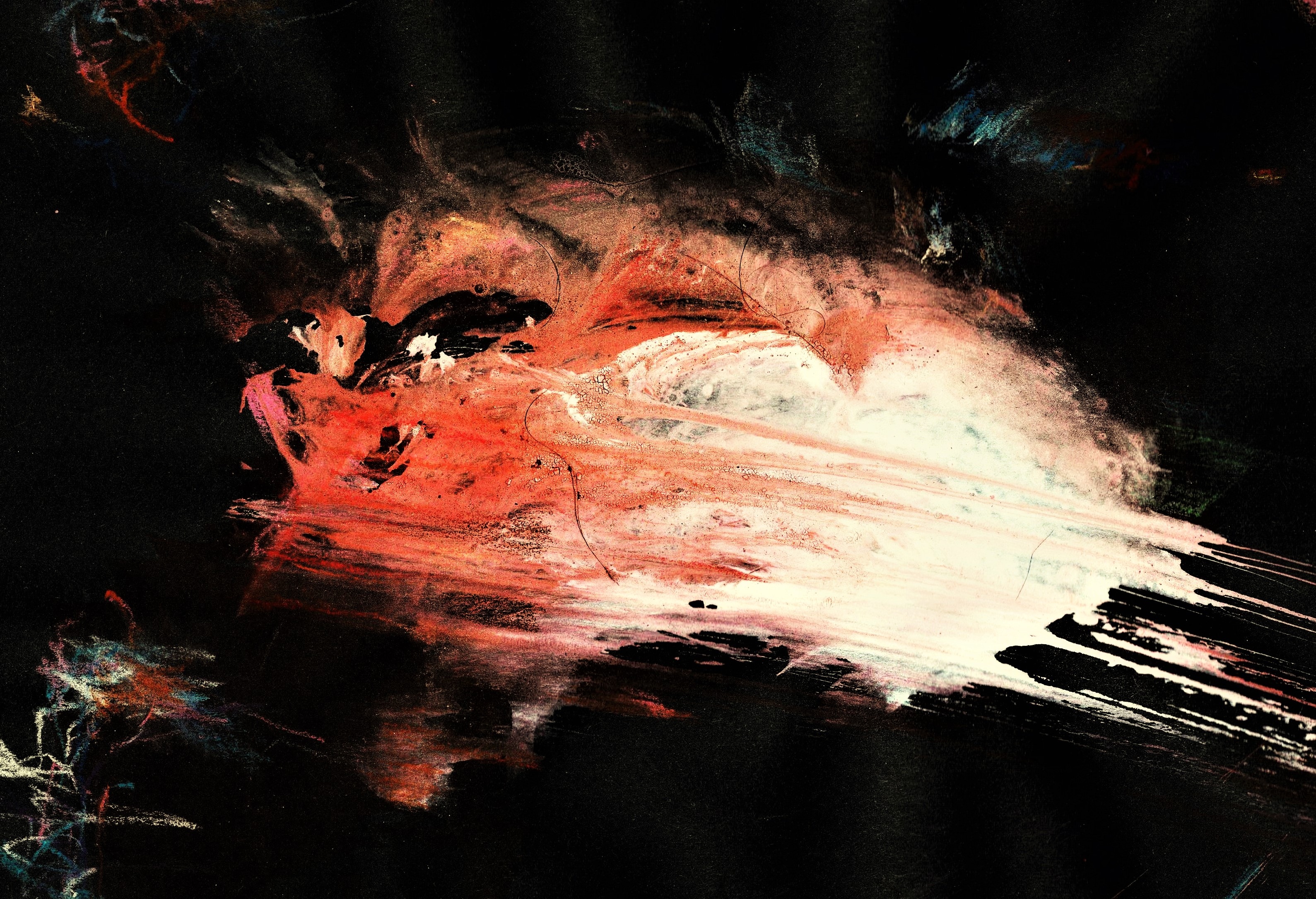
This environment, of course, impacts my art. Initially, I reacted by retreating inward. I continued to work on my minimalist series, dedicating myself to details, trying to subtract even more to distill the essence. It was an attempt to create a space of silence and concentration in a chaotic world, an almost meditative counter-reality.
The following image is a result of this phase, in which I changed my technique to express this feeling.


At the center of these works are the opposites in the Daoist sense: silence and noise, order and chaos. I was particularly interested in the boundary, the “in-between”—the moment when the meditative world collides with harsh reality, and we are suddenly torn from our concentration.

The Scream: When the Outside World Breaks In
But this retreat cannot be a permanent state. There are subjects so unbearable that they break through any wall. We know that the most vulnerable among us—especially children—have been subjected to unimaginable abuse throughout history. Yet we tend to suppress, to look away, to relativize.
This suppression perhaps partly explains how it is possible to ignore or even deny the systematic violence against children in Gaza by the Israeli military for so long. The shock gives way to a numbness. To counteract this, I didn’t want to create a work that stokes hatred, but one that reaches the emotional level and encourages reflection.
This is the space where childhood shatters.
The image is a masterful indictment of the loss of innocence. It is not about a specific situation but makes a universal statement about how conflict and violence affect the most vulnerable. The idyllic world of the child—a space of wonder, dreams, and the security of a blanket—is not just endangered by the present threat; it is irrevocably shattered by the mere presence of violence.


The Empire of Lies: From Crime to Narrative
The deliberate killing of children is one level of horror. Another, more subtle level is the manipulation of truth that first enables such crimes and then conceals them. The debate around the so-called Epstein files is a disturbing example. In both cases—whether children are shot on camera or victims of abuse are silenced through intimidation and minimization—we witness the spiritual death of innocence.
How does one deal with this abyss? Getting an overview is the first step. But a look at the media landscape reveals a surreal picture: Epstein’s crimes, his death in custody, the continuing release and discussion of documents, and conflicting public claims have produced an inextricable mass of facts, accusations, denials and speculation. What remains is a disturbing example of how difficult it can become to distinguish established facts from the narratives built around them.
When Truth No Longer Matters – Cracks in the silence
Is any of it even true? That question was once the beginning of all reflection. Now, however—and this is perhaps the greatest source of frustration—it seems it no longer matters whether something is true. All that matters is the narrative, the story, which can be adapted at any time. In such an environment, trust, confidence, and empathy wither.
And here, the circle closes back to my art. If objective truth disintegrates and only narratives remain, what then is the artist’s role? Perhaps it is not to depict the one truth, but to create a space where feeling and reflection become possible again. A space that makes the cracks in the silence visible.
Silenced Messengers
The decay of truth that I described in the first part leads to a disturbing strategy for dealing with problems. Instead of fighting the causes, we fight those who point them out. The old principle of first analyzing the facts and then seeking a solution is being systematically dismantled. The messenger with the inconvenient news is simply silenced.
A respected academic provides uncomfortable statistics? You’re fired. Reporters cover inconvenient crimes? They’re silenced. Satellites deliver alarming CO₂ data? They’re switched off. The list goes on and on. It is an attempt to create a reality that fits a desired narrative by eliminating all dissenting voices.
The Facade of Nature
My latest works, which are currently in progress, also address this theme of deceptive narratives—this time in the context of our environment. They explore the seductive beauty of a seemingly intact nature and the destruction hiding just beneath its surface.

At first glance, the picture draws you into a magical underwater world where luminous jellyfish float through the darkness like weightless lanterns. On closer inspection, however, this natural harmony is broken by sharp-edged, artificial fragments that cling to and within the translucent bodies of the animals like particles of trash. The colorful and aesthetic surface thus serves as a seductive veil for the creeping destruction of our oceans. Pollution no longer merely surrounds nature; it has already become a part of the living beings themselves. (Image: “The Trash Within Us”)

Golden Trash
At first glance, the picture captures the deceptive beauty of an orange sunset, bathing the sky and water in a warm, almost surreal light. But this idyllic glow is a narrative that outshines the truth, because in the foreground, the light reveals the dark silhouettes of trash and destruction lining the shore. In this way, a supposedly intact nature is exposed as a fragile facade, its wounds only becoming visible in the light of what is seemingly beautiful. (Image: “Golden Trash”)
Conclusion
So, what remains in a world of broken narratives and deceptive facades? When the messengers of truth are silenced and destruction is cloaked in beauty, loud accusations lose their power. Perhaps this is the ultimate task of art today: not to shout the one, loud truth, but to unmask the lie hidden within the beautiful appearance. And in doing so, to hold open a space for a quieter truth, one that can only be felt.
Related Articles: Nothingness in Color | Discovering the Beauty in the Ugly | Art Portfolio
Explore Art & Writing
Art Portfolio → Featured Artworks → Arts & Philosophy Journal → All Articles
Explore Asian Art Essays for writing on Chinese painting, calligraphy, aesthetics and art history.
Available Artworks
Original works are available on FriedrichZettl.com and Saatchi Art


Leave a Reply