
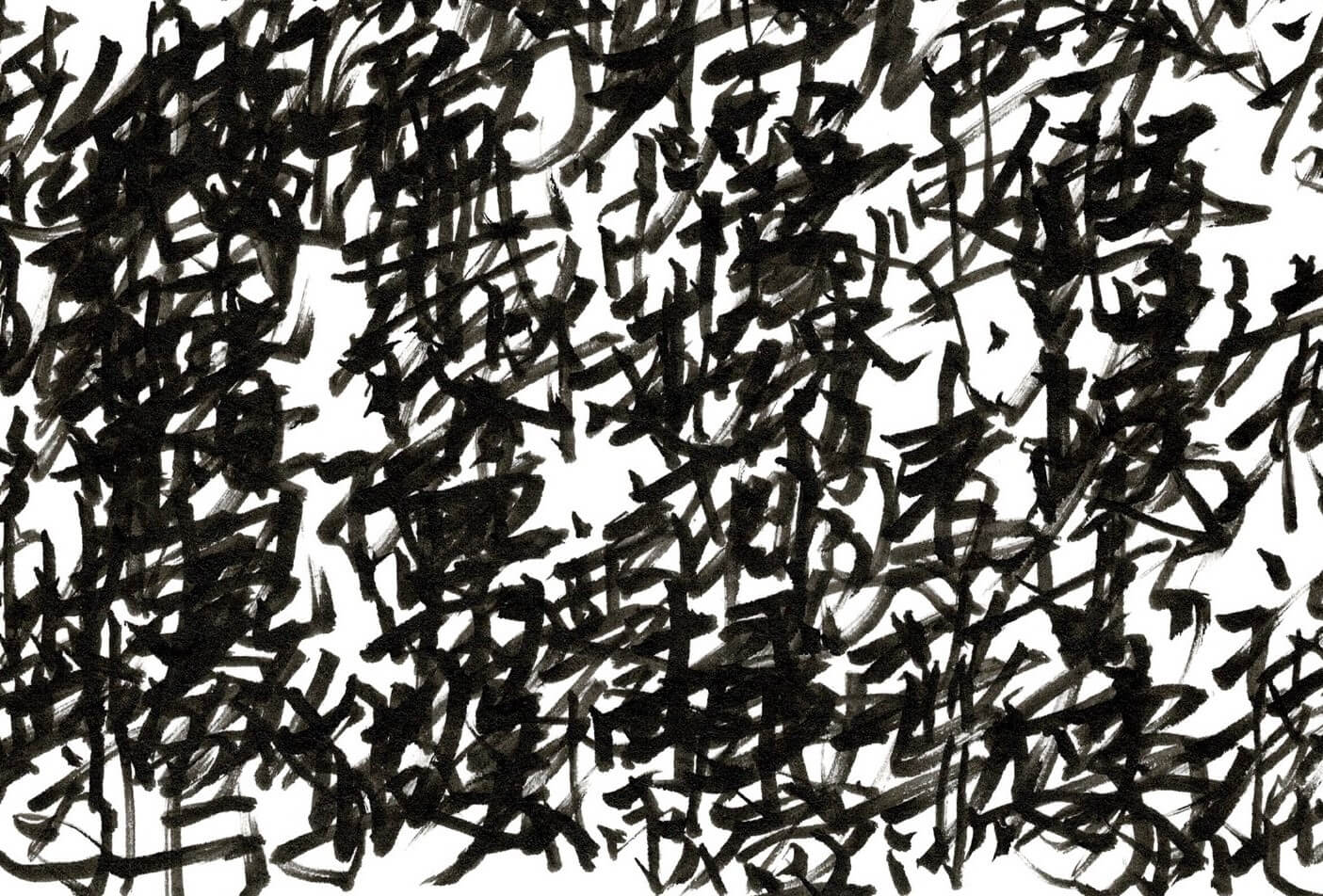
Painted Calligraphy 绘书 (huìshū) has occupied me for many years because it allows writing and painting to meet on the same surface. Chinese characters remain the starting point, but through repetition, layering, color and rhythm they gradually lose their purely linguistic function and become part of the image itself.
In this article, I would like to show the process more closely through two contrasting approaches: the dense monochrome works I call Black Zen and a group of painted calligraphies dominated by red. The accompanying video offers a more direct impression of how these works develop through repeated writing, overpainting and spontaneous decisions.
Middle phase work of Painted Calligraphy
Let’s start with a piece of work I did in 2021 to shorten the whole thing a bit. It takes little imagination to recognize something as organic as foliage. The use of different colors reinforces the impression and creates a certain feeling of well-being – hopefully.

The situation is similar with “Ice Blue”, where we now only use ONE color, but playful color nuances are still possible.


If we follow certain ideas of Daoism or Zen Buddhism, less is more, because the abundance confuses us, stirs up our feelings, and does not allow us to see what is essential.
So, taking up this thought, we try to reduce. If you leave out a lot, there is less left over. It is now all the more important that we have to add more thoughts, and more “philosophy” to what has been reduced.
Now if we limit ourselves to just one color, we have to get more out of it. In the first sheet above, the strokes were relatively soft to emphasize the mild mood. We used sheep hair brushes for this. Now we use wolf hair brushes: the hair is harder, so the tip is more elastic and this means we achieve more dynamism, even a certain degree of aggression.


Red Dao
In Zen Buddhism, the topic of “ego” or letting go of the ego occupies a prominent place. We all have an ego, each of us is different, and everyone sees themselves as something special. I have written about the pitfalls of this view before. And there’s nothing fundamentally wrong with that. There is a way of looking at this in Zen Buddhism that I really like. The individual is compared to a wave in the sea. Every wave is different. But if we look out at the sea from a distance, we still can see the waves, but they all seem pretty much the same. Only their entirety makes the sea a sea. When we look at the work up close, we can see every single mark – however perfect or imperfect it may be.
Among other things, it was this idea that was influential in the following work, in which there are still a few slight color nuances in the original.
Painted Calligraphy in Process
The origins of this approach go back to my years in Beijing in the late 1970s. I have described that story, and how repeated writing gradually became a form of painting for me, on my Painted Calligraphy Series page.
Black Zen
Now let’s try to reduce significantly more. How did we try to achieve this? The following aspects are particularly noteworthy.
Painting material: Best, handmade paper, quality brush.
State of consciousness: Long mediation before starting work
Philosophy: Dao, ideas of Counterpoint theory
Background music: Giovanni Pierluigi da Palestrina (1525 -1594)

The role of Dao
It will no longer be surprising that Daoism plays a major role in this. Since I have already written a lot on the topic, it is enough to remember that opposites, i.e. yin :: yang, are dominant. In this case, it was particularly difficult to create both a meditative mood and at the same time remain powerful or dynamic. Someone who has never dealt with this before might easily think that it is enough to write random scribbles on paper since everything is black in the end. However, it is important to place every line, even every point, as best as possible and any negligence will have a bitter revenge.
Why Palestrina now? Music generally plays a very important role and in some of my works, you can almost guess what music was playing. Palestrina, a singer and bandmaster of the Renaissance and an outstanding master of church music, was above all the founder of a contrapuntal style in dialogue form. Johann Sebastian Bach would probably be unthinkable without Palestrina.
I tried to incorporate what little I know about counterpoint in musical composition into this work. In any case, I not only try my best to maintain order in the chaos of black lines, but I also try to capture the sublime of Palestrina.
I hope the whole thing was understandable and didn’t cause any major confusion. Thanks for your kind attention!
Related Articles: Painted Calligraphy Series: Text as Texture | Chinese Calligraphy: Traditional, Painted and Experimental Works | Between Calligraphy and Painting
Explore Art & Writing
Art Portfolio → Featured Artworks → Arts & Philosophy Journal → All Articles
Explore Asian Art Essays for writing on Chinese painting, calligraphy, aesthetics and art history.
Available Artworks
Original works are available on FriedrichZettl.com and Saatchi Art


Leave a Reply