
And a few comments on Depression.
Depression: A long winter is behind me. It felt endless, stretching on and on. In Vienna, snowfall isn’t guaranteed every year, but one thing I can count on is my winter depression. Usually, I manage it pretty well. It starts in early January and fades away by late February. However, this winter brought an unwelcome guest—a persistent, flu-like infection that lingered and added its own challenges.
Yet, that’s not the focus here. Instead, I want to share how I tried to channel this extended winter period into art. This journey took me deep within myself. The works I’m presenting aren’t meant to be a “top 10 horrors” list. They reflect an exploration of winter’s grip—a creative passage through cold and darkness before the promise of spring brings new hope.

Artists and Depression
Depression can have a profound impact on a painter – both positive and negative. The effect often depends on the individual personality, the intensity of the depression, and the artistic approach.
Negative Effects are a lack of motivation and creativity. Self-doubt and perfectionism can have a paralyzing effect, too. Exhaustion and concentration problems exist. Creative blocks can intensify. Isolation and withdrawal are my own specialties. Moving from the isolation of one’s own four walls to isolation in Mauritius is obviously not a good solution.
Positive Effects can be the outlet for emotions. Some artists process their depression in their paintings and thereby create profound, emotional works. Depression can change one’s view of the world and give rise to new forms of expression or styles.

My Focus During This Time: For me, depressive phases are primarily characterized by self-doubt. This can go so far that I consider myself one of the worst painters who have ever called themselves such.
After my intensive work on the topic “Fictional Journey to a Fictional Zen Master,” I wanted to go a step further, but without being able to define the goal linguistically. If Zen is already something that can hardly be captured in words, how much more difficult is it to enter or define a realm that omits as much as possible of what constitutes art in general? In other words, a realm in which the question of “beautiful” or “ugly” no longer arises, because both are present and merge into a dialogue – or into a higher sphere. Or when displaying artistry is seen as an inappropriate show-off?

Development of My Winter Works on Depression
The Zen series I just mentioned was predominantly monochrome, focusing on shades of black and white. While experimenting with color in a few pieces, I chose to stay true to the monochrome flow, avoiding any disruption to its cohesive tone.
However, I would like to show one of the experiments in color. It features a neutral, earthy gray background that evokes a diffuse, transitional mood—neither fully dark nor entirely light. Warm and cool colors intermingle across the canvas in a seemingly chaotic yet unexpectedly harmonious balance.

The black lines appear as fragments, dissolving traces that hint at impermanence. Angular shapes and jagged lines introduce a subtle unease, mirroring inner turmoil.
Touches of yellow, blue, and white light up the composition, offering a faint glimmer of hope. This balance between chaos and control, achieved through a blend of rough and soft brushstrokes, is a recurring theme in many of my works.
Wandering Back to Years of Beautiful Winter
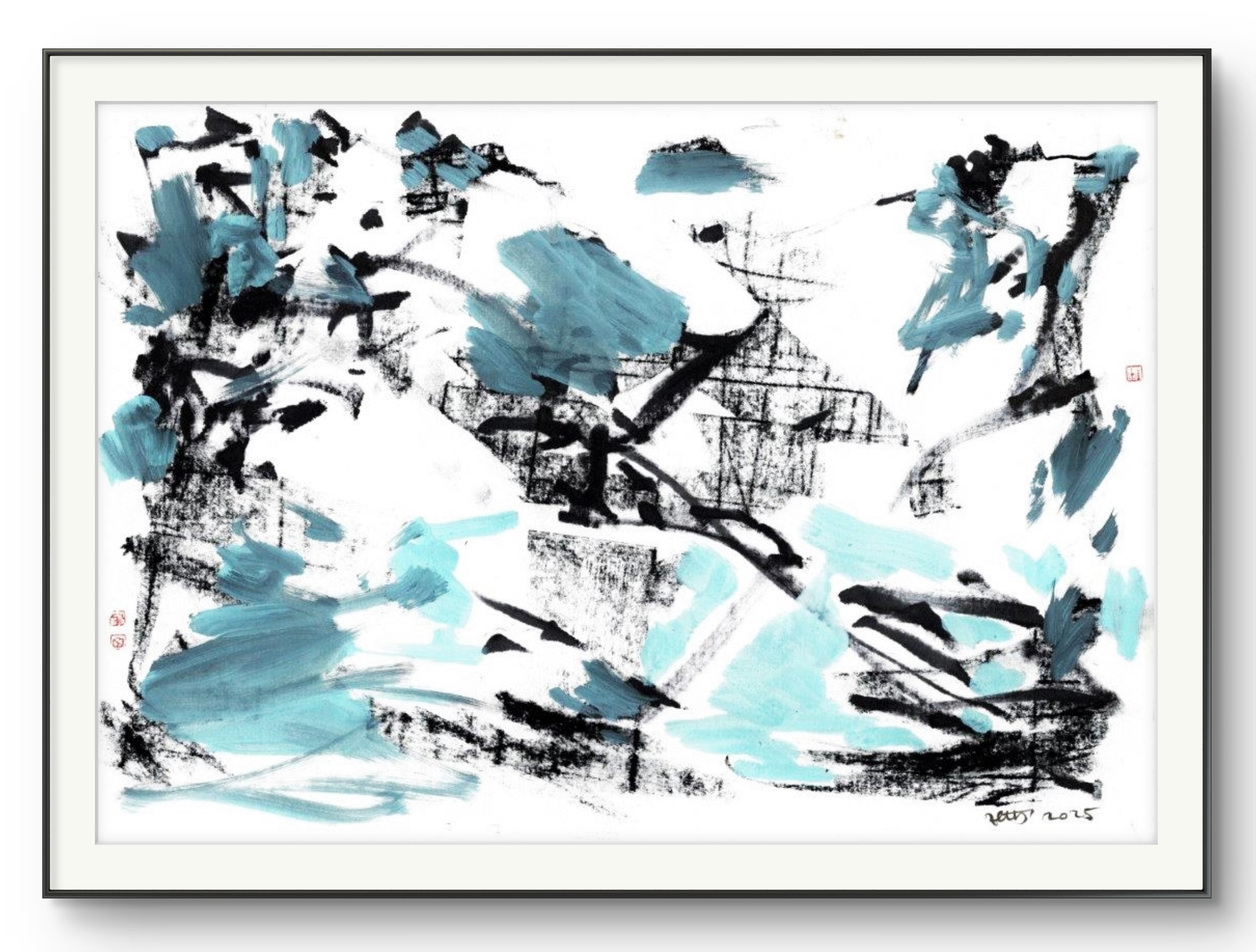
Since I was already aware that I was dissolving, I tried to address another theme. Reflections on earlier winters from my childhood in the countryside:
The dominant color palette of black, white, and cool blue creates an almost frosty, otherworldly mood—both physically and emotionally—but also a certain clarity or melancholy. The black seems like frozen structures or shadows from the past. They are irregular, sometimes fragmented—a kind of fragile memory. (In the middle, you should see the front of a house).

The blue is softer, often applied in a flat manner, which contrasts with the harder lines—as if something were dissolving or disappearing in the cold.
There is a certain emptiness in the image as if there were a space between the past and the present, between memory and distance.
The structures are almost reminiscent of a landscape, perhaps a place that no longer exists or only lives on in fragments in memory.

Two Works for Comparison
As is often the case, I create multiple variations of a theme. This approach allows me to explore and deepen specific elements. In the following two paintings, my focus was on enhancing both density and depth, but above all the inner dialogue.


Swan Song or Pointlessness?
A final and most recent painting from the depression phase.
What’s also typical for me during this phase is that I too often don’t finish paintings. However, I do so very consciously in this case. Of course, I could create a touch of “beauty” with a few warm colors and elegant strokes, and perhaps I’ll return to the theme later. But then it would be something completely different. I asked Gemini to analyze the painting again—as always, I’m impressed:

“This painting, viewed through the lens of depression, presents a landscape of profound emotional weight. The dark, muted tones, and dense textures create a sense of claustrophobia and emotional heaviness.
The composition lacks a clear focal point, suggesting a sense of disorientation and aimlessness. The forms are fragmented and indistinct, like memories or thoughts that are difficult to grasp.
The use of black, in thick, textured strokes, dominates the palette, conveying a sense of despair and emotional darkness. The splashes of green, while offering a hint of color, are muted and subdued, as if struggling to break through the darkness.
The overall effect is one of emotional turmoil and isolation. The painting seems to express the feeling of being trapped in a dark, oppressive space, where hope and light are difficult to find.
This piece, in its raw honesty and emotional intensity, offers a glimpse into the artist’s inner world during a period of depression. It’s a reminder that art can be a powerful tool for expressing and processing difficult emotions.“
This approach is undeniably bold and uncompromising, but it comes with the risk of drifting into “pointlessness.” By stripping away everything that makes an image visually appealing, I risk arriving at insignificance. At some point, it’s crucial to hit the brakes and reassess.
Yet Another Try
Once I had completed the article a week ago, a lingering sense of dissatisfaction remained. I had claimed to know precisely how to enhance the image, but I was reluctant to alter the original work. Instead, I decided to start anew, adopting a more conciliatory approach this time.

Related articles: Watching the Night I Winter is Here with its Gifts I Gone They Are
Explore Art & Writing
Art Portfolio → Featured Artworks → Arts & Philosophy Journal → All Articles
Explore Asian Art Essays for writing on Chinese painting, calligraphy, aesthetics and art history.
Available Artworks
Original works are available on FriedrichZettl.com and Saatchi Art


Leave a Reply