
Daoism in Chinese Arts
Welcome to zettl.blog, where the ancient wisdom of Daoist philosophy meets the serene beauty of traditional Chinese painting.
Here, we embark on a journey through the harmonious blend of art and thought, exploring how the principles of Daoism—such as balance, simplicity, and the natural flow of life—find expression in the delicate brushstrokes and profound symbolism of Chinese masterpieces. Hence join us as we unravel the mysteries behind each painting. We will reveal the deep connections between the artist’s inner world and the universal truths of existence. Discover a new perspective on art that transcends time and culture, inviting you to reflect on your own place within the Dao.
Our articles strive to succinctly illustrate key facets of Daoism, supported by visual aids. Drawing from scientific sources, particularly classical Chinese painting theories, we present clear, factual insights rather than esoteric conjecture.
Find articles about Chinese painting in general at ART THEORIES
Daoist Talks Series of articles on painting

Daoist Talks XI
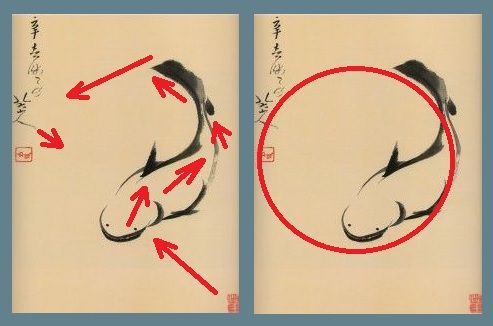
The Dot and Emptiness – Lecture from January 9, 2026 at Cafe Museum
At the heart of Daoist aesthetics lies the dynamic tension between the manifest and the unmanifest—the Dot and the Void. In this creative process, the dot is not merely a mark on paper, but a concentration of Qi, the initial spark of existence emerging from nothingness. However, its true power is only realized through the surrounding emptiness. This “Empty Space” (the Void, Emptiness) is not an absence of content, but a vibrant, active field of potential that allows the stroke to breathe and resonate.
True artistic creation follows the principle of Wu Wei: the artist does not force a form upon the void but allows the brush to act as a conduit for the natural flow. By consciously embracing omission, the work transcends mere representation, inviting the viewer to complete the unseen with their own spirit. In this dialogue, the point provides the rhythm, while the void provides the infinite depth, ultimately revealing the underlying harmony of the Dao.
Daoist Talks X
Wu Wei, a cornerstone of Daoist philosophy, emerges from ancient Chinese thought and holds pivotal significance within Daoism. While the concept may pose challenges to Western comprehension, grasping its essence offers valuable insights, extending beyond the realm of Asian art to enrich our broader understanding of life’s natural rhythms.


Daoist Talks IX
Bada Shanren Fish – the term ziran 自然
Ziran, a core tenet of Taoism, embodies the essence of “naturalness” and “spontaneity.” It signifies the intrinsic nature and self-so of existence. And it advocates for alignment with the universe’s natural course rather than opposition or control. Embracing Ziran invites us to harmonize with life’s inherent rhythms.
Daoist Talks VIII
Daoist philosophy acknowledges the ego’s existence as thoroughly as Western thought, dedicating extensive discourse to it over the ages. Yet, it uniquely juxtaposes the ego with the notion of the self, inviting a deeper examination of this distinction in our forthcoming exploration.


Daoist Talks VII
In the realm of classical Chinese poetry, Daoist principles resonate profoundly. We delve into two masterpieces by Li Bai and Du Fu, whose works embody the Daoist ethos. Accompanied by Wang Ziwu’s (王子武 ) evocative paintings, we offer a visual and literary analysis that captures the essence of Dao in verse.
Daoist Talks VI
Over the past millennium, Chinese painting has been deeply infused with Daoist philosophy. The pervasive influence of Daoist thought is so profound that entire volumes have been dedicated to its study. Indeed, the practice of xieyi painting, with its emphasis on spontaneity and natural expression, can be seen as a visual manifestation of Daoist principles.


Daoist Talks V
Dao and Zen in Arts – analyzed by AI
The author’s experimentation with AI programs yielded fascinating insights into the impact of Zen Buddhism and Daoism on Chinese painting, revealing a profound connection between these philosophies and the art form.
Daoist Talks IV
Dao, Zen, And Buddha – And Daoist Extra!
Today, we delve into a remarkable piece by Liang Ka (梁楷; c. 1140 – c. 1210), renowned in the West for his depiction of Li Bai. Yet, it’s his lesser-known scroll, “The Story of Eight Eminent Monks,” that stands as a pivotal work in Chinese art, deserving of greater recognition for its profound artistic and cultural significance.


Daoist Talks III
Mindfulness in Daoist painting is epitomized by the humble dot, the smallest element within a composition. In the West, a dot may seem inconsequential. Yet in Daoist art, it represents the universe’s boundless potential and the interconnectedness of all things. This profound symbolism invites us to contemplate the vastness contained within the minute. It encourages a deeper appreciation for the art form’s meditative qualities.
Daoist Talks II
Our exploration centers on Daoism’s influence in Chinese painting. Grasping the core tenets of the Dao will illuminate the profound depths of Chinese art, enhancing our appreciation and understanding of its spiritual and aesthetic dimensions.


Daoist Talks I
Two Daoist stories and a Daoist painting
Westerners often begin their Daoist journey with Laozi, whose seminal work, the Dao De Jing (Tao Te Ching), stands as the quintessential text of Daoism. Yet, it’s not uncommon for readers to find the text challenging to grasp. Despite this, the Dao De Jing’s profound wisdom continues to inspire and guide those seeking to understand the Dao’s intricate philosophy.
Related, recommended topics
Dao and Zen
Zen (禪), with its resurgence in popularity, brings a sense of fulfillment. Yet, a search through the digital landscape reveals a plethora of superficial articles, lacking the depth and authenticity that true Zen philosophy embodies. This contrast highlights the need for discernment in our quest for genuine understanding.


Dao in Huang Binhong Landscapes
In the realm of traditional Chinese painting, emulating the works of ancient masters is a revered practice. From a Chinese perspective, this exercise is crucial for artistic growth. Embracing this philosophy, I too undertook the challenge and found the results to be well-received. The key lies not in replicating each stroke but in capturing the essence (qi 气) of the artwork and forging one’s own path. As long as the spirit of the painting remains alive, the learning process is fruitful.
Zha Shibiao Album Leaf, a Daoist Masterpiece
ZHA SHIBIAO: A Simple Picture And Yet A Treasure.
Today, we turn our attention to a modest album sheet by Zha Shibiao, an artwork that may appear unassuming at first but reveals its true allure upon closer inspection. This piece, often overlooked in publications, invites us to pause and reflect, uncovering the depth of its charm and the artist’s skillful mastery.


Mu Qi Key Work: Six Persimmons
The iconic “Six Persimmons” by Mu Qi is a masterpiece that resonates with many, whether through direct acquaintance or a fleeting awareness. Esteemed Japanese art historians regard it as a pivotal image in the annals of art history. Additionally, it is a testament to its enduring significance and beauty.
Empty Space in Chinese Painting
The concept of “nothingness” or “void” (虚 xū) holds a significant place in Chinese and Asian art. In this article, I aim to explore its multifaceted meanings. While a comprehensive understanding may elude us in a single piece, this exploration will lay the groundwork for further discussion in subsequent posts.
In Daoism, Chan Buddhism (Zen), and Chinese painting, “nothingness” is not merely an abstract idea. In fact it is a central tenet that permeates the essence of these traditions. Its profound implications are integral to the spiritual and aesthetic dimensions of these art forms.


The Importance of a Dot
In essence, a dot is a brief stroke, and the principles governing lines also apply to it. The significance of this is to imbue the dot with meaning; otherwise, it remains a mere, purposeless blob. This act of infusing meaning transforms the dot into a powerful symbol within the artwork.
About the Author:
Friedrich Zettl, an expert in Chinese painting and art history, spent five transformative years in China. His academic journey at the Central Academy of Fine Arts culminated in a dissertation on the expressive free-hand style of Chinese painting (写意画 xieyi-hua).
For years, Zettl has shared his insights through lectures on Chinese art. He contributed articles to the esteemed Chinareport—a publication with decades of history under the guidance of late Professor Gerd Kaminski—and participated in symposia on China. His presentations often take place at venues like the oe.g.c.f., enriching audiences with his deep understanding of Chinese artistic traditions.
Explore Friedrich Zettl’s Art and Ideas→
Art Portfolio → Asian Art Essays → Journal → Articles Archive
Find me on Instagram and YouTube