

Introduction
Friedrich Zettl is a contemporary artist working primarily with ink, brush and calligraphy, influenced by Chinese and Asian art traditions. His work explores gesture, abstraction, nature and the relationship between image and consciousness, informed by Daoist and Zen thought.
His shift from Western to Chinese art began in the 1970s. He studied Sinology and spent several years in China, learning painting, calligraphy, and seal carving firsthand. His research focused specifically on xieyi (写意), the traditional Chinese freehand style.
Today, Zettl works primarily with ink and paper, drawing on Chinese brushwork and calligraphy while developing a personal form of contemporary ink art that combines abstraction, gesture, and philosophical reflection.

An Artistic Journey Between East and West
Zettl started in Western painting, mainly Expressionism and Surrealism. He always wanted the freedom to move beyond realistic representation.
But studying Chinese art and philosophy completely changed his understanding of painting. Ink painting and calligraphy showed him the raw power of a single brushstroke and the absolute necessity of empty space. His focus shifted to the Daoist balance of opposites—yin and yang—where movement, rhythm, and spontaneity directly reflect the artist’s state of mind.
He did not abandon his Western roots. Instead, his work today is a direct dialogue between the two, connecting Western modernism with Chinese brushwork and aesthetics.
For Zettl, bringing East and West together isn’t just about mixing visual styles. It is a way to express what words and literal images cannot.
China, Chinese Art and the Central Academy of Fine Arts (CAFA)
Zettl first encountered Chinese art over 50 years ago, immediately recognizing it as applied philosophy. He studied Sinology and trained in Chinese painting, calligraphy, seal carving, and traditional art theory.
His years in China fundamentally shaped his development. Instead of relying solely on historical sources, he learned directly from artists, teachers, and the culture itself.

Zettl and the important sculptor, Wang Keping 王克平, now living and working in France
His time at the Central Academy of Fine Arts (CAFA) in Beijing was a crucial step. It showed him that in Chinese painting, technique, philosophy, and the artist’s state of mind are completely intertwined.
Studying this art form changed his view of the creative process. He learned that a painting is not just a copy of the outside world. Instead, it expresses the artist’s inner energy and the dynamic balance of yin and yang.
Because of this, China became much more than an academic subject. It shaped his entire intellectual and artistic foundation, and it still drives how he approaches painting and calligraphy today.

Friedrich Zettl with Ma Desheng 马德升 in Beijing (Ma was one of the founding members of the Stars Group 星星美)
Research into Xieyi and Chinese Painting
Zettl’s academic research centers on xieyi (写意), or “freehand” painting. In 1987, he completed his dissertation, “Die Entwicklung der xieyi-Malerei” (The Development of xieyi- painting), at the University of Vienna. In the xieyi tradition, the rhythm and spirit of the brushwork matter far more than realistic details.
He realized that a brushstroke does not just depict an object. It captures movement, energy, and the painter’s exact state of mind.
These principles permanently shaped his own art. His approach to ink, calligraphy, and empty space relies heavily on the dynamic tension between control and spontaneity—a direct reflection of the Daoist concept of yin and yang.
For Zettl, xieyi is not just a historical technique. It is a way of working where the true essence of a subject comes to life through gesture, suggestion, and the raw energy of the brush.
From Western Modernism to Contemporary Ink Art
A Contemporary Artistic Language
Zettl’s current practice is rooted in ink, paper, and the strict discipline of the brush, while maintaining the raw freedom of Western modernism. His work does not simply imitate traditional Chinese painting or Western abstraction; it exists in the space between them.
Calligraphy, empty space, and spontaneous gesture are central to his art. He has developed a visual language where a single brushstroke acts simultaneously as an image, a movement, and a physical trace. His creative process relies heavily on action and response—the constant interaction of intention and spontaneity, which directly reflects the Daoist principle of yin and yang.
This approach defines his different bodies of work, including his Zen Paintings, Painted Haiku, calligraphy, and gestural abstractions. Ultimately, Zettl does not copy historical styles. Instead, he uses his deep understanding of Chinese art to forge his own distinct, contemporary visual language.

Ursula Wolte – wife of Huang Zhou – Wolfgang Wolte – Huang Zhou 黄周 (famous for his donkey paintings), and Friedrich Zettl
Art, Daoism and Zen
Zettl’s understanding of art is deeply rooted in Daoism and Zen Buddhism. These philosophies shape not only his themes but his entire creative process.
The Daoist principle of yin and yang—the dynamic balance of opposites—is central to his work. In his paintings, empty space is never just an absence; it is an active element that allows the image to breathe. A brushstroke is more than a simple line. It carries rhythm and energy, capturing the exact trace of a moment where control and freedom meet.
This constant interplay of opposites drives his artistic thinking. Fullness and emptiness, movement and stillness, or order and spontaneity are not contradictions. They exist together to create tension and balance.
For Zettl, painting is not just about making an image. It is an exploration of presence, absence, and silence. These concepts connect his practice to centuries of Chinese tradition, while remaining firmly grounded in his perspective as a Western artist navigating two distinct cultural worlds.
Selected Exhibitions, Lectures, and Publications
Zettl’s artistic and intellectual work has developed through research, lectures, publications, and international exhibitions, primarily across Europe and China. His practice is continually shaped by his encounters with artists and scholars worldwide.

Former Federal President Dr. Heinz Fischer at the opening of the first major exhibition by Friedrich Zettl

Michael Ludwig (Lord Mayor of Vienna, opened my exhibition. Kosmo, Friedrich and
Prof. Gerd Kaminski, the host of the exhibition at Friedrich Schiff Gallery).
Latest Exhibitions:
- 2024 – Artly Mix, São Paulo, Brazil
- 2024 – Boomer Gallery, London, United Kingdom
- 2022 – Hong Art Museum, Chongqing, China

2022: Exhibition at Hong Art Museum in Chongqing, China. Supported by oe.g.c.f and bmeia
Lectures and Research
Zettl has lectured and written on Chinese painting, art theory, calligraphy, and Daoism. His research and teaching focus on the expressive traditions of Chinese brushwork and the philosophical ideas shaping them.
His academic contributions include a five-part lecture series on xieyi-painting at a Viennese university, alongside presentations at international symposia on topics such as “Confucius and Art,” “The Role of Women in Modern Chinese Art,” and “Age and Old Age in China.” Additionally, his published work includes the lecture “Vortrag Punkt und Leere” (Bacopa Verlag), which further explores the relationship between art, emptiness, and philosophy.

Zettl and Prof. Gerd Kaminski, head of the oe. g.c.f.
Publications and Media
Zettl’s work and research have been featured in publications, interviews, and media appearances across Europe and China.
Publications in China
腾讯网 [Tencent News] 2021
光明日报 [Guangming Daily] 2021
新浪科技 [Sina Technology] 2021
微博 [Weibo] 2021
光明日报 2022 [Guangming Daily]
中央电视台 2023
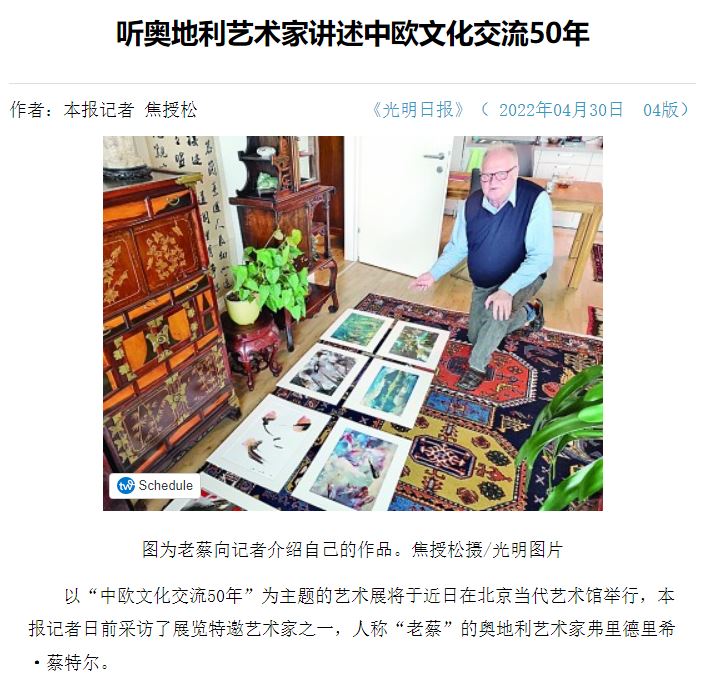
Cover article in the Guangming Daily about Friedrich Zettl

Publications in Austria
Zettl gave most of his lectures at oe.g.c.f. and most of his articles appeared in the China Report.
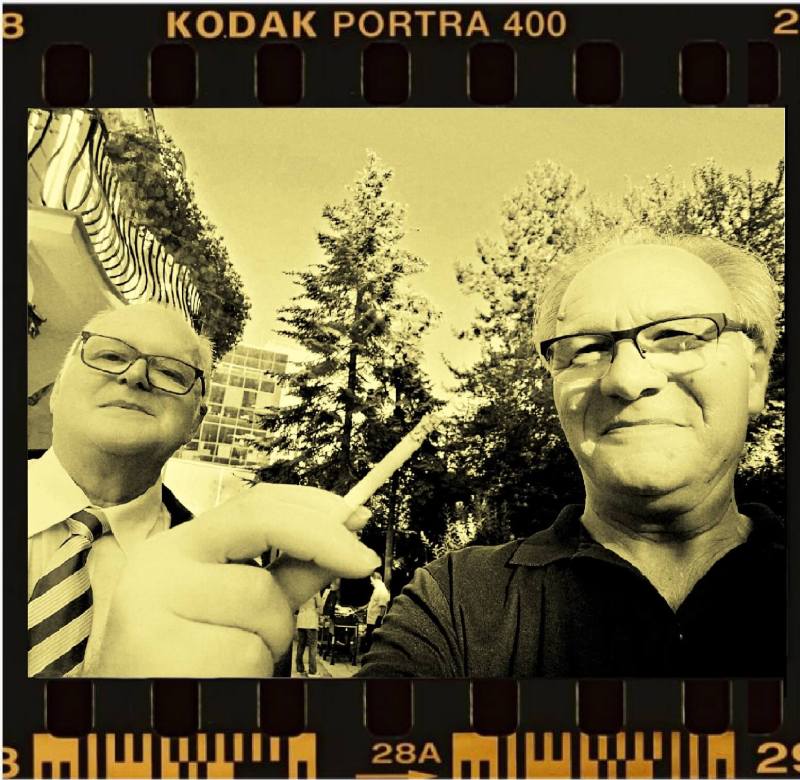
Friedrich Zettl and Mag. Walter Fehlinger, Mr. Bacopa (Bacopa Publishers)
Some publications were released by Bacopa Verlag and Sonatabook.
Zettl’s artistic practice continues to evolve through the exchange between different cultural traditions. He focuses on the space where painting goes beyond literal representation. Driven by the Daoist balance of yin and yang, his use of brush, ink, gesture, and emptiness forms a distinct language of its own.
Photos related to Friedrich Zettl biography
Featured on Chinese television and the Austrian broadcaster okto.tv. Aired 05/27/2023


Friedrich Zettl with Professor Wolfgang Kubin at the Chinese Embassy in Vienna, toasting to a new book

Award signed by Helmut Sohmen, Dr. Fischer, and Interior Minister Kurz

with late Ambassador Dr. Wolfgang Wolte

Photo with late Interior Minister Otto Roesch and City Council Hans Mayr

With former Federal President Dr. Rudolf Kirchschlaeger and wife, artist Yang Yanping and daughter, Yuezhen and Friedrich Zettl
Friedrich Zettl’s Art and Ideas
Explore the Art
Explore the Theory
Read the Journal
Find all Articles:
→ Articles
Artworks by Friedrich Zettl are available as originals or high-quality prints in various sizes: FriedrichZettl.com or Saatchi Art.