
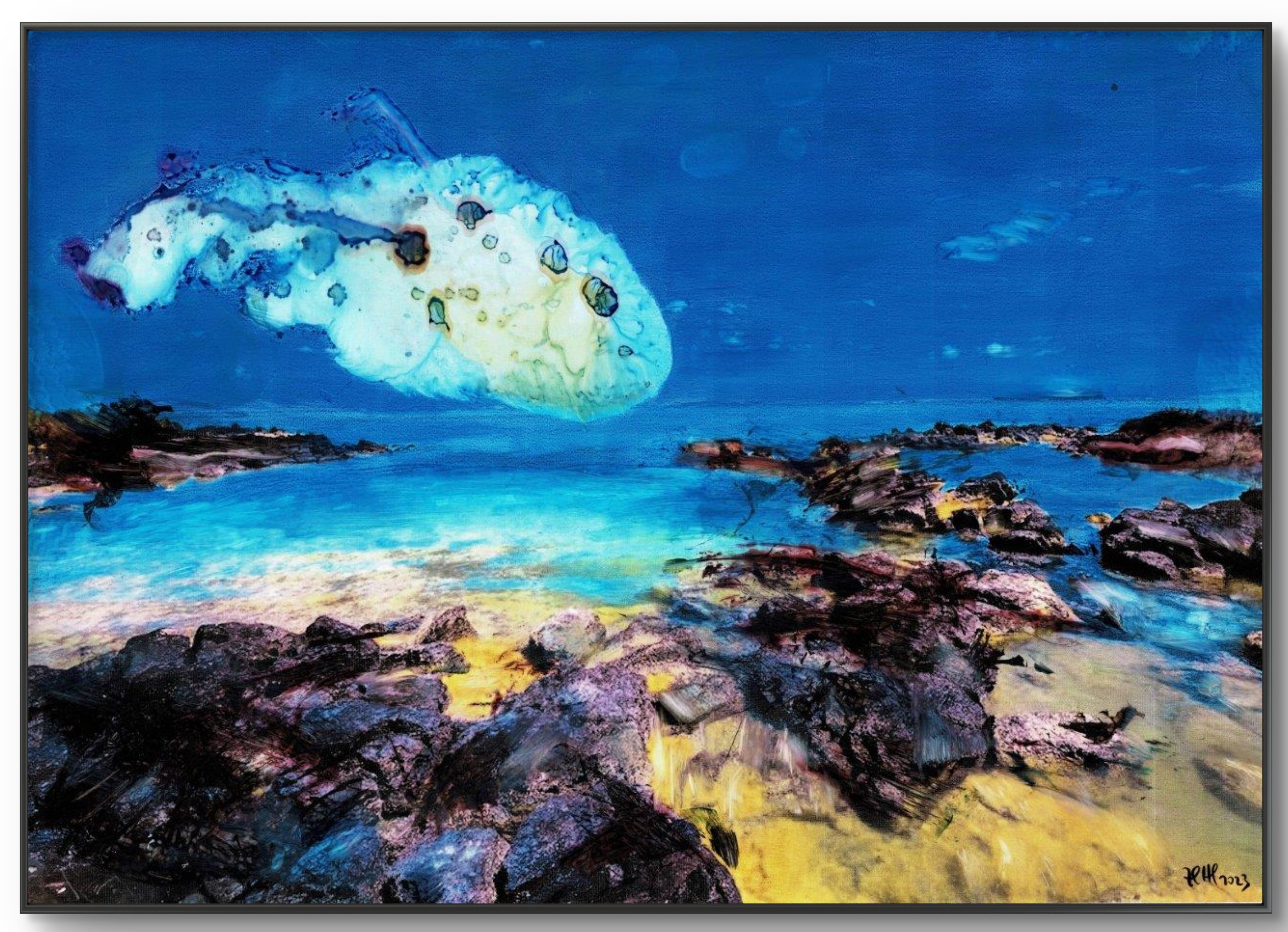
State of the Art 2026
As in previous years, I would once again like to present one work under the heading State of the Art →, (Stand der Dinge) that, for me, is representative of 2026.
As I have mentioned before, this does not necessarily mean choosing the painting that is technically the most successful, or the one that would look best above the fireplace. The idea is to choose a work that most clearly reflects my approach to painting in that particular year. And by approach I do not only mean painting technique or visual effect, but also the thoughts behind my work.
Some years I do not give this selection too much thought. This year it was more difficult. Artistically speaking, I have been dancing at several weddings, as we say in German, and in several areas I felt that something had moved forward.
So this time I would like to allow a second painting to have its say as well. In fact, there were four works competing for the honour, but we have to draw the line somewhere.
Why This Painting?
The first reason is that the painting reflects on a Daoist story by one of my favourite philosophers, Zhuangzi: The Empty Boat — 虚舟 (Xū Zhōu). [1]
The story is simple. A man is crossing a river in a boat when another boat collides with his. If the other boat is empty, he does not become angry. If there is a person in it, however, he shouts at him, and if the person does not react, he becomes increasingly angry.
The collision is the same. What changes is the presence of someone we can blame.
For me, this is one of those wonderfully simple stories that become less simple the longer one thinks about them.
We tend to assume intention behind many things that happen to us. Somebody ignored me. Somebody offended me. Somebody put an obstacle in my way. Sometimes this may of course be true. But quite often the other person is simply occupied with his own problems, fears, ambitions and distractions. His boat happens to collide with ours.
The story, however, goes further. Zhuangzi turns the thought around: what if we ourselves could become the empty boat? The original passage ends with the idea of a person who can “empty himself of himself” and therefore move through the world without being harmed in the same way.[1]
That is considerably more difficult.
Ego and Self
I have written before about the subject of Ego versus Self →, and that article fits quite well here.
Do we have an ego?
Of course. And that is probably a good thing.
Some people have a stronger one – politicians or the frontman of a successful band come to mind – while others have so little that it can almost turn into submissiveness. Much of this is simply part of our character, and I do not want to discuss the psychology of ego here.

What interests me more is a question I occasionally ask myself:
Am I doing what I am doing because I want to stroke or inflate my ego, or am I doing it because I want to work on my Self?
My painting is my personal approach to this question.
And the “fish” in the painting is, of course, my own – not exactly small – ego.
But at the same time it also reflects something of my Self. Or at least what I would like it to be. 😊
The fish has no magnificent glittering scales and no elegant fins. There is not very much there to become attached to.
Is it attractive? No.
Is it unattractive? No.
It is.
It no longer seems particularly concerned about the fact that a fish is supposed to live in water. It has simply taken the position that gives it the best view and allows it to look at the “rocks” of life.
It is interested. Perhaps it even communicates with what surrounds it. But it is no longer completely entangled in what is happening.
And the more it leaves its ego behind, the more colour seems to surround it.
A Technical Side to the Story
There are also some more practical reasons why I chose this painting as a representative of 2026.
Like the recently shown Meditation by the Sea→, this is a painting I started several years ago and then put aside because something was missing. It lacked consistency, and at the time I did not know how to solve that problem.
Almost three years later I returned to it.
With several oil glazes and a number of smaller interventions, I eventually arrived at a version with which I am relatively satisfied. “Relatively” is probably a useful word for painters.
More importantly, I think the painting shows something that has become increasingly relevant to my work: By and by I have continued to develop the idea of xieyi (写意) from Chinese painting in my own way and combined it with Western approaches, including abstraction and Surrealism.[2]
I am not interested in imitating traditional Chinese painting. What interests me is what can happen when some of its underlying ideas are allowed to enter a very different kind of painting.
The work also belongs, at least in my mind, to The Magic Sea, a series I have been working on for quite some time and which apparently still has no intention of letting me go.
The Second Candidate
At first sight, the second painting could hardly be more different.
And yet I think it follows a similar idea: being rather than appearing.

Its title, Mountains Swim – Fish Fly, already points in that direction. Mountains do not swim and fish do not fly. Just as the fish in The Empty Boat is apparently unaware that it is supposed to be in the water, conventional classifications have become rather unimportant here.
Going against conventions has always been part of my work. But in this painting there is also another aspect that, like many years before, has become increasingly important to me again.
Like The Empty Boat, Mountains Swim – Fish Fly is also a reflection on the society in which we live.
We have all been challenged in recent years by sometimes dramatic social and political changes. We are used to mountains being above and fish below. We are also used to certain values and conventions we grew up with and were educated to respect. But quite a few things that once seemed reasonably stable have begun to shift.
Qualities such as politeness, empathy and social responsibility sometimes seem to count for less, and may even be dismissed as weakness or “wokeness”. General knowledge? Why bother, when an answer to almost anything is available at the push of a button?
I do not want to turn this into a political essay. What interests me as a painter is what such changes do to our perception. When familiar coordinates begin to shift, contours become less clear. Things change places. Mountains may swim and fish may fly. And sometimes we find ourselves in a kind of whirlpool in which it takes considerable energy simply to keep our heads above water.

This is also reflected in the painting itself. Forms appear, change direction and dissolve again. Something may be a fish, something else a mountain, a rock, a body or simply a movement of paint. There are few stable coordinates to hold on to.
What the Painting Can Do Without
At the same time, something else has changed in the way I paint.
For some time now, I have been moving away from academic painting. I do not mean this negatively. Academic training gives an artist an excellent structure to build on. But perhaps at some point one should also be prepared to leave some of that structure behind.
This is not as easy as it sounds. In my case I have been rather radical about it.
In the past, while working on a painting, I would look at it and ask what it still needed: a little more light here, more tension there, perhaps another form to balance this one.
With Mountains Swim – Fish Fly, I began asking a different question:
What does the painting want to get rid of?
That may sound like a small difference, but for me it is not.
There are places where I could easily have made things clearer. A fish could have become more recognisable, a mountain more convincing, the space more logical. But that would have imposed an order on the painting that it did not ask for.
So instead of adding information, I tried to remove the need for it.
Perhaps this is where xieyi has become more important to me than its visible stylistic characteristics. Not because I want my paintings to look Chinese, but because suggestion can sometimes carry more life than explanation.
And the Circle Closes
And this brings me, maybe somewhat unexpectedly, back to the empty boat.
The “fish” in the first painting is floating in the sky, and of course this is not entirely accidental either. Perhaps he has simply decided that a certain distance from our increasingly challenging surroundings is necessary from time to time. Not because he has lost interest in what is happening below – as I mentioned before, he is still watching and communicating – but because keeping some distance may also be a way of preserving one’s inner balance.
Seen in this way, the two paintings are perhaps not as different as they first appear. In one, mountains swim and fish fly because familiar coordinates have become unstable. In the other, the fish has found his own way of dealing with this situation.
He simply floats a little higher.
And perhaps that is not the worst place to be at the moment.
A Final Note
In the context of this Stand der Dinge, I would also like to mention my latest article published by Bacopa Verlag.
I have written about qi (氣) several times before, but in this article I have tried to go a little deeper and, at the same time, make this rather difficult subject easier to understand. Der Fluss des Qi in der chinesischen Malerei (The Flow of Qi in Chinese Painting) looks at the role of qi in Chinese painting and at some of the ideas behind a concept that is not always easy to translate into Western terms.
The article was published online in German, but with the translation functions available in most browsers it can easily be read in other languages as well.
Der Fluss des Qi in der chinesischen Malerei – Bacopa Verlag
Footnotes
[1] The parable of the empty boat appears in Chapter 20, The Tree on the Mountain (山木), of the Zhuangzi. In James Legge’s 1891 translation, a man crossing a river is struck by another boat. If the other boat is empty, he does not become angry; when he believes another person is responsible, anger arises. The passage concludes by asking what could harm a person able to “empty himself of himself” while moving through the world. The wording and interpretation in the main text above are partly my own.
[2] Xieyi (写意) is commonly translated as “freehand” or “expressive” painting. Rather than concentrating primarily on precise representation, the tradition gives particular importance to expressive brushwork and the artist’s response to the subject. The term has a considerably richer history than this short description can cover; I use it here primarily to describe an influence on my own approach, not to classify my paintings as traditional xieyi


Leave a Reply