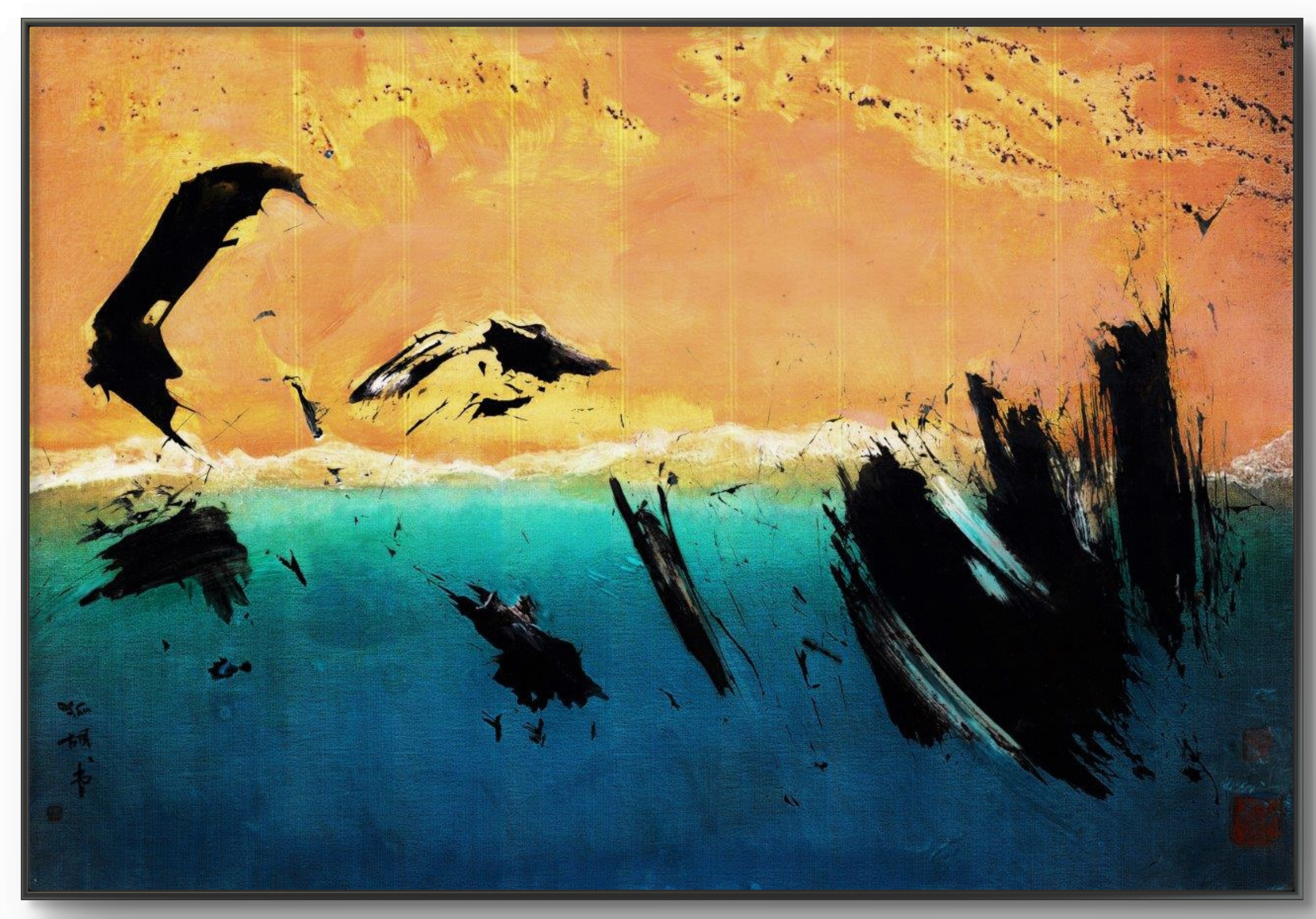
Abstract painting by Friedrich Zettl with sweeping black forms over layers of turquoise, blue, orange and pale green.

Meditations on a Single Note

On Mindfulness, Silence and the Art of Listening

Earlier this summer I had an experience that fits very well with the subject of today’s article.

We were driving along a road in Lower Austria we had travelled before when I suddenly noticed a sign pointing towards a so-called Peace Stupa. I had never seen it before, although the sign had obviously been there for some time.

We decided to have a look and were impressed for several reasons. The stupa stands above vineyards and fields, prayer flags moving in the wind, and the architecture is quite unusual for this part of Austria.

The interior surprised me even more.

It is an almost empty circular space under a high dome. Because of its shape, its hard surfaces and the absence of furniture, the acoustics are remarkable. In the centre stands a large, high-quality gong.

I stood in the middle of the stupa and my companion struck the gong. I closed my eyes and listened.

Somewhere in the back of my mind I had stored the information that the human ear can hear a sound for about twenty seconds. After twenty seconds I was therefore ready to leave, when I suddenly realised that I could still hear something.

The sound was still there.

This occupied me for the rest of the day and in the evening I did some reading. My twenty seconds turned out to be a rather questionable piece of information. How long a sound remains audible depends on many things: the instrument itself, frequencies, resonance, the acoustics of the room, background noise and, of course, our individual hearing.

Under favourable conditions, the sound of such a gong can remain perceptible for considerably longer.

But who actually hears it for that long? And we can work on ourselves to be able to hear a tone for longer? That raises a fundamental question:

When Does a Note Begin – and When Does It End?

We have probably all come across the term mindfulness and have tried, in one way or another, to get something useful out of it for ourselves.

Meditation and mindfulness have been essential to me for various reasons. One aspect that interests me particularly is of course their relationship to my art.

For me personally, imagination is closely connected with attention. Attention is something like a muscle that can be trained. [1]

Attention and Imagination

When we watch a fantasy film, somebody else has already created a fantasy world for us. We can immerse ourselves in it, of course, but we move within a space that has largely been predetermined by somebody else. When we read a book, things are different. From a few words we create landscapes, rooms, faces and often an entire world of our own.

The ability to be attentive is fundamental to my painting—especially when I am working in an abstract or minimalist style.

Several times people have told me that they are not really interested in abstract art but that, for some reason, my paintings appeal to them or “say something” to them. Of course, I cannot know exactly why. But I think one reason may be that I try to give even the most insignificant things – a dot, a small brushstroke, a trace – meaning and therefore a certain kind of life.

I think something similar happens with a musical note.

If we play even a relatively simple piece of music ourselves and afterwards hear it played by a master, we quickly realise that the difference cannot lie in the notes alone. After all, the same score is lying in front of both of us.

It is what we put into those notes.

Before going any further I should add that this article is neither scientific nor music-theoretical. I simply do not have the training for that. Kindly defined, I am a passionate amateur, although music has always been an important pillar in my life.

What exactly is a musical note?

As always when we deal with a subject, it is useful to define it first. Unfortunately, even the apparently simple question of what a note actually is is not so easy to answer.

Are we talking about the horn of a train, the sound of a drop of water falling onto a stone, or only about what we usually call a musical note?

To make things easier, I will stay with one musical note today and reduce it even further to, let’s say, middle C.

One note should be enough for our purposes.

Sound and Silence

A note is something that exists, something we can hear. Its opposite would appear to be silence.

It is tempting to think of sound and silence in terms of yang and yin, although this should not be understood too literally. Yin and yang are relational rather than fixed categories. One exists and is understood in relation to the other.

But does silence really exist?

If we meditate on silence, or simply think about it attentively for a while, we soon notice that the often-mentioned silence of a forest is not very silent at all. There are leaves moving in the wind, branches creaking, and there are birds, insects and all the other inhabitants of the forest.

The silence of a deep cellar would sound quite different. This silence has a different quality and can even contain something slightly threatening.

And the silence of lonely mountains is different again. There may be hardly anything consciously audible, and yet there is wind around the peaks, atmospheric sounds and perhaps distant noises finding a resonating space in the valley.

The more closely we listen to silence, the more difficult it becomes to say where silence actually begins.

Dot and Note

At this point I come back to painting.

A dot is one of the simplest things imaginable. The tip of the brush touches the paper and for a very brief moment we have something that I like to imagine as two-dimensional. Then it develops relationships to the space around it and becomes part of something three-dimensional. And as we have already discussed in earlier articles, an enso in painting can be understood as an infinitely large dot that encompasses the entire universe.

I see a certain similarity with a musical note. There is the first moment in which the note is produced and then it is amplified by the resonating body of the instrument and spreads through the surrounding space.

This is not meant as physics. Rather, it is about mental practice aimed at expanding the range of our sensory impressions.

I once made a playful attempt to paint the moment in which, in my imagination, a dot changes from two dimensions into three. For me this is also the moment when light enters and space begins to develop.

We are talking about an extremely short unit of time. But time does not really matter for our little meditation. Sounds existed long before humans began dividing day and night into hours, minutes, seconds and eventually nanoseconds.

Can We Hear a Painting?

I have asked myself before what a musical sound actually is and touched on some of these ideas in articles such as Can We Hear a Painting?

Later I thought of a good example from one of my favourite painters, Pan Tianshou.

Even with relatively little imagination, I think we can almost hear the cry of this lonely bird into the mist, or into nothingness.

There is, of course, no sound in the painting.

Nevertheless, I hear one.

This interests me because it says something about what we ourselves add to a work of art. A painting gives us something, but we do not only receive. Our memories, associations, imagination and attention contribute something as well.

Perhaps that is one of the places where mindfulness and imagination meet.

Cause and Effect

Let us return to our middle C.

The heard note is the effect. But something must have caused it. In the case of a piano, a hammer strikes a string. But the hammer did not do so by itself. It was set in motion by the mechanism of the piano because a key was pressed.

The key, in turn, was pressed by the pianist’s finger. The movement came from the hand and wrist, which received their impulses through the nervous system and the brain.

But this is still not the beginning.

The pianist saw the middle C on the score. The eye transmitted the information; the written notation was thus first recognized and interpreted based on further information. It was played softly, loudly, gently, or thunderously—embedded within a specific musical context.

So perhaps the beginning of our note lies in the moment in which the pianist sees it on the page.

But even that does not take us very far. Somebody composed the music, somebody printed the score, somebody produced the paper and somebody else built the piano.

We can continue this chain almost indefinitely.

And with this rather simple meditation on one note, we have arrived at something that plays an important role in Buddhist thought: cause, effect and interdependence.

The Dalai Lama has repeatedly used ordinary objects to illustrate this idea. Things that appear to belong to one individual depend on the work and contribution of countless other people – from the production of raw materials to transport, manufacture and all the other steps we usually do not think about. [2]

Looked at in this way, our single middle C has a surprisingly large family.

Back to the Gong

Our little meditation has shown me at least two things.

The first became very clear to me in the stupa. I had assumed that the sound was finished because I had a certain number in my head. Had I stopped paying attention at that point, the sound would indeed have been finished – at least for me.

But it was not.

That does not mean that mindfulness somehow improves our ears beyond their physiological limits. It simply means that attention can change how much of what our senses provide actually enters our conscious perception. [3]

The second point is the chain of cause and effect. The more closely we look at even a very simple event, the less isolated it appears.

For me, both things are closely connected with creativity.

If I pass a dot without really looking at it, it remains a dot. If I hear a note without really listening, it remains a note.

By giving apparently insignificant things our attention, we can give them meaning and extend our world of perception.

I consider this important for someone who creates art, but equally for someone who receives it.

A Small Case Study

The following painting has already appeared here in an unfinished version. Its working title was Zen Meditation by the Sea.

Basically, I liked the first version, but something was missing.

It “didn’t make music.”

I realise that this is not a particularly precise art-historical or technical description. 😊

After thinking – or perhaps meditating – about it again, I returned to the painting. I added several glazes of oil paint and changed a few passages.

Now it “sounds” to me.

Perhaps the forms communicate differently with each other. Perhaps some areas have become quieter and others more active. Or perhaps all the meditation on notes and silence has simply changed the way I look at it.

In any case, I like it better now.

OK, I am biased. 😊

footnotes:

[1] I use the relationship between mindfulness and imagination here primarily to describe my own experience. Research does suggest a connection between mindfulness practices and aspects of creative performance, although the results vary considerably depending on the kind of mindfulness practice and the creative task being measured.

[2] Interdependence is a recurring theme in the Dalai Lama’s teachings. He frequently illustrates it through ordinary objects and everyday life: what appears to be an individual achievement or possession depends on innumerable other people, materials and circumstances. I have not attributed the particular example of his clothing that I remembered to a specific lecture, as I have not been able to verify its exact source.

[3] Research into mindfulness and cognition suggests measurable effects on some aspects of attention and executive functioning. The effects are not uniform across all cognitive abilities, however, and mindfulness should not be understood as simply making the senses physiologically “better.”


Related articles: The Principle of the Balance in Chinese Painting I How to Kill Your Muse I The Journey to the Zen Master

Explore Art & Writing

Art Portfolio → Featured Artworks → Arts & Philosophy Journal → All Articles

Explore Asian Art Essays for writing on Chinese painting, calligraphy, aesthetics and art history.

Available Artworks

Original works are available on  FriedrichZettl.com and Saatchi Art


Posted

in

by

Comments

18 responses to “Meditations on a Single Note”

  1. Stan Stewart - muz4now avatar

    Beautiful. As always, I am enchanted by the way you are able to trace your inner world into your paintings and then back again.

    I relate because I often see images or more often experiences — like a movie — when I compose. I’ve been working on longer works (about 11 minutes in two recent compositions) and this movie sometimes gets very grand and powerful. Yet the images are very personal and I don’t yet have language to describe them.

    Thank you for putting your experience into words.

    Peace,
    Stan

    1. Zettl Fine Arts avatar

      Many thanks, Stan, for your always kind and encouraging words! As an old man, one has plenty of time to rummage around inside oneself. And to clear out the clutter—or at least try to… 🙂
      Yes, I’ve listened to some of your compositions, and I find the path you’re taking very exciting and successful! I wish you continued success! We get better and more mature with age, like fine wine.

  2. Spira avatar

    To say I love today’s article would be a gross understatement.
    We circle back to attentive presence, which I find a core quality.

    If I may add something to the extension of the musical note meditation:
    Along with what you accurately describe, Friedrich, I believe it is our ability to observe the pauses. The ones before & the ones after.
    Martha Argerich once said that she considers the pause as the most significant element in music.
    And over time I keep discovering the truth of that in both music and art.

    Thank you for, yet again, such a generous offer.
    My best wishes for your weekend, Friedrich.

    1. Zettl Fine Arts avatar

      Ha, Nick! Those pauses are exactly the topic I want to touch upon in a planned article about music and painting. I didn’t want to cover it in this particular piece because I wanted to stick to the notes themselves as much as possible. What happens between the notes—the space, the relationship—is a truly fascinating subject. I was lucky enough to see Martha Argerich perform live twice. She is one of the absolute greats! Thanks for your comment, and all the best!

  3. swabby429 avatar

    By sharing your perception of the gong’s note, you have furthered its life and range. The same principle happens with your paintings of your contemplations.

    1. Zettl Fine Arts avatar

      Thank you very much, I’m really pleased to hear that. Added value through mindfulness 🙂

  4. Misky avatar

    You refer to “Zen Meditation by the Sea” saying that at one point it didn’t make music. I refer you to “Contemplation in Teal” and tell you that music unfolds (for me) sequentially in this painting (it is one I adore), note by note by note. Contemplation in Teal exists all at once, but my eyes cannot actually take in all the information at once. My eyes travel; a gestural abstract …it gives my eyes a musical score; it conducts. I can almost reconstruct your strokes: your hand accelerates; it drags; here it struck and there it lifted.

    My motor system crosses between seeing movement and hearing movement; my brain is much messier than hermetically sealed rooms. For me, “Contemplation in Teal” is a musical score: the red-orange strike is a C-sharp, as an example — but for me, the note doesn’t stop, it leaves a residue, just as a scent can put me twenty years in the past. That is the effect on my messy little brain.

    Nick, quite rightly mentions the silence between notes, its tension and release, and I agree entirely.

    I mention the residue of notes that linger, one that can pull us into past moments. It is that kind of ‘note’ that pulls and pulls us forever in different directions.

    1. Zettl Fine Arts avatar

      Thank you so very much, dear Marilyn! Your wonderful reply confirms a suspicion I’ve long held: we are kindred spirits! I was particularly pleased by your comments on my earlier image, “Contemplation in Teal”—not so much out of vanity, but because I just finished writing an article about “QI” today that is due to be published soon. (I can send you the link later, if you like.) The very aspects you touch upon are among those I try to illustrate—because there are so many misconceptions out there!

      When we see such “simple” images, it is all too easy to think in terms like “that didn’t take much effort.” And indeed, it doesn’t. Yet, theoretically, I could create two or three of them in a single day. But—as you’ve likely guessed—it is all too rare that one actually turns out well. And there is a very good reason for that. Thanks again, and warm regards, F.

      1. Misky avatar

        I would appreciate that link, yes thank you, F.

  5. Cindy Georgakas avatar

    First of the Stupa is just gorgeous, Friedrich. I would have stopped as well and I wonder if you could here the sound through the structure that called you in and your painting is so beautiful as well. Where does sound start and end and same with the dot in your paintings. All music and art have an interconnection that settle into the senses and create such interesting interplay and exchange. Your paintings definitely capture sound and create interest which vibrates through our being. Lots of beautiful connections here, trained or untrained. xxx

    1. Zettl Fine Arts avatar

      Thank you so much, dear Cindy! The sound of the gong cannot be heard outside the stupa. It is a very special sound, surely linked to the quality of the gong and the architecture. Of course, we always run the risk of reading something into it—just as we might perceive the sound inside a church differently. Whatever it is, it goes deep. Thanks also for your kind words about my artwork. I wish you a truly wonderful weekend and lovely times with your wonderful family! xxx

      1. Cindy Georgakas avatar

        Oh I’m with you in spirit as there’s never been a stupa I could refuse. Deep is right and you’re so very welcomed. Thanks my friend!!! xxx

  6.  avatar
    Anonymous

    As usual, a very thought-provoking post, Friedrich. It occurs to me that, as you mentioned, a note is not merely a pure frequency of the air pressure wave. There are countless factors at play. The instrument itself produces overtones based on its structure (i.e., the wood of a violin; the material from which a flute is made: metal vs. wood, for example; the reed of a woodwind, etc.). The artist him/herself can control the beginning of the note with well-practice techniques of ‘attacks’ on the string, the breath, or even the force at which a piano key is struck. The artist must have an idea of the sound s/he wants to produce. The listener responds (if fully attentive) based in part, on prior exposure to music or sound memories absorbed previously.
    At any rate, Friedrich, this is one of the thoughts inspired by your blog. Thank you.

    1. Zettl Fine Arts avatar

      Thank you so much for your helpful and welcome additions! Yes, isn’t it amazing how far we can get with mindfulness? From the “grand concert appearance of the triangle,” which sounds different in the concert hall than in a music shop, to the question of where a note actually ends. At the eardrum? Physically, that might be true. But then there are tones that are said to have healing properties or that drive one to madness. (Like the glass harmonica, which was banned from public spaces by the police because it was thought to cause nervous breakdowns.) I’m sending you a personal hello – let’s see how it goes 🙂 Best regards, f

  7. graysummers avatar

    Thank you for these insights Friedrich. I came back to read this again. Holistically, music has infinite combinations. As you say, even in one single note. Well being, meditation, fear of the unknown and much more emotional therapeutic considerations are important for each of us. And they are very much based, upon listening, to our own personal choices. Our singular responses.

    When frightened of the contraindications to health, many of us seek music for therapy. For anxiety and worrisome thoughts, I brought a very good quality tuning forks set in the Solfeggio scale. The 9 individual frequencies obtained ring for a very long time individually. It has a wonderful way of decreasing volume from intense beginnings to the quiet of settling the senses and quieter still to complete calmness whilst eventually disappearing. Into silence if you allow it to. Like Mindfulness and putting your worries onto a leaf that floats off down the river. The leaf disappears too. All music, and singular notes too, in different ways, work their own stories.

    Rather like your bell. Choices of which fork to strike were based on frequency properties and the 528 Hz in particular was often used. Considered the ‘Miracle Tone’. I began listening to Gregorian chant based on that particular frequency too. At the same time of listening to the chanting, the fork was struck alongside. A holistic experience was then in existence. Calmness, and very successful in its property, was the result.

    There can be no message in my reply regarding what is perfect regarding how we hear notations. The miracle of sound therapy goes down so many avenues. Your mention of Mindfulness, alongside a single note, is extremely insightful. Building questions around that note has not been my own personal intention regarding meditating. Letting an elongated note wash over the senses and neural synapses is the focus.

    But, as you say, considerations to how that note is achieved is spot on. One note can indeed come from many different sounding sources. When heard, we instinctively know as individuals what works for us. Certainly your visit to the bell worked for yourself personally with that note staying in your synapses for so long afterwards.

    Once again, you have given us so much to consider. I really enjoyed this post Friedrich. Thank you so much. All the best. 🙏🏽🍁🍂

    1. Zettl Fine Arts avatar

      Many thanks, Gray, for your incredibly helpful additions and observations! Since you are not only a great musician with a wealth of experience to match, you have naturally delved deeply into the subject matter.

      Once again, I am struck by how closely our views align on some of the aspects you mentioned: “And they are very much based upon listening to our own personal choices. Our singular responses.” That is exactly it. We determine this ourselves; we can choose or work on it—just as we can work on our reactions to adverse external circumstances.

      “…many of us seek music for therapy.” Ha! I once put together a musical “emergency kit” for myself. Unrequited love? Schubert. Re-fragmenting my “mental hard drive”? Bach…

      When it comes to Solfeggio frequencies, I often listen to 741 Hz: this frequency addresses the throat chakra and represents intuition and clear self-expression. It is said to help bring thoughts and ideas out into the world. 🙂 Thanks again, and musical regards in C major, f 🙏🏽🍁🍂

      1. graysummers avatar

        Thank you for the positivity Friedrich. Recently, it’s been nice to relax more regarding the songwriting. And being happy with the sound currently achieved. As you say, we find our own balance. I know my abilities as a musician, and the limitations, and have therefore accepted them in order to cease fighting for variety and skills. Getting too old now to worry. 😉

        Our personal choices are significant for well being as you say. Even perceived initial silence when escaping to an appropriate bolt hole, and then becoming aware of sound that filtrates into the senses, assists tremendously. Allowing certain gentleness in, keeping unwanted noise out.

        It’s so good to know you have an emergency kit. Rather like an essential oil mix of perfect synergy that addresses positive response within the limbic system with aromatic need. You seem to have a wonderful therapy kit for all the senses. Your art is deeply profound. And a mix of music, aroma and focus viewing your imagery on canvas/paper reminds me of the perfect ‘tea ceremony’ experience.

        And thank you for reminding me regarding the Solfeggio links to Chakra. I read the basics about the frequencies and Chakra importance. However, I must look into getting a decent book for this subject. My knowledge regarding Chakra energies, in general, is extremely sparse.

        Regards to you too Friedrich. Once again….Thank you for your insightful reply. 🙏🏽

      2. Zettl Fine Arts avatar

        Thanks again, Gray! When it comes to chakras, we’re venturing into territory that’s quite close to esotericism, and I haven’t studied it scientifically. But I have, and should again, practice the entire cycle.

        There’s a particularly good resource on YouTube, in my opinion (Dr. Joe Dispenza: Chakra Blessings Meditation). Of course, there are others – just try them out. I can’t say anything about him personally, but I’ve tried some of his methods and found them quite helpful. Good luck and all the best! f

Leave a Reply

Discover more from Friedrich Zettl Fine Arts

Subscribe now to keep reading and get access to the full archive.

Continue reading