
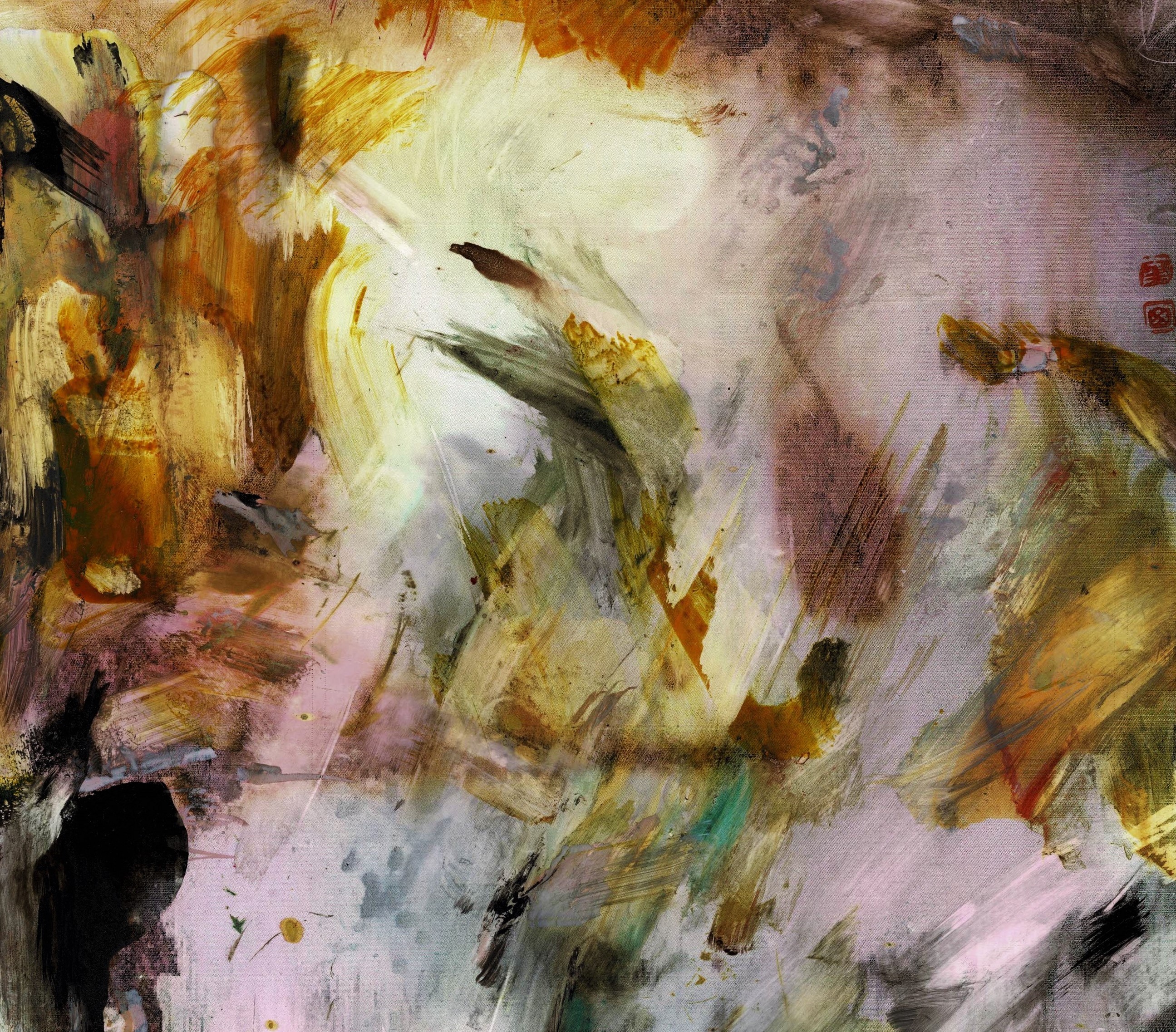
Finding Light in Abstract Art & Overcoming Depression.
Goodbye to the Winter: My last article on dealing with depression as an artist was better received by my readers than expected, and I’m grateful for that! [article] Since some of these works are minimalist or unusual, it’s certainly not easy for everyone to appreciate.
In today’s post, the spectrum I’m trying to cover is defined by minimalist studies, sketches, drafts, and finished paintings. The works are intended to lead from the winter season into the first rays of spring.

“Drawing is the artist’s most direct expression—his signature, his revelation.” [1]
The Power of White & Black in Art
I’ve written in detail in the past about how, for many, in Chinese painting, white, i.e., the unpainted, is more important than black. “Respect the black, but revere the white,” (尊墨重白) [2] says one of the classics of painting. The white, which often makes up a much larger part of the picture than the painted areas, can say a lot about how far a painter has progressed. (see also: https://zettl.blog/2021/05/the-essence-of-chinese-painting-ix/)
As someone who likes to question or simply play around with things and thoughts, I’ve “switched up the colors,” and the following three works are examples of this. Painted on black paper, these are now BLACK areas that require special attention. This seems very simple at first. However, since this also requires attention to aspects such as light, contrast, dynamics, etc., it quickly becomes a challenge.
Art has a remarkable ability to connect individuals, transcending differences in approach and style. In this spirit, I dedicate these works to my fellow artist and online friend, Nick (inSPIRAtion). Several times, our conversations offered me strength during moments of uncertainty. Nick’s thoughtful and encouraging reactions have been an invaluable source of support. Nick recently showcased his own black paper art. His surreal style is fascinating. Despite different approaches, we share a similar artistic language.
Abstract Art with Underlying Ideas
The following three pieces represent light emerging from the dark, marking the conclusion of my series on depression.
Although these works may appear to be just abstract, gestural drawings, each piece is rooted in a specific concept roughly formulated before starting painting. So this conceptual foundation is embedded in the art, even if it is not immediately evident to viewers.

The work below was triggered by the provocative thought of how Christo, [3] who exclusively packaged concrete objects, would package elements of my abstract works.


Based on a @ photo by Wolfgang Volz


Omit even more
Before presenting more detailed works, I’d like to share two minimalist pieces I created during my depression phase. In these works, I aimed to strip down as much as possible from that emotional state. Through this process, I sought to explore how many strokes were truly essential. The Austrian artist Oskar Kokoschka [4], whom I greatly admire, once wrote: “True art is an art of omission.”

Black branches reach, a soft dance,
Stillness holds the frame.

New growth climbs the paper’s white,
Spring’s breath, a light touch.
Transferring from the small to the large.
To conclude, I’d like to present two pieces created with more effort. These works reflect the principles of reduction and the dark state of mind while striving to establish a more solid foundation.
The first piece remains turbulent. The initial traces of spring emerge amidst the lingering gray and winter undergrowth. This work is portrayed as a black jazz song: “Goodbye to the Winter“.

Soft hues pierce the smoky haze,
Jazz rhythm, rebirth.
The Mount of Olives
The Mount of Olives, again rendered in an abstract manner, alludes to Easter, resurrection, and the beginning of a new yearly cycle. However, in light of current circumstances, it has taken on a tone that is far from optimistic.


footnotes:
[1] François Auguste René Rodin (1840 – 1917) was a French sculptor generally considered the founder of modern sculpture.
[2] 尊墨重白 (Respect the black, but revere the white)
尊 (zūn): Respect, honor
墨 (mò): Ink (black ink, specifically)
重 (zhòng): Value, emphasize, consider important
白 (bái): White
[3] Christo Vladimirov Javacheff (1935–2020) and Jeanne-Claude Denat de Guillebon (1935–2009), known as Christo and Jeanne-Claude, were artists noted for their large-scale, site-specific environmental installations, often large landmarks and landscape elements wrapped in fabric, including the Wrapped Reichstag.
[4] Oskar Kokoschka (1886 – 1980) was an Austrian artist, poet, playwright, and teacher best known for his intense expressionistic portraits and landscapes, as well as his theories on vision that influenced the Viennese Expressionist movement.
Shops: FriedrichZettl.com – Saatchiart. Media: Blog – Youtube – Instagram


Leave a Reply