
Daoist Influences, Emptiness and Contemporary Ink Art
How can I paint emptiness without making it into an object? These works approach that question through contrasts: sparse marks and dense black, stillness and agitation, a recognisable figure and the space around it. The Daoist aspects in my paintings lie partly in how those relationships develop.
The first part follows these relationships through several works. The second turns to studies prompted by music and by my reading about quantum physics. The scientific ideas are sources of questions and metaphors here; the paintings do not demonstrate physical theories.
Donald S. Yarab’s Exploring Consciousness in the Block Universe offers a fellow blogger’s discussion, including an exchange with ChatGPT. I mention it as a speculative reflection alongside my own, rather than as scientific evidence.
My last article on this was: What is Reality? What is Nothingness?
Part 1: Daoist Relationships in the Paintings
In Daoist Talks, I have often considered the relationship between opposites. In these works, I returned to calm and movement, silence and noise, the meditative and the agitated. I wanted to see what happens when one quality changes how we experience the other.

Emptiness in Art
In some works, I leave most of the sheet unpainted. A few marks then have to carry the image. In the first painting, the black gestures pull across the white field, while the smaller form on the right changes the balance of the whole.
I then turned the relationship around. What if dense black occupies most of the image? In the following work, the remaining white openings become interruptions in the dark movement. They take on some of the force that the black marks had in the first picture.

The autumn work approaches the question through colour. Its orange ground is painted, yet the dispersed forms can still leave a feeling of openness. For me, this connects the question of emptiness with transience: a scene can be full of colour and still seem to be passing away.

Music and Minimalism
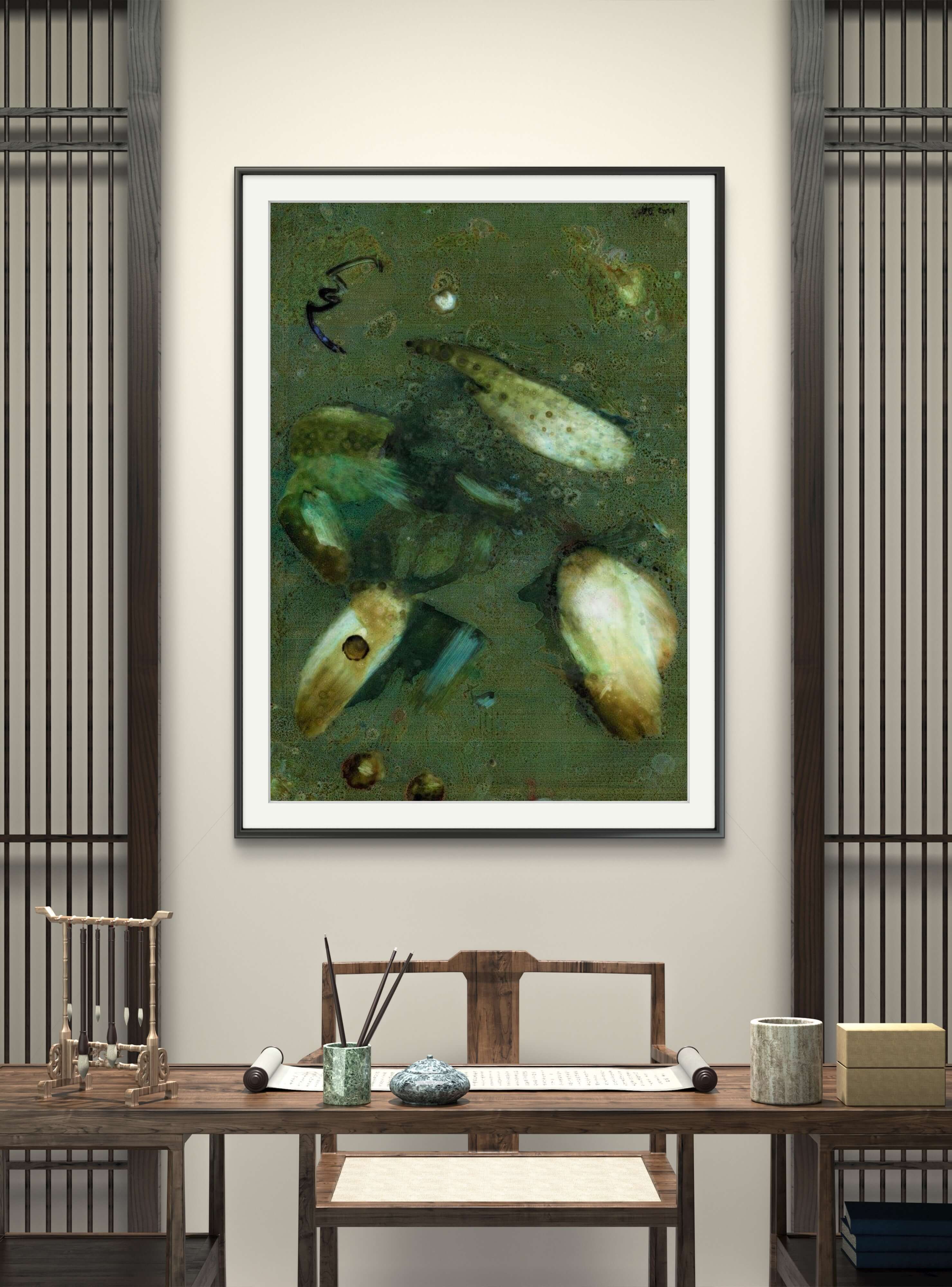
Music continues to enter my work. Here, I narrowed my attention from a whole composition to a single bar. In Night Song, the dark green field and a few pale and red accents became a way of approaching that small musical interval.

Moving Beyond Attachment
The final work in this part turns towards non-attachment in a Buddhist sense [1]. That is a related interest, rather than simply another name for Daoism. In Evening, Then Night, pale forms seem to gather and dissolve in the green ground. I wanted them to feel organic while leaving their identity unsettled.

Part 2: Taking Apart and Reassembling
The second group begins with a practical problem: how much of a picture must I take apart before something different can emerge?
During the summer of 2024, I spent a surprising amount of time on what could look like destruction—within my paintings. I think of Glenn Gould here. I have listened to his Goldberg Variations more than a hundred times, and they still hold my attention [2].
What interests me is the sense of a familiar work being examined and put together afresh. The interpretation has its own shape, while the music remains recognisable. That is how I hear Gould, and it has influenced the way I think about revising a painting.
I have been drawn to that approach for years. My reading about physics and AI added another set of questions about perception and possibility. The works here are studies through which I try to think, not finished answers to those questions.
Painting Nothingness
The first study follows What Is Reality? What Is Nothingness?. I was interested in descriptions of the quantum vacuum, while recognising that a physical vacuum and an open area in a painting are different things. The connection is a starting point for imagination.
At first, the following image may read as dispersed strokes and colour. If I suggest a young woman near the middle left, a figure may begin to emerge. The detail shows how few marks carry that possibility.
The figure belongs to an imagined world whose scale remains uncertain. Forms around her can suggest rocks, mist or distance. A hint in the painting—and a word from me—can change the viewer’s reading. That is a perceptual effect, not a physical collapse caused by consciousness.


I do not begin these works without an idea. Portrait elements and suggestions of landscape often enter the details, even when the whole image remains abstract.

From Quantum Strangeness to Artistic Metaphor
Einstein’s phrase “spooky action at a distance” belongs to a specific debate about quantum theory, rather than a general description of everything quantum [3]. I borrow the feeling of strangeness more freely in the next painting. It is a playful response to the difficulty of fitting unfamiliar ideas into familiar pictures.
The forms can be read at different scales: what seems close in one passage may seem distant in another. The painting allows those readings to sit beside one another. It does not depict all physical possibilities existing at once.

Bringing It All Together
In the final study, I brought several of these approaches together. The broad, dark gestures above connect with my Zen-inspired work; their relationship with the open blue ground returns me to Daoist questions about opposites. These are the associations guiding my process, rather than features that make a stroke inherently Zen or Daoist.
Quantum entanglement is a scientific phenomenon with no direct equivalence in Daoist philosophy. Yet, as an artistic metaphor, the idea of relationships that challenge our ordinary understanding of separation resonated with my longstanding interest in interconnectedness.
I also return to qiyun shengdong (氣韻生動), the first of Xie He’s six principles of painting, often rendered as “spirit resonance” and “life-motion” [4]. For me, the phrase raises a practical question: do the parts of the picture feel alive in relation to one another? It belongs to Chinese painting theory, not to quantum mechanics.

The pink line could be high in the sky, even in space—or deep in the sea. I can follow either reading without asking the picture to choose. What matters to me is whether the line continues to hold the image together.

Further Reading
For the scientific background, the 2022 Nobel Prize in Physics overview provides a starting point on entanglement. My earlier article also distinguishes physical concepts from the philosophical comparisons I make.
Glenn Gould at Work
An absolute gem that shows Glenn Gould at work and demonstrates well what was discussed above:
Footnotes
[1] For an early Buddhist account of craving and its relinquishment, see SN 56.11. The comparison here concerns my painting process, rather than a visual definition of liberation.
[2] Glenn Gould’s official website discusses his Goldberg Variations interpretations. The description of hearing a work afresh is my personal response, not a quotation from Gould.
[3] NIST: Bell tests and “spooky action at a distance”. Quantum entanglement concerns physical correlations; it is not a scientific equivalent of Daoist relationships or a painter’s shifts of scale.
[4] Xie He, Guhua pinlu (古畫品錄), the six principles of painting. English renderings of qiyun shengdong vary; see the discussion in The Xuanhe Catalogue of Paintings, note on qiyun.
Related articles
What Is Reality? What Is Nothingness? · Emptiness, Space, and Depth · Daoist Talks
Explore Art & Writing
Art Portfolio → Featured Artworks → Arts & Philosophy Journal → All Articles
Explore Asian Art Essays for writing on Chinese painting, calligraphy, aesthetics and art history.
Available Artworks
Original works are available on FriedrichZettl.com and Saatchi Art


Leave a Reply