
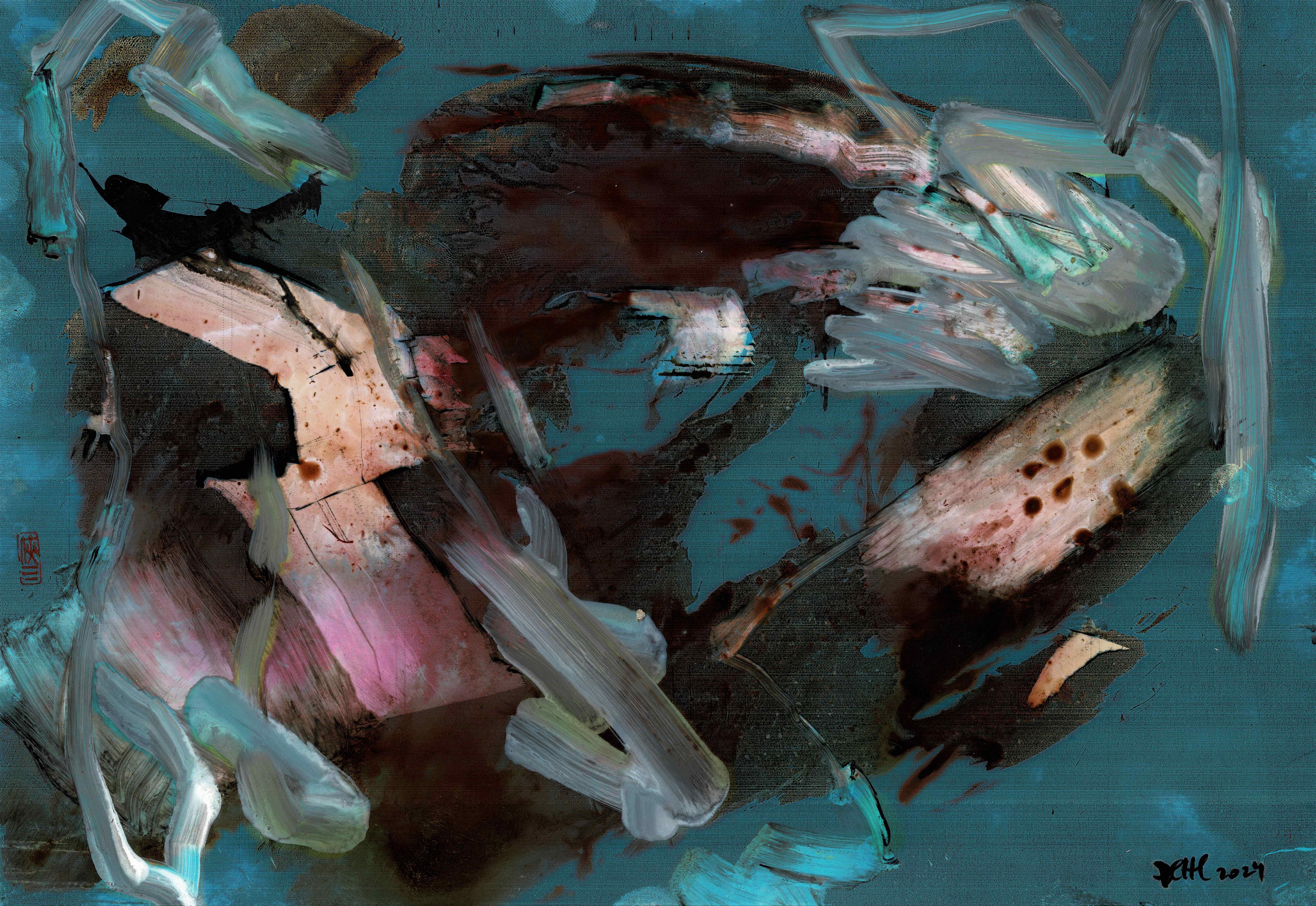
The Spring collection.
Emptiness, space, and depth: Many artists dedicate themselves to exploring space, and depth in painting. These qualities have been more prominent in traditional painting but have seen less emphasis in modern times. Today, we delve into this topic.
Following this discussion, as announced in my recent post, I will present an article on the Daoist teacher Lü Zu shortly. I am still contemplating the content, but it’s also an opportune moment to showcase my recent work.
Recently, I navigated through a moderate crisis that prompted me to reevaluate certain aspects of my work, propelling it forward. My initial step was to simplify. While the concept of reduction and release has been discussed previously, this presentation aims to demonstrate its practical application in my work.
I want to emphasize that my work consistently draws inspiration from Zen Buddhism and Daoist principles. Although these influences may not always be immediately apparent, they are deliberate. For me, the themes of emptiness, space, and depth resonate deeply with Zen philosophy. Daoist teachings further guide the realization of these concepts.
Emptiness, space, and depth. First series.
Creating emptiness, space, and depth while stripping away the unnecessary presents an exhilarating challenge. The outcome must be narrative, imbued with mood, philosophical insight, and other distinctive qualities. Below are two examples from a series of approximately ten simple works. The first piece revisits a theme I’ve explored recently: the morning mood.

In this series, I achieved reduction by just using a single chalk pencil or sparingly applying a second one.

Second Series of Emptiness, space, and depth.
Exploring opposites is a core aspect of my artistic process, leading to a series where black takes center stage. Despite this, some pieces in the series emphasize omission. While earlier works highlighted the white or the emptiness of the sheet, this piece seeks to confront the emptiness within the black.

Playing with black led me to create ‘Back to Black,’ especially since I had already touched upon the concept of jazz in my previous work. Additionally, I am working on an ongoing series about music in painting, which I will discuss in detail in a separate article.


And finally, I returned to a more traditional subject. In the past, I’ve created numerous lotus-themed works that sold exceptionally well. However, these were more customer-oriented and traditional compared to my current piece.

Bringing together
After a weekend in the countryside, I sought to capture my impressions. This endeavor was also a response to my long hiatus from drawing nature. The result is a charming series of these impressions, where I aimed to employ more refined strokes once again. (The opposite in Chinese painting is ‘ku bi’ (苦笔). It means “bitter brush strokes”, a style that resists the allure of elegance or bravura, favoring strokes that unveil intricate character.)

In both the minimalist work and the music reference, I sought a fresh approach to ‘Break on Through to the Other Side,’ particularly because I found the initial result unsatisfactory. Nonetheless, I am content with this version.

This was followed by a series of works that built upon my previous attempts and also revisited traditional Chinese landscape painting, albeit in a highly abstract form.

Emptiness, Space, and Depth in a Last Series
I wrote about my dear friend Li Jiwei’s visit. After his successful trip to Venice, we reunited and engaged in a detailed discussion about our work and ideas. This conversation was incredibly refreshing and inspiring. Following his departure, I created 2-3 works that responded to his style, yet without imitation. Instead, these pieces aimed for an intercultural dialogue.

During our conversation, Jiwei invited me to work in his studio in Beijing. Although I won’t be doing that for various reasons, I began to daydream. How would I express myself in a large studio with big canvases? Perhaps something akin to this painting.

Extra:
At present, seven of my pictures are featured in a virtual exhibition. Initially, I hesitated to apply for it. However, the gallery has done an excellent job. The presentation is impressive, and they’ve also produced a printed catalogue, which I’ve just received and found to be well-executed: metaspacegallery
I’m contemplating the relevance of traditional exhibitions if one doesn’t have a substantial customer base. Like all aspects of our lives, the art business is also experiencing significant transformations.
Related articles: dot-and-emptiness I the-essence-of-chinese-painting-ix I just-2-chinese-characters
Explore Art & Writing
Art Portfolio → Featured Artworks → Arts & Philosophy Journal → All Articles
Explore Asian Art Essays for writing on Chinese painting, calligraphy, aesthetics and art history.
Available Artworks
Original works are available on FriedrichZettl.com and Saatchi Art


Leave a Reply