
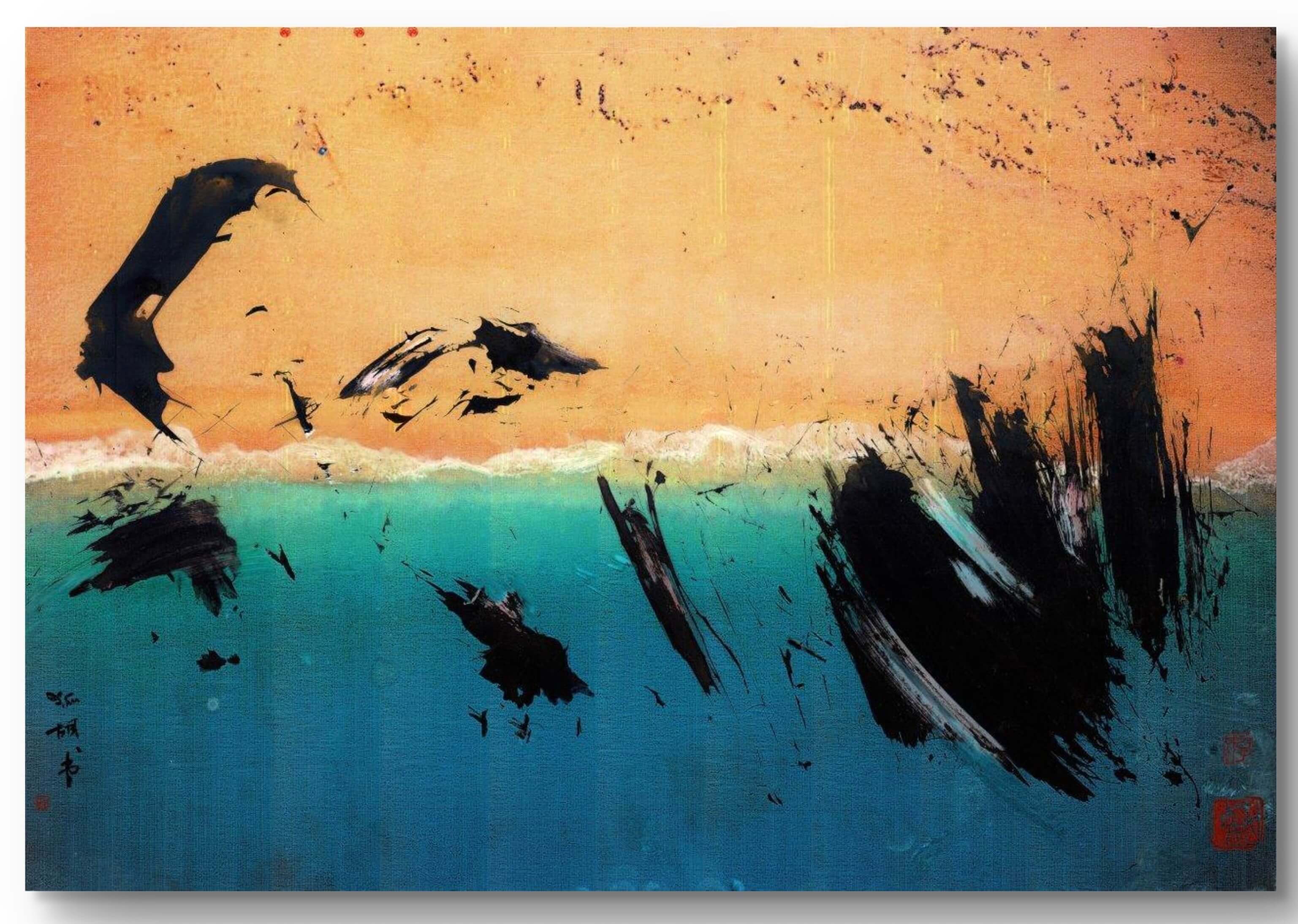
Who Sows Calligraphy will Reap Paintings.
Between Calligraphy and Painting: In order not to get too boring, this article will be the last one for some time in which calligraphy sets the tone. We have already heard quite a bit about this high-quality art form by now. A few more aspects will be addressed today that can take us to an even higher level of understanding.
What drawing is for the Western painter, calligraphy is for the Chinese colleague, as we have already explained in the past [1]. When I notice that I have reached a kind of dead point with my painting, that there is dynamism or tension become weak, I start a phase of calligraphy.
Before we turn our attention to the last example for calligraphy, I would like to show with a few new works how this dedication to calligraphy affects painting.
One of my typical last works before the calligraphy phase was this one below. I wanted to achieve something specific [2] and even though some aspects were ok, I wasn’t happy about it. Recently, the essence of the whole thing has often been lost by paying attention to small details. However, my dissatisfaction with myself is often just a sign that I need a vacation.

Below I have drawn on the composition, especially the lines of force, after the calligraphy phase.

The situation is similar to a piece of work for my “The Magic Sea” project, the progress of which I will write about again soon.

Every now and then I give in to the idea of ridiculing everything. When, as in this case, I work on paper towels.

Reduction in abundance
The calligraphy influence is much more evident in a more recent work. A draft for a Zen-oriented landscape painting. It’s just a sketch. Still too cheap and too pleasing, but it could be the basis for an attractive oil painting.

A large, black calligraphy work
If time permits and it is of general interest, I recommend this short video. It’s the creation of a painted calligraphy that penetrates into a higher level.
So far, as explained, the focus of my painted calligraphy has been primarily on the characters themselves or on structures that were created by stringing Chinese characters together and overwriting them. Now several levels of gray come into play, which visually becomes almost black, but upon closer inspection reveal different communicating levels. Which reinforces the meditative aspect.


Zen in Calligraphy – the Making
extra:
In the final section, I would like to return to the calligraphy of Ashley’s Haiku. Once we reach a certain level of routine in calligraphy, we tend to become complacent. This means emphasizing the elegance of the brushwork or striving for effects. From a Daoist perspective, one should avoid this as much as possible. It is a sign of vanity, and complacency. This should be reserved for craftsmen.
We can compare this to some virtuosos in classical music when performers behave like roosters. [3] However, the true master of calligraphy, as some Daoists see it, holds back where it is easy to win laurels and shows his competence in details. For which you have to have a certain level of experience and sensitivity. Both as a calligrapher and as a viewer. The following diagram shows skill in maintaining leeward areas, or below, creating triangles that enhance dynamics. And we should, as previously said, always pay the greatest attention to the dots.

footnotes:
[1] In this regard, I agree with Paul Steinberg’s quote: “Drawing is a form of thinking on paper.”
[2] Among other things, I wanted to depict a landscape in which the light of the white snow is replaced by the black of late winter. Covering the landscape with a heavy blanket of depression.
[3] Even though Lang Lang is a cherished pianist, I shudder to see how ridiculous he acts. This video says it all youtube
Shops: FriedrichZettl.com – Saatchiart. Media: Blog – Youtube – Instagram
related articles: old and new works, a kind of yin yang too, And the beat goes on, Another work after Huang Binhong


Leave a Reply