
The relationship between music and art
During a lively discussion with soundeagle on my blog article about Lang Lang in Vienna, I mentioned rather casually that I could imagine painting to his piano piece The Last Rag, which he had introduced to me via a link. After some consideration and listening to it, I decided to interpret his piece of music graphically instead of painting to the music.
Painting music is a theme I have touched upon quite a few times in the past. Stylistically and technically, the range of implementation is very broad. Most of the time, music is simply a tool for me while working, a way to get into a specific mindset—like the ambient music of Brian Eno or David Byrne.

Sometimes I analyze a work more deeply, like Stravinsky’s The Firebird….

…..or the complex structures of Palestrina.

My usual way of getting there: I listen to the piece, summarize the essence in one or two sentences, and look for a visual core statement.
The Approach to “The Last Rag”
What is this piece to me? It is a contemporary composition that, despite its modern expression, stands firmly within a traditional context. The composer does not cling to rigid rules and brings a lot of himself into the piece. Since he also has a close connection to painting, calligraphy, collecting, and cultural exchange, a few cornerstones for my grid were quickly established.
My first thought regarding the implementation was an older study of Chinese characters.

But in the end, that would have been more “rug” than “rag”. The world of classical Chinese calligraphy would have pushed itself too strongly into the foreground and restricted me. Instead, I developed a new technique. It requires a lot of patience and concentration, but it brings out the message in a completely new way.

Yin and Yang in an Old Rag
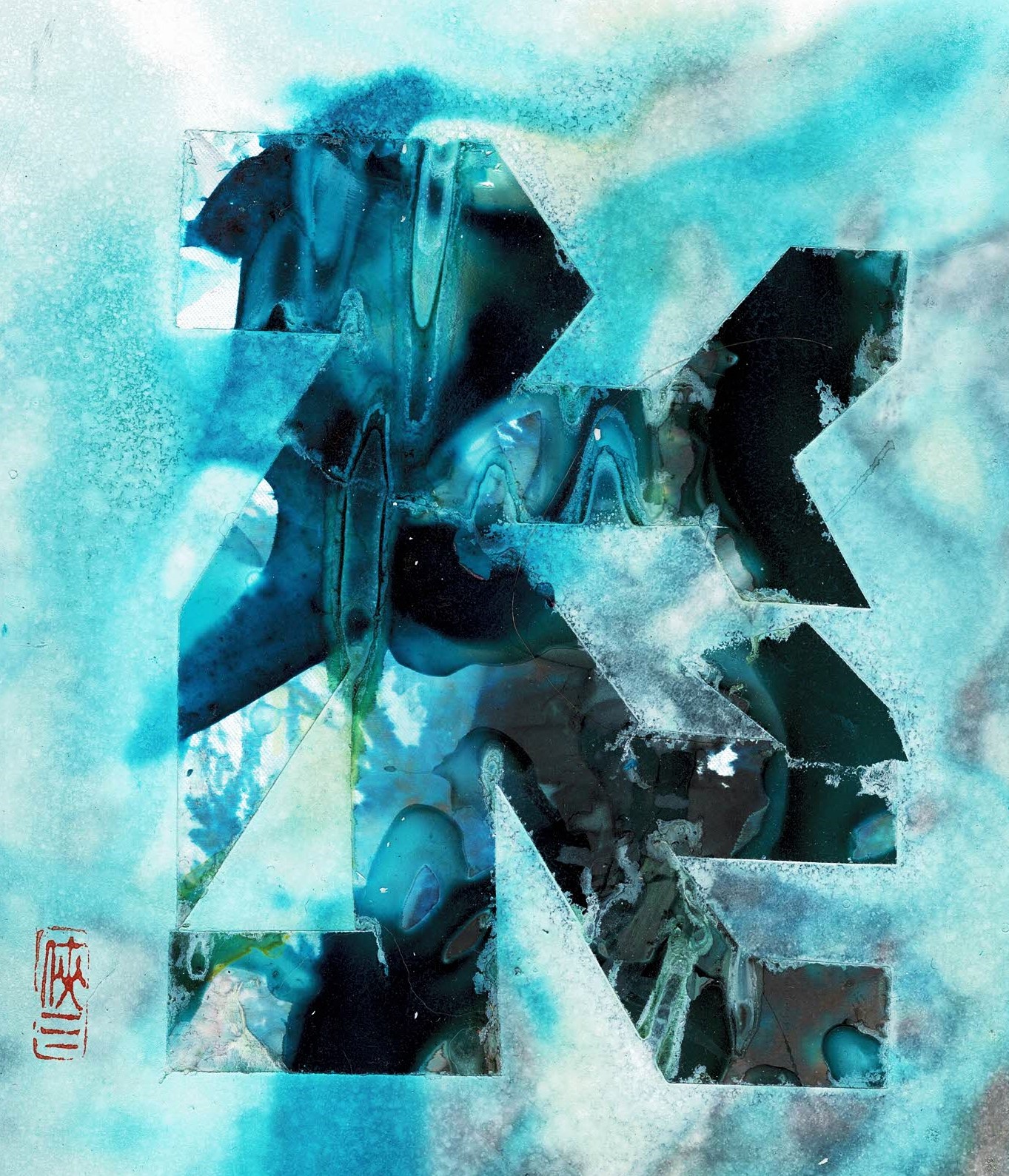
The appeal for me lay in taking the word “rag” literally. I wanted to give the picture the character of an old shred of cloth. Once a light summer dress, then discarded, cut into pieces, and used for cleaning, only this last rag remains. Washed dozens of times, it still holds a tender, blurred memory of spring and days of joy.

These inkling-like memories form the background—the yin, the delicate and fleeting. The cloudy cyan and gray look like faded fabric where old patterns only shimmer through. A controlled coincidence, integrated into my overall concept. The light here is not a cosmic phenomenon, but breaks subtly within the texture. Since ragtime music is predominantly two-dimensional to me [1], I deliberately kept the spatial depth flat.

The contrast—the yang part—is formed by very dark, almost black areas that distantly resemble written Chinese characters. They set strong accents, but they also carry a sense of the morbid. Not a negative morbidity, but rather like in Ravel’s La Valse, where the waltz only wafts between the notes. With soundeagle, too, you perceive the ragtime best between the notes. The first bars remind me of the late-classical impressionists, the work as a whole strongly of Alexander Scriabin.

The Image as a Form Analogy
My work is not an illustration of the music, but translates its basic principles into a visual language: strict form and torn rhythm.
Ragtime is a paradox: cheerful and danceable, but often shot through with a deep melancholy in the minor passages. My picture visualizes this contrast through the soft coloration and the hard, angular signs.
The 4×3 grid forms the traditional, formal framework of the piece—essentially the twelve bars or sections.

Just as a piano ragtime consists of successive phrases, the image presents clear, separated “sound blocks.” They provide stability for the viewer, just like the steady bass of the left hand on the piano.
The fragmentation of the characters is the direct analogy to syncopation [2]. If you try to follow the flow of a character, the eye stumbles over edges and gaps—exactly how the ear stumbles with ragged time. This texture breaks the traditional, elite association of calligraphy and pulls the image into an everyday, worn aesthetic of use.
A first, fleeting glance offers little that could be called charming. It is only in the details—the individual bars—that the soul of the piece opens up.

Second attempt for “The Last Rag”
This newly developed technique is difficult to control, which became painfully clear to me during a second attempt. Some details, however, turned out quite similar to what I had striven for. I had also stopped concentrating on the piece of music and instead focused on a “dirty rag”.


Third Attempt for “The Last Rag”
This third version pushes the experiment even further. Although the structure of the original 4×3 grid is essentially retained, it is handled less rigidly to allow the elements more freedom.

The strict boundaries of the “sound blocks” have dissolved into a more fluid, dynamic swirl of deep blue and cyan, reflecting a point in the music where the composition shifts and breaks with conventional rules.

While the fragmentations still evoke a sense of syncopation, they now interact directly with a central beam of light, altering the overall visual quality of the canvas. The dark, characterful yang accents are no longer confined to specific bars; instead, they float and drift through the layers like the elusive melody of ragtime itself.

Now we shall see how the composer views this visual response to his work.
footnotes:
[1] Unlike large symphonic works, which often unfold a three-dimensional, architectural sense of space through their complex instrumentation, classical piano ragtime concentrates on the linear interaction of two clearly defined layers: the rhythmic foundation of the left hand and the syncopated melody of the right hand.
[2] Syncopation: In music, a rhythmic displacement where an unaccented beat is stressed, creating the typical “stumbling” or swinging character of ragtime.
Related articles: can-we-hear-a-painting I art-of-seeing I lang-lang-in-vienna
Explore Art & Writing
Art Portfolio → Featured Artworks → Arts & Philosophy Journal → All Articles
Explore Asian Art Essays for writing on Chinese painting, calligraphy, aesthetics and art history.
Available Artworks
Original works are available on FriedrichZettl.com and Saatchi Art


Leave a Reply