
From Studio Light to Cosmic Ur-Light
Light as State of Being is about light in painting, and about what I call cosmic light or frozen light in my own work. I am interested in a brightness that seems to belong to the painted forms themselves, without a lamp or sun to explain it.
I had planned a different article: an announcement that I would take a break from writing about my art. That one could wait. Even loyal readers may find some of my concerns too specific, and I do not want to waste their time. Yet I keep asking what a painting might offer someone beyond my own studio. Light seemed worth another attempt.
Cosmic Light, Frozen Light
Like many painters, I would like to find a way of seeing beyond the conventions I have learned. That is an ambitious goal, and at my age I am unlikely to reach it completely. Still, there are particular problems in which I feel I am making progress. The treatment of light is one of them. It gives me a reason to keep working—and to postpone that announcement.
Light and Painting in the Past
In much European studio painting, light helps establish volume, depth and mood. It can pick out a face or an object with the concentration of a spotlight. Floris van Dijck’s Still Life with Cheeses, painted around 1615, offers a useful example: the pale cloth, cut surfaces of the cheeses and small highlights make the objects tangible against the dark background. This is one strand of painting’s history, rather than a rule for all painting before the nineteenth century. [sample 1]

The Impressionists gave changing outdoor light a central role, building on earlier traditions of painting from nature. Van Gogh took his own expressive path. In the view of Arles below, blue trunks cross the pale orchards and the distant town. Colour and brushwork do more than describe the scene; they make its brightness felt. Seeing the light of southern France can deepen one’s response, but the painting also has a life of its own. [sample 2]

In these two examples, light helps us read a world of objects and distances. What interests me in my own work is whether a painting can retain that sense of depth while giving up the need for a recognizable source of illumination.
Cosmic Light
The expression cosmic light [1] needs care. It can suggest spiritual claims that I do not intend. My academic training makes me wary of presenting an artistic intuition as scientific evidence. Astronomy interests me, but these paintings are not illustrations of astrophysical measurements.
So What Is Cosmic Light?
Astronomy distinguishes several phenomena that are easily confused when we speak loosely about cosmic light:
Cosmic microwave background: radiation released when the universe became transparent, about 380,000 years after the Big Bang, now observed at microwave wavelengths.
Background light from galaxies: a diffuse record of radiation emitted over cosmic history.
Cosmic rays: high-energy particles, mainly protons and atomic nuclei, rather than light.
The first two are forms of electromagnetic radiation; cosmic rays are particles. The distinction matters. The movement of energy interests me as a painter, but my brushstrokes do not record these physical processes. They give me a way to imagine movement, density and emergence.
In spiritual writing, “cosmic light” can also stand for consciousness or enlightenment. I use the term in a more personal, pictorial sense. It names an impression I am trying to create, without asking the viewer to accept a spiritual doctrine.
The painting below brings the question back to the surface. Against turquoise, dark strokes and pale passages seem to gather around a bright opening. The forms suggest movement without settling into a single recognizable place. This is where my use of the word cosmic begins. [sample 3]

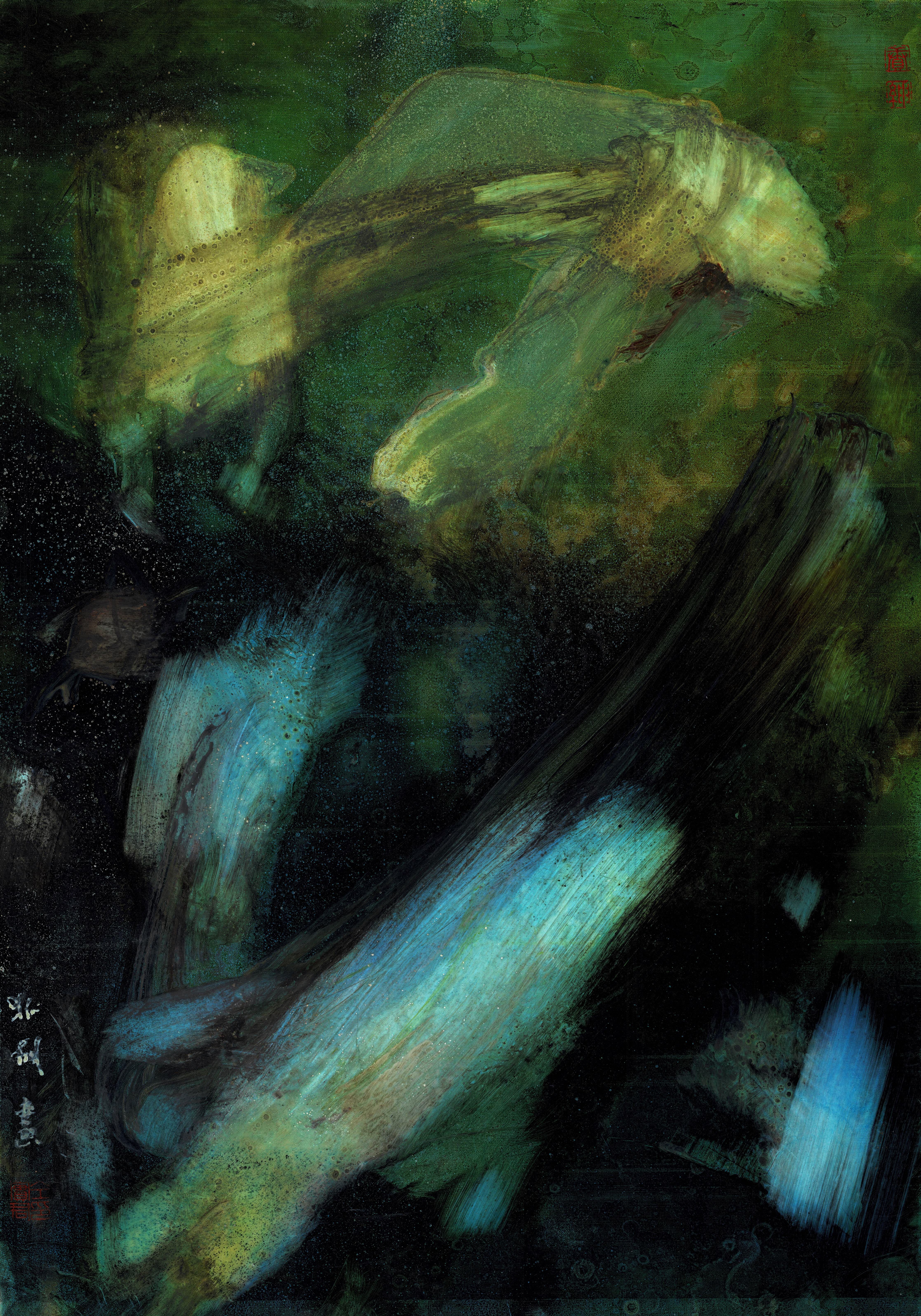
I try to loosen the hold of familiar perspective, proportion and directed illumination. [2] A painting can then suggest a vast distance, a landscape or deep water without having to choose among them. In Bioluminescent Void, green and turquoise passages emerge from a dark field; they seem to carry their brightness with them. The title offers an association, not a scientific description. I connect the unforced relationship I seek between these forms with wu wei. [3] [sample 4]

Ur-Light as the Core Theme
I call this search Ur-light: primordial light. I want to move away from depicting a lamp or the sun and toward light experienced as a condition of the image itself. [4]
“Frozen light” is another name I use for this impression. It is an artistic metaphor, not a literal account of matter or of what happens on the paper. [5] In Flickers in the Void, fine red, pale and yellow-green marks interrupt a black field. The eye connects these scattered events into a space. [sample 5]

Light in Asian Painting
In many Chinese ink paintings, a single light source and consistent cast shadows are not the main means of organizing the image. Ink tones, brushwork and unpainted paper can suggest atmosphere and distance instead. That does not mean light is absent from Chinese painting, or that all Asian traditions share one approach. For my work, the useful lesson is that space and presence need not depend on modelling every form under an imagined lamp.
A Step Further in Light
Xieyi painting (写意, xiěyì), often described as freehand brushwork, places particular weight on expressive brushwork and the intention behind the image. [6] It may use colour as well as ink; monochrome is not its defining rule. My own understanding of xieyi and its relation to my painting grows out of this tradition, although Western art has shaped me too. Daoism and Zen remain important points of reference. I sometimes find resonances with ideas from physics, but those affinities belong to my interpretation, rather than proving that physics confirms Zen. [sample 6]

Abundance Through Omission
I have written before about gaining by leaving things out. [7] In my experience, omission has to make room for another kind of richness; otherwise the painting becomes thin. Light often takes on that task. In the ink work below, the white ground enters between broken black marks. It gives them separation and rhythm, without requiring a painted glow. Studies like this help me ask how little can remain while the image still holds together. [sample 7]

The final two works show how I pursue the question through a series. [8] When a painting is finished, I often return to its underlying idea, asking what I could still remove. The next work may follow immediately or much later.
I had already shown the first in When the World Shatters. Two pale, irregular forms remain suspended in a dark field. Small areas of yellow and red keep them from becoming merely grey. To me, the image draws on the subconscious rather than a deliberately constructed scene. [sample 8]

In the next attempt, I reduced the contrast as well. Pale, porous forms hover against a muted blue-green ground. Their edges do not quite close, and the light seems caught within them. How far can I take that reduction before the painting loses its presence? [sample 9]

I hope these thoughts make the paintings a little more approachable. But words also reach a limit. It is time to leave the light to the pictures.
Footnotes
[1] Astronomical terms. NASA distinguishes the cosmic microwave background from cosmic rays. “Cosmic light” in the discussion of my paintings is my own descriptive expression.
[2] The historical examples. Collection records: Floris van Dijck, Still Life with Cheeses, c. 1615, Rijksmuseum; Vincent van Gogh, View of Arles, 1889, Bayerische Staatsgemäldesammlungen. My discussion of light is a visual reading of these examples.
[3] Wu wei. Here I use the Daoist idea of unforced action to describe the relationship I seek between the forms. It is a practical artistic connection, not a claim that the painting demonstrates a philosophical doctrine.
[4] Ur-light. The German prefix Ur- suggests something primordial. I use the term for light that appears inherent in the image, rather than cast onto its forms from outside.
[5] Frozen light. A metaphor for the appearance of the paintings. Mass–energy equivalence does not mean that ordinary matter is literally immobilized light.
[6] Chinese painting and colour. The Minneapolis Institute of Art’s landscape exhibition illustrates the range from richly coloured court painting to pale colour and monochrome ink. These traditions should not be reduced to a single attitude toward colour or light.
[7] Omission. Leaving something out is a recurring concern in my work. The point here is the visual relationship between the remaining marks and the space they open up.
[8] Working in series. Repetition and variation help me test pictorial decisions. The analogy with experiments describes my working habit; it does not turn an aesthetic judgement into a scientific result.
Related Articles
The Essence of Chinese Painting: Emptiness and the Meaning of White · Wu Wei: Effortless Action in Daoism and Chinese Painting · When the World Shatters
Explore Art & Writing
Art Portfolio → Featured Artworks → Arts & Philosophy Journal → All Articles
Explore Asian Art Essays for writing on Chinese painting, calligraphy, aesthetics and art history.
Available Artworks
Original works are available on FriedrichZettl.com and Saatchi Art


Leave a Reply