
Before I gotta go [1] and take my leave for a while for the winter break, I want to introduce a new series that I indirectly announced in my last article: Dreams.
I have dedicated the year 2025 primarily to minimalism. But as it is with Yin and Yang: after a time of abstinence and strict reduction, the pendulum demands a swing in the other direction—towards opulence. This counter-movement is clearly visible in my new series on dreams and their surreal components.
Although I am often my own harshest critic, I am grateful that I not only keep managing to develop new techniques, but that I can also improve them fairly well and use them for what I want to express.
Before I gotta go: A Thank You
Fittingly towards the end of the year, I would like to thank you for all the attention, loyalty, and encouraging feedback. Writing this journal helps me to order my own thoughts. But it is only through you, the readers, that I experience the resonance that gives meaning to my work—however imperfect it may be.
A Dialogue on TV
But before I really go, there is a special appointment coming up: A modest TV appearance. Professor Wolfgang Kubin, whom I have mentioned here a few times, is turning 80. A celebration is planned for this occasion, and Wolfgang wished for the two of us to appear in a kind of dialogue.
My topic suggestion “Dot and Void” delighted him. It remains to be seen to what extent the audience can get something out of this philosophical excursion. The celebration will be attended by prominent guests and recorded for television, which in turn gives me the opportunity to formulate my ideas on the subject here later in a comprehensible way.
The Dream as an Old and New Theme
But back to art. As mentioned at the beginning, I want to show some of my latest works. The subject of “dreams” has accompanied me since my youth. As an autodidact, my approach back then was still impetuous and the execution correspondingly amateurish. One of my first pictures depicted a dream I had actually dreamt.

From today’s perspective, the approach was of course outdated. Just as I find most dream paintings—even those of significant painters—often unsatisfactory. Why? Because strictly speaking, they are illustrations. At best, they reflect an imagined dream world, similar to a descriptive short story or an etching from the 19th century, like in this collage I did many years ago.

If it was Sigmund Freud with his Interpretation of Dreams who influenced me strongly in my youth (like many other Surrealists), it was later C.G. Jung. But in a great leap in time, I now want to show works that break away from pure depiction – what Jung described as the eternal or the archetypes.
The Search for the Right Technique
When I approached the topic dreams again recently, I was still busy with my series on black natural paper. With this picture, I effectively “exited” that series:

I quickly realized: Depicting dreams with this technique is hardly possible. The technique was too rigid, too graphic.
So I tried something else: Oil. Actually, my main concern was to transfer my progress in the area of minimalism to oil painting. Like all my works, this picture is deeply shaped by Daoism, with the opposing pair “sparse versus opulent” in the foreground.

Oneiric Divide
The next attempt approached the core of the matter much better. I already mentioned the painting in my last article: Don’t let the old man in.
Now that my goal had been defined, I had to clarify for myself what exactly I am aiming for. To make it short: This time I do not want a representational examination of the dream, but a visualization of what a dream leaves behind. At best, it is therefore not realistic, but rather a Zen moment in its essence, with only a vague idea or a compressed feeling of a dream experience.
It is about a mixture of feeling, mood, and reflection.

This picture ties in with an earlier series, which also included works like these ones:


What connects the two concepts? A new approach to Surrealism. It is fundamentally abstract but contains areas that appear almost photographic, thus incorporating the “sur-real” (the beyond-real). The goal is to highlight the essence of dreams without telling a story.
The Disneyfication of Dreams
We live in a time when the subject of dreams is often “Disneyfied.” Similar to some animated films, images are used that represent nothing more than concentrated banality and try to please everyone in order to appeal to the widest possible audience. Generations of children have been corrupted in this way. Especially today, where AI graphic programs are increasingly used, an artificial disneyfied “dream world” is created which suggests that Jane and John Doe understand the dream without ever having really thought about it.
When we have had a “beautiful” dream—for example about a loved one—we wake up with a good mood that carries us through the day. But there is the other kind of dream to which I want to dedicate myself in this part of the new series: The dreams that leave us waking up disturbed.
The Anatomy of a Nightmare
It is about dreams that have touched something deep inside us. Dreams that eventually paralyze us. Although nightmares often have a plot, we often only remember fragments: A red car rushing towards us while we are unable to step aside.
If one frees these scenes from their objecthood (the car, the street), what remains is the pure “feeling” of oppression and energy.

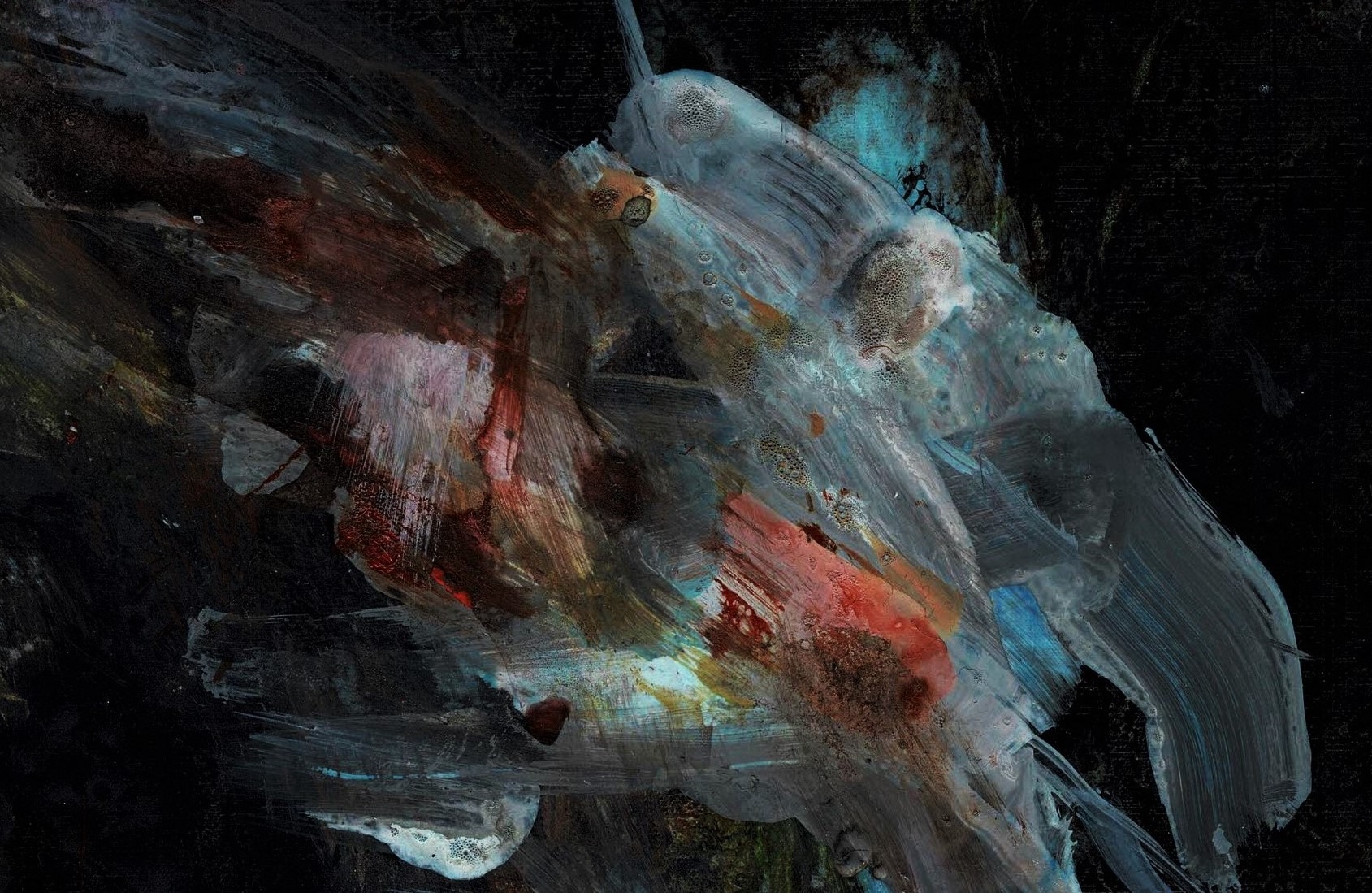
This is the core of my attempts: To condense. I deliberately renounce “beauty” and try instead to compress the earthy, the intangible, and the threatening.

I came closest to my aspiration in a work that is not quite finished yet. But a detail from it reflects the mood perfectly:

Before I gotta go…
…I wish you all the very best for 2026!
A possible motto for the coming year was formulated by one of my favorite humorists, Karl Valentin:
“May it not get as bad as it already is.”
footnotes:
[1] I borrowed the title for this article from Courtney Barnett, from her song: Before you gotta go.
Related articles: When the World Shatters I dreamtellers I nothingness-in-color
Explore Art & Writing
Art Portfolio → Featured Artworks → Arts & Philosophy Journal → All Articles
Explore Asian Art Essays for writing on Chinese painting, calligraphy, aesthetics and art history.
Available Artworks
Original works are available on FriedrichZettl.com and Saatchi Art


Leave a Reply