
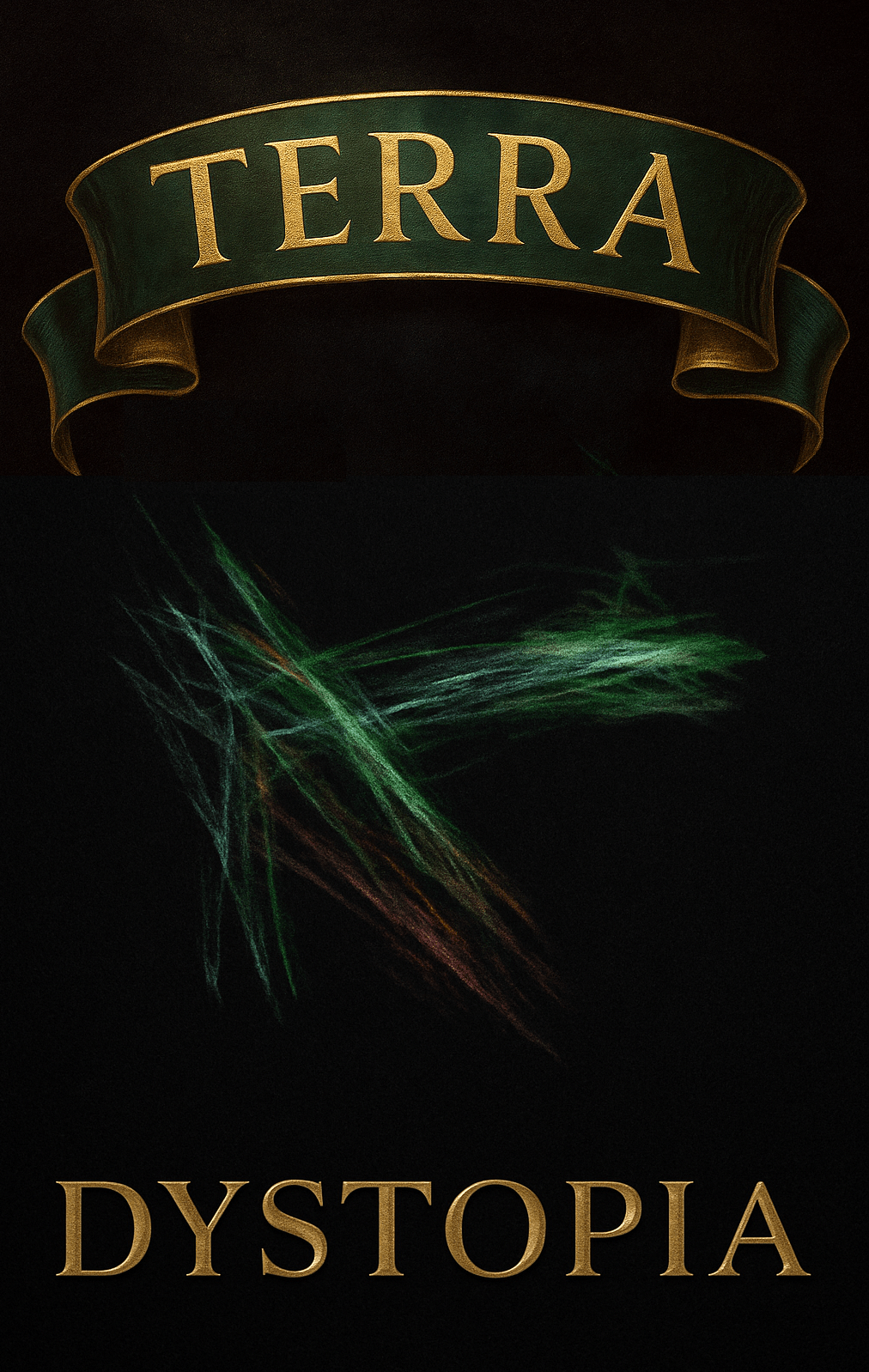
Landscape of Our Times
Terra Dystopia is the working title for a new “thought”-project. Whether it will eventually evolve into a series of images remains undecided and is not the focus of this article. The works I’m presenting today should therefore not be seen as direct illustrations of the text. Rather, they form a potpourri of completed pieces, studies, sketches, and fragments from this summer—created during long periods of contemplation and reflection on a deceptively simple question: What kind of time are we living in today? What would be a correct term?
Engaging more deeply with this question began with the “DOGE coup” —or more precisely, with observing how this drastic political maneuver would be publicly perceived and evaluated. Terms like late capitalism surfaced repeatedly, followed later by fascism and dictatorship. In my article Would You Buy a Used Car from This Man, I referenced Yanis Varoufakis, who speaks of techno-feudalism — a term I find strikingly accurate and aligned with my own assessment.
What particularly concerns me isn’t just that I see all the dystopian parameters aligning, but the breathtaking speed of this shift. I began this article barely two months ago, and in that short span, the scope of a dystopian reality has intensified significantly.
Prerequisites for a dystopian society
For new ideologies to emerge and take hold, they require a conducive environment—namely, ideological, societal, and political conditions. These conditions are ideally present in a dystopian society. I then summarized the key characteristics of dystopia as portrayed by authors like George Orwell or Aldous Huxley, and examined how many of these traits have already manifested in our own society—and to what extent. Of course, listing them all would fill a book. My examples are therefore somewhat arbitrary.
There is, however, one aspect in my recent paintings I do wish to highlight: the morbid, destructive undercurrent that has surfaced. It stems from the following consideration: a dystopian society is not built to last. Its downfall is inherent—destruction is embedded in its very ideology.

1 The Word Behind the World
The term dystopia stems from the Greek roots δυσ- (dys, meaning “bad” or “ill”) and τόπος (topos, meaning “place”). It’s the dark mirror of utopia—not simply a paradise lost, but a society where the illusion of harmony conceals deep structural decay. I first stumbled upon this etymology while browsing a Wikipedia entry [1], and it quickly pulled me into a rabbit hole of unsettling resonance. Other sources like cambridge.org [2], added further layers to the concept. The deeper I read, the clearer it became: We’re not merely imagining dystopia anymore. We’re living through its prologue.
This isn’t a pessimistic take. It’s simply a way to reflect on our world, find our direction, and think about the consequences of our actions. In the following section, I’ll outline the key points that, in my view, form the foundation of my perspective.

2 The Illusion of Perfection
One hallmark of dystopia is the illusion of utopia. A society free of poverty, disease, and conflict—on the surface. But beneath that sheen lies suppression, inequality, and fear. The narrative arc often revolves around three elements: the problem itself, the mechanisms of concealment, and the timeline of collapse.
💬 A fitting example of this is China’s social credit system. It creates the illusion of a perfect, harmonious society, but beneath it lies a system of total surveillance that enforces conformity and suppresses individuals out of fear of social ostracism.

3 Privatization and the Vanishing Commons
In dystopian societies, public services are often privatized beyond recognition. Water, energy, even governance itself become commodities. Without oversight, the needy are left behind. This isn’t fiction—it’s happening. In parts of the world, not only access to clean water is already a luxury.
💬 A clear example is the water crisis in Flint, Michigan. After the city switched its water source to the Flint River to cut costs, private companies failed to properly treat the water, leading to lead poisoning that disproportionately affected low-income communities and created a long-term public health disaster.

4 Stratification and Social Castes
Rigid social hierarchies are a dystopian staple. In Huxley’s Brave New World, Alphas and Epsilons lived worlds apart; today, we have gated communities, elite schools, and algorithmic sorting. Social mobility is grinding to a halt as the ladder gets pulled up from above.
💬 The college admissions scandal is a perfect example. Wealthy parents bribed and cheated to get their children into elite universities, exposing the supposed meritocracy as a pay-to-play scheme. It’s a system where access and opportunity are inherited, not earned.

5 Technology Without Humanity
Cyberpunk worlds often feature dazzling tech and dismal lives. Surveillance, automation, and synthetic pleasures replace genuine connection. The irony? We’re building these systems ourselves. Smart cities, facial recognition, and predictive policing are no longer speculative—they’re operational.
💬 Consider Singapore’s “Smart Nation” initiative. While it boasts efficiency and safety through a vast network of sensors and facial recognition, it also creates a pervasive surveillance state where citizens’ every move is monitored, blurring the line between security and social control.

6 Regression in Progress
Dystopias often depict a reversal of progress. Education, science, and ethics stagnate or decline. In post-apocalyptic variants, knowledge becomes fragmented, mythologized, or lost. In our world, misinformation spreads faster than facts, and critical thinking is under siege.
💬 The anti-vaccine movement is a stark real-world example. It represents a direct assault on established scientific consensus, fueled by viral misinformation and conspiracy theories that have led to the resurgence of preventable diseases like measles—a clear reversal of medical progress. This phenomenon shows how easily scientific knowledge can be fragmented and mythologized online, undermining critical thinking and public trust in institutions. [3]

7 Hunger and Excess
A stark wealth gap ensures that the elite dine on organic delicacies while the masses consume synthetic substitutes. In In Time, the rich live forever while the poor trade minutes for survival. Today, food deserts exist alongside gourmet supermarkets. The contrast is grotesque.
💬 Consider the recent infant formula shortages in the United States, where parents frantically searched empty shelves for the basic nutrition their babies needed to survive. At the very same time, the market for gourmet, “human-grade” pet food was booming. Or Washington D.C., with neighborhoods where you can find a Whole Foods stocked with organic produce just a short drive from a “food desert,” an area with limited access to affordable and nutritious food. This creates a reality where affluent residents can easily maintain a healthy diet, while those in lower-income areas are often forced to rely on convenience stores and fast-food chains.

8 Democracy in Disguise
In dystopias, the lower classes have little say in governance. Decisions are made by elites, often behind closed doors. Propaganda replaces dialogue. Education becomes indoctrination. The state is not just obeyed—it’s worshipped.
💬 A clear, recent example is the handling of the 2023 banking crisis. When major banks like Silicon Valley Bank and Credit Suisse teetered on the brink of collapse, a small group of government officials and financial elites made sweeping decisions in private, committing vast sums of public money to bailouts. There was no broad public debate or democratic vote; the decisions were presented as faits accomplis to “prevent a larger crisis,” while the same public is told that there is no money for social programs. This demonstrates a system where, in moments of crisis, democratic processes are bypassed in favor of closed-door decisions made by a select few. Just to give one example.

9 Language as Control
Orwell’s Newspeak is a chilling example of linguistic repression. If you lack the words to express dissent, you cannot rebel. In our time, algorithms filter speech, and certain narratives are algorithmically buried. Language is power—and it’s being curated.
💬 A prime example is the phenomenon of “shadowbanning” on social media platforms. Without any notification, a platform’s algorithm can limit the visibility of a user’s posts, making them invisible in hashtag searches or explore pages. This means a user can continue to post, believing they are broadcasting to their usual audience, while their reach is being actively suppressed, effectively curating the discourse by making certain voices or narratives harder to find.

10 The Death of Individuality
Conformity is celebrated. Individuality is punished. The state demands sameness, and deviation is treated as disease. In 1984, Big Brother is omnipresent. Today, we curate ourselves for likes, followers, and algorithms. Authenticity becomes a risk.
💬 A chilling modern example is the phenomenon of “cancel culture” on social media. Individuals, from celebrities to ordinary people, face public shaming and ostracism for expressing opinions that deviate from the mainstream or for past actions that are re-evaluated under present-day social norms. This creates an environment where people meticulously curate their online personas to be as inoffensive and conformist as possible, fearing that a single misstep could lead to social and professional ruin, making genuine authenticity a high-stakes gamble.

11 The Fear of Elsewhere
Dystopias often instill fear of the outside world. Borders are sealed, and foreign ideas are demonized. In reality, nationalism and xenophobia are rising. The “other” is blamed for internal decay. It’s a classic tactic—and a dangerous one.
💬 The political campaign surrounding Brexit in the United Kingdom serves as a powerful illustration. Proponents of leaving the European Union often framed the debate around “taking back control,” effectively instilling fear of the “outside” influence of the EU. Immigrants were frequently blamed for straining public services and taking jobs, deflecting from domestic policy issues and creating a narrative where an external “other” was the cause of the nation’s problems.

12 Religion and Ideology
Traditional beliefs are either erased or replaced by state-sanctioned ideologies. In 1984, Ingsoc becomes a religion. In The Incal, Technopriests rule. Today, we see ideological echo chambers, where belief systems are algorithmically reinforced.
💬 The QAnon movement is a good example. As well as the rise of the “tradwife” and “manosphere” movements online. These are not just lifestyle trends; they are complete, self-contained ideologies that dictate everything from relationships and family structure to politics and personal worth. Within these digital echo chambers, algorithms feed users a constant stream of content that reinforces a rigid, reactionary worldview, effectively replacing mainstream societal norms and individual critical thought with a pre-packaged, quasi-religious belief system.

13 Surveillance and Censorship
Permanent surveillance is a staple of dystopia. Governments monitor, censor, and manipulate. In our world, data is harvested, behavior is tracked, and dissent is flagged. Privacy is no longer a right—it’s a privilege.
💬 Consider the PRISM program [4] , revealed by Edward Snowden. This initiative by the U.S. National Security Agency (NSA) involved collecting internet communications directly from the servers of major tech companies like Google, Facebook, and Apple. While officially targeting foreign intelligence, the program inevitably swept up vast amounts of data from American citizens without a warrant, creating a massive infrastructure for monitoring online activity and flagging dissent under the rationale of national security.

14 The Vanishing Middle Class
In dystopias, the teachers, journalists, and scientists who could challenge the regime are silenced or co-opted. When truth becomes dangerous, dystopia is not far behind.
💬 The most brutal form of this is physical elimination. The conflict in Gaza has become the deadliest period for journalists on record, with numerous reporters killed while simply doing their jobs—a stark demonstration of the risks of reporting from a war zone.
Then there is systemic purging. Following the failed coup attempt in Turkey in 2016, the government used the state of emergency to silence dissent on a massive scale. Over 15,000 education workers were dismissed, thousands of academics were fired, and more than 130 media outlets were shut down, effectively crippling the country’s intellectual infrastructure.
A more subtle, but equally corrosive, example is the political pressure on scientists in Western democracies. We repeatedly see scientific advisors and public health officials marginalized, defunded, or publicly discredited by governments when their findings on climate change or pandemics clash with political or economic agendas. This co-opting of science turns expertise into a political tool and erodes public trust in objective truth.

15 Nature as Memory
In dystopias, nature is banished. The world becomes synthetic, sterile, and controlled. My series The Magic Sea touched on this theme. “Terra Dystopia” continues that reflection. As climate change accelerates, we risk losing not just ecosystems, but the memory of what they were.
💬 A devastating real-world example is the mass bleaching of the Great Barrier Reef. Rising ocean temperatures, a direct consequence of climate change, are causing the vibrant coral ecosystems—some of the most biodiverse environments on Earth—to expel their life-giving algae and turn into sterile, white graveyards. We are witnessing a natural wonder, a real-life “magic sea,” becoming a synthetic-looking, desolate landscape, and we risk a future where generations will only know the reef’s former glory through archival footage, the memory of its living splendor lost to a bleached reality.

16 The Fiction of Reality
Dystopias construct false realities. The masses are fed illusions. In Brave New World, even rebellion becomes entertainment. Today, satire is mistaken for news, and news is dismissed as fiction. Truth is slippery—and that’s no accident.
💬 A president, under fire for questionable associations with one of the most notorious pedophiles, claims to have barely known the man. As scrutiny intensifies, he becomes increasingly entangled in a web of embarrassing lies. And when none of it seems to hold, his spokesperson announces—on live camera, no less—that the president had, in fact, been working undercover for the FBI to bring the villain down. All of it broadcast in real time, accessible to a global audience.

source: Der Tagesspiegel
17 Stability Over Humanity
Dystopian economies prioritize stability over well-being. Efficiency trumps empathy. Surplus is absorbed by war or consumption. In 1984, goods are rationed. In Brave New World, excess fuels addiction. Now, in our world, productivity is sacred—even when it breaks us.
💬 A good real-world parallel is the high-pressure environment within Amazon fulfillment centers. Workers are frequently monitored by automated systems that track their every move, from the number of packages they handle to their “time off task,” reducing their labor to a set of metrics. This system prioritizes the stability and speed of the supply chain over the physical and mental well-being of its employees, leading to high rates of injury and burnout.
Another powerful example is the gig economy model used by companies like Uber and DoorDash. By classifying workers as independent contractors, these platforms offload all risk and responsibility onto the individual. The system is designed for maximum corporate efficiency and stability—no health insurance, no retirement benefits, no guaranteed minimum wage. This creates a precarious existence for workers, who must absorb the costs of vehicle maintenance, fuel, and their own well-being, all while being managed by an impersonal algorithm. It’s a system that treats human labor as a disposable commodity in the pursuit of a frictionless, on-demand service.

🧠 Final Thoughts
These examples aren’t exceptions; they are features of our current society. This raises a difficult question: If we’re already living in a system with dystopian traits, where companies like Palantir have become normalized tools of governments, what happens as AI continues to evolve? Is it even possible to return to the society we knew before? Would a simple change of government be enough to reverse course, or have we already missed the boat?
A simple return to a past “normal” is unlikely. The integration of technology into governance, the economy, and social life isn’t a temporary state—it’s a structural shift. Technologies like AI and mass data analysis are now fundamental tools for both corporations and states, while the gig economy and algorithmic echo chambers have reshaped our world in ways a single election can’t undo.
However, that doesn’t mean the course is fixed. History shows that societies constantly adapt and push back. “Normal” as we knew it is likely gone, but the future isn’t a foregone conclusion. It’s a project that is actively being built, for better or worse.
footnotes:
[1] Wikipedia entry for “Dystopia”: https://de.wikipedia.org/wiki/Dystopie (German)
[2] Cambridge Companion to Utopian Literature: https://www.cambridge.org/core/books/abs/cambridge-companion-to-utopian-literature/origins-of-dystopia-wells-huxley-and-orwell/42BDA41241F2A5E3D2ADDAC565FBE122
[3] Harvard video: https://www.youtube.com/watch?v=WKqZ7AamoPo
[4] Prism Program: https://www.youtube.com/watch?v=JR6YyYdF8h
Related articles: spring potpourri I Autumn Reflections I when-the-world-shatters
Explore Art & Writing
Art Portfolio → Featured Artworks → Arts & Philosophy Journal → All Articles
Explore Asian Art Essays for writing on Chinese painting, calligraphy, aesthetics and art history.
Available Artworks
Original works are available on FriedrichZettl.com and Saatchi Art


Leave a Reply