
Reflections and My Attempts.
Wabi Sabi [1], a term relatively unknown in the West until recently, holds a special place in my heart. This article reflects my personal approach to Wabi Sabi, illustrated with my own works mostly painted this year.
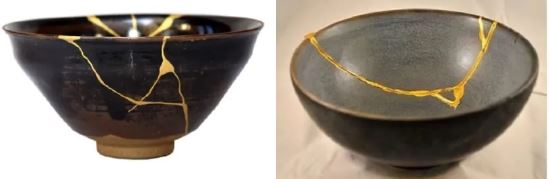
Many associate Wabi Sabi with the art of repairing broken bowls with gold, creating a new aesthetic from imperfections. However, Wabi Sabi goes beyond this; it is deeply connected to Zen Buddhism and Daoism.

Daoism, with its reverence for nature, simplicity, and acceptance of life’s natural flow, strongly influences Zen and Wabi Sabi aesthetics. The Daoist principle of Wu Wei (無為) or “effortless action” encourages alignment with the universe’s rhythms without force. This concept is evident in both Zen and Wabi Sabi, where spontaneity and naturalness are valued over calculated precision.
Wabi Sabi appreciates things as they are, without artificial enhancement. This philosophy aligns with xieyi painting [2], where every brushstroke must be perfect, with no room for corrections.

Western and Eastern Aesthetics
The West often embraces the bright, loud, and exaggerated, which becomes evident when we step into nature, away from screens and transition towers. Many years ago, I discovered a small book by Tanizaki Jun’ichiro (谷崎 潤一郎) [3] on Japanese aesthetics from 1933 that beautifully explains some differences in aesthetic perception.
“When we see Western paper, it feels like a simple, everyday object. However, the patterns of Chinese or Japanese paper exude warmth, calming our hearts. Though all are white, the whiteness of Western paper contrasts with the thick Japanese hosho or white Chinese paper. Western paper reflects light, while hosho and China paper absorb it like freshly fallen snow. The latter feels supple, making no noise when folded, akin to touching a leaf.” [Jun’ichiro, p.19]

Jun’ichiro contrasts this with everyday objects made of silver, polished to shine brightly in the West, while in Japan, people cherish the patina on sake or silver kettles. He further observes, “The Chinese also love jade. I wonder if anyone other than East Asians can find beauty in these cloudy stones, which enclose a dull light deep inside, as if air had solidified over centuries.” [Jun’ichiro, p.21]

This perspective highlights the profound differences in how cultures perceive and appreciate beauty.
Wabi Sabi and Haiku
Wabi-sabi also shares many similarities with haiku, as both emphasize aesthetic and philosophical elements that are heavily influenced by Zen and Japanese culture. Both wabi-sabi and haiku celebrate the impermanence of life. Haikus often capture moments in nature – such as the falling of leaves in autumn or the blooming of cherry blossoms in spring – and capture them in their fleeting beauty. Wabi-sabi expresses this impermanence in the form of objects that show signs of aging, wear and tear, or natural changes.

Wabi Sabi: Less is more
When I was writing my dissertation on xieyi painting and studying very old Chinese art theory texts, I came across statements that a painter should never show 100% perfection in his paintings. In doing so, he offers the opportunity for the viewer to become more involved. Something that has had a big impact on me. In the West, on the other hand, we tend to make everything more and more perfect and many “artists” now use AI. Apart from the fact that this has nothing to do with art, what bothers me most is the stereotype of the insignificant. And since we instinctively know that imagination is an important aspect of art, we have created a “fantasy world” that permanently changes the way we see things and drains us.
Hara Hachi Bu and the Art of Moderation
The Japanese prefecture of Okinawa is renowned for the longevity of its inhabitants, rooted in the philosophy of Hara Hachi Bu [4]. This principle of moderation applies to various aspects of life, not just food. Influenced by Buddhist and Daoist teachings, it emphasizes self-control and harmony with nature. Alongside nutrition, social connections, daily exercise, and a strong sense of purpose—often called Ikigai [5]—play crucial roles in this lifestyle.
Embracing Imperfection – Wabi Sabi
Despite being aware of the pitfalls of Western perfectionism, escaping it can be challenging. From choosing the straightest cucumber in the supermarket to writing blog posts that meet SEO criteria, perfectionism permeates many aspects of life. AI can help refine our articles, but it often results in a writing style that feels more like marketing or political jargon.
The beauty of the unpleasing
One of my favorite painters, Shi Tao [6], painted a long scroll and called it 10,000 Ugly Inkblots. Shi Tao was considered the master of dots. Following this idea, I painted a few sheets with ugly ink strokes.

What we perceive as “beautiful” is determined to a certain extent by external factors. We find it beautiful, even right, when baby girls wear pink rompers and baby boys wear blue. For some, it can remain a dogma into old age. The same applies to “wall hangings”. Completely irrelevant mass produced images offered in the bargain table of a furniture store can outdo a Picasso.
I imagined how some of my wabi sabi works would look in a child’s room – and above all, what effect it would have on children’s viewing habits. No Ariel Mermaid, no ugly McJunkfood clown. Of course, that doesn’t mean that we should do without dwarves and dragons, but an additional offer could have a big impact on perception in older age.


The book discussed by Tanizaki Jun’ichiro is mainly about how shadows were planned in Japanese interior design. Here, again, there are niches in which you hang pictures or display objects, which then make the objects particularly attractive. My attempt at this looks like this:

If anyone wants to see more examples, I uploaded 2 shorts on youtube: vertical series
wabi sabi horizontal series:
extra:
I just returned from Marsa Alam, Egypt. Feeling drained and listless at the start of the month, snorkeling in the Red Sea provided a much-needed boost. A few days ago, I checked my emails and found an invitation from ApartmentGuide, a subsidiary of the renowned real estate company Redfin, to write an article. I’ll be sharing tips on designing the perfect meditation space at home. No big deal, but maybe the start of an phantastic new career 🙂 (Just joking, of course). Now, I have an exciting project for the weekend.

footnotes:
[1] Wabi Sabi (侘び寂び) is a Japanese aesthetic that finds beauty in imperfection, impermanence, and the natural cycle of growth and decay. It celebrates simplicity, authenticity, and the tranquility that comes from accepting life’s inherent flaws.
[2] Xieyi painting (写意画), also known as “freehand” or “sketching thoughts” painting, is a Chinese art style that emphasizes spontaneity, expressiveness, and capturing the essence or spirit of the subject with minimal brushstrokes. It often contrasts with the meticulous, detailed style of gongbi painting, favoring a more fluid and dynamic approach.
[3] Tanizaki Jun’ichiro: Praise of the shadow. Draft of a Japanese Aaesthetic. Manesse, Zurich 1987.
[4] Hara Hachi Bu Hara hachi bun me (腹八分目) (also written hara hachi bu , sometimes incorrectly hari hachi bu ) is a Confucian teaching that instructs people to eat until they are 80 percent full. The Japanese expression translates as “Eat until you are eight parts (out of ten) full” or “stomach 80 percent full”.
[5] Ikigai (生き甲斐, lit. ‘a reason for being’) is a Japanese concept referring to something that gives a person a sense of purpose, a reason for living.
[6] Shi Tao, also known as Shitao, was a Chinese painter and calligrapher of the early Qing Dynasty. Born into the Ming imperial clan, he later became a Buddhist monk before converting to Daoism. His innovative and expressive brushwork, often emphasizing spontaneity and individuality, made him a prominent figure in the Individualist movement of his time.
related articles: Less is More – WU WEI
Shops: FriedrichZettl.com – Saatchiart. Media: Blog – Youtube – Instagram


Leave a Reply