
And about morality and integrity as the foundation of the common good.
Emperor Hui Zong: After having dealt with the aesthetics of imperfection and the beauty in ugliness in the two previous articles, today we want to devote ourselves again to beauty. Examining the works of Emperor Hui Zong (宋徽宗, 1082–1135) [1] today evokes admiration for his artistic achievements. This appreciation does not imply support for monarchy or nostalgia for the “good old days.” Instead, it reflects the importance of viewing our present within a historical context.
Today, many world leaders behave like emperors again or are revered as such, significantly impacting global societies. In our interconnected world, the actions of immoral rulers ripple across nations, influencing lives far beyond their borders.
Before diving into Emperor Hui Zong’s life and legacy, let’s first understand the role of the emperor in ancient China.

The Emperor as the Son of Heaven
In ancient China, the emperor was more than just a political leader; he was a central, almost mythical figure. As the Son of Heaven, he acted as the link between heaven and earth [2]. His rule was legitimized through the concept of the Mandate of Heaven (天命, Tiānmìng), granting him divine authority while demanding moral integrity and dedication to the welfare of his people.
The emperor’s primary duty was to maintain harmony between heaven, earth, and humanity. Through virtue and wisdom, he ensured the cosmic and social order, a system often referred to as Li (礼) and Tian Xia (天下).
The principle of Li (礼) represents virtue, propriety, and the ethical conduct that governs human interactions, fostering harmony within society. Tianxia (天下), meaning “all under Heaven,” reflects the idea of a unified world order where the ruler ensures peace and justice for all. Together, they emphasize the moral responsibility of leaders to maintain both social order and universal harmony, aligning human actions with cosmic principles.
The Mandate of Heaven: A Mechanism for Renewal
The Mandate of Heaven was not a permanent guarantee of power. If an emperor failed to uphold harmony and justice, the balance of the empire faltered. This failure often manifested in natural disasters, famine, or epidemics as signs of divine discontent. [3]
Such failures justified the emperor’s removal. Overthrowing an incapable ruler was not only acceptable but also morally necessary. The term geming (革命), now synonymous with “revolution,” originally meant “to sever the Mandate of Heaven” ( 命 ge = mandate, 革 ming = sever).
Emperor Hui Zong: Art as a Mirror of the Times
Emperor Hui Zong (宋徽宗, 1082–1135) was not only a significant ruler of the Song Dynasty but also a remarkable artist and a patron of the arts. His court became a thriving center for artistic and intellectual exchange, celebrating the integration of art, philosophy, and scholarship. His reign (1100–1126) marked a cultural golden age that contrasted sharply with the political turmoil of his time.
Hui Zong actively participated in philosophical discussions, viewing art not merely as decorative but as a profound expression of spiritual and moral values. His contributions significantly influenced the aesthetic trends of the era, shaping both the cultural identity of the Song Dynasty and the interaction between art and society.
However, his dedication to beauty and aesthetics had its drawbacks. Critics argue that Hui Zong’s focus on art caused him to neglect crucial political and military responsibilities. This neglect played a role in the Song Dynasty’s crisis, culminating in the Jurchen invasion [5], the fall of the capital Kaifeng, and Hui Zong’s eventual capture. [4]
Emperor Hui Zong: Confucianist, Daoist, and Buddhist
For me one of the most fascinating aspects of Hui Zong’s life is the harmony he found between various philosophical traditions. His political leadership followed Confucian principles, emphasizing pragmatism and order. Yet, wen can clearly see the influence by Daoism and Buddhism, incorporating their ideals into his personal and artistic life.


In art, Hui Zong embodied both meticulous detail and expressive freedom—a balance resonating with Daoist philosophy. For him, art was more than a visual endeavor; it was a tool for cultivating harmony and spiritual understanding in society and within the individual.

Hui Zong’s Calligraphy Achievements
Hui Zong excelled in both calligraphy and painting, leaving an enduring legacy in Chinese art. He stands for his unique calligraphy style, the “Slender Gold Script” (瘦金体), with its elegance and precision. (Calligraphy Portfolio →)

At the same time, his mastery of the expressive Grass Script (cao shu 草書) demonstrates his artistic versatility. [6]

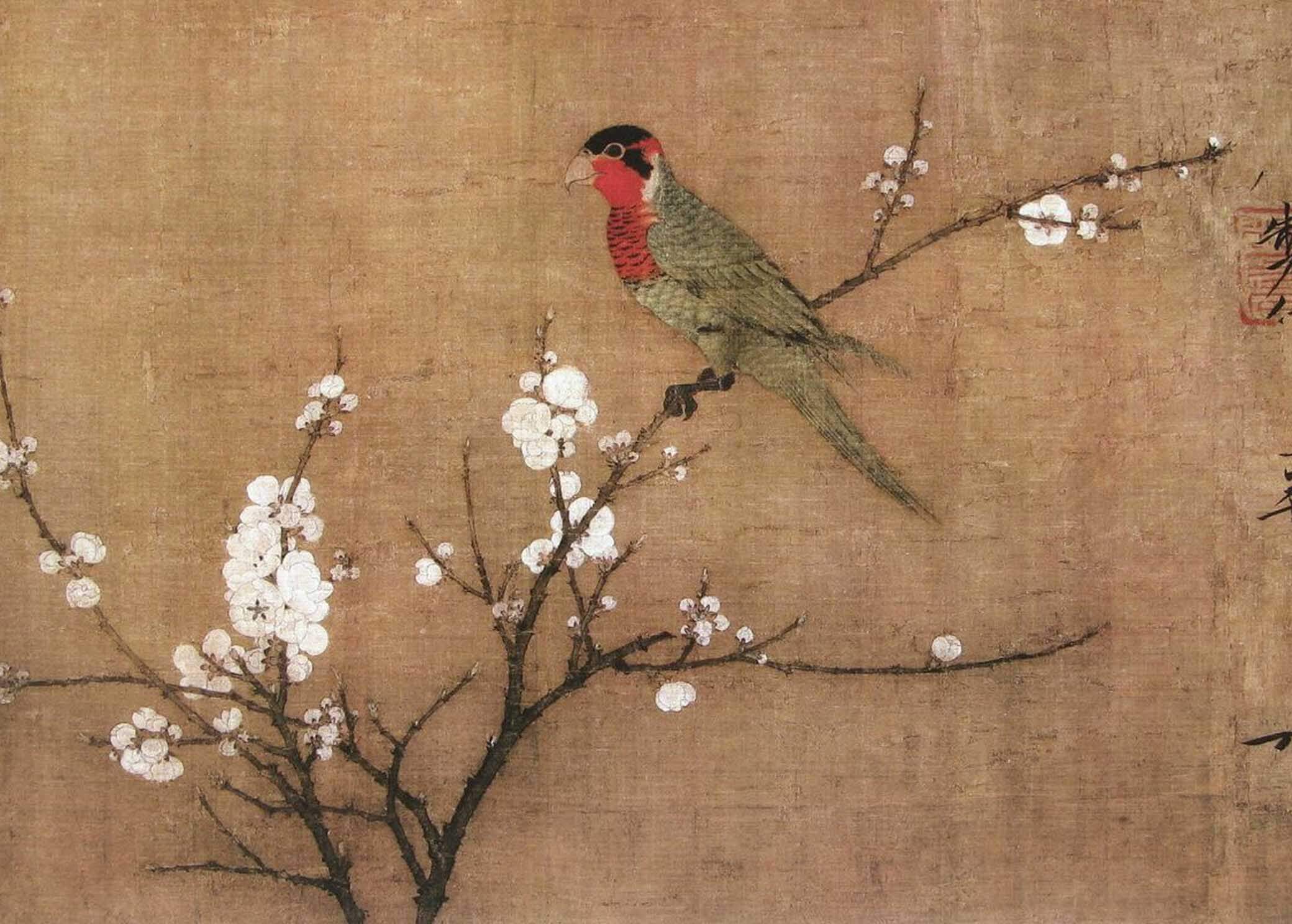
His paintings, deeply rooted in Daoist philosophy, often depicted flora and fauna, symbolizing the harmony between man and nature. One of his most famous works, Auspicious Cranes, exemplifies this connection.

The crane, which symbolizes longevity and auspiciousness, is also a link between divinity and humanity in Taoism.
A particularly striking example of Hui Zong’s artistic self-expression is a scroll painting on silk. The artwork features Hui Zong himself playing zither music. This piece captures not only his artistic prowess but also his spiritual depth, highlighting his dedication to the arts as a reflection of his inner life.

147.2 x 51.3 cm. The Palace Museum, Beijing.
Emperor Huizong, depicted in Daoist robes playing a zither.
Emperor Hui Zong and His Artists’ Circle
Hui Zong surrounded himself with some of the most brilliant artists, poets, and scholars of his time. Imagine this: the highest political figure in your country actively engaging with scholars and artists. Under his patronage, the Imperial Academy of Painting (翰林图画院, Hanlin Tuhua Yuan) was founded, an institution of immense significance in Chinese history.
The influence of this academy is still visible today. For example, I have a set of four bamboo scroll paintings in my bedroom, proudly signed by the artist as “Member of the Hanlin Academy“. The “artist” actually was none other than the important General Tso [ Zuo Zongtang 左宗棠], a statesman and military leader of the late Qing dynasty. He had crushed the Dungan Revolt and recaptured Xinjiang Province from rebel forces. This speaks to the enduring prestige of Hui Zong’s Han Lin-Academy initiative.

Hui Zong’s reign coincided with an extraordinary period in Chinese art associated with influential painters and calligraphers such as Mi Fu (米芾) and Li Gonglin (李公麟). Together, they formed an elite artistic circle, united by a shared vision: to use art as a medium for reflecting and preserving the aesthetic and philosophical values of the Song Dynasty.
Emperor Hui Zong’s Enduring Legacy
Hui Zong’s deep passion for art profoundly shaped the cultural landscape of his time. His commitment to promoting painting and calligraphy set new standards for artistic excellence, elevating the perception of art across all social classes. Under his influence, artworks were no longer seen as mere decorations but as vessels for spiritual depth and cultural identity.
His example inspired many subsequent emperors, solidifying the idea that leaders should be well-versed in calligraphy and art. This tradition continued for centuries. Even Mao Zedong, often likened to a modern “emperor,” was an exceptional calligrapher.

Interestingly, this reverence for calligraphy extended beyond politics. For instance, many Yakuza ojabun (bosses of the Japanese Mafia), seeking to present themselves as honorable warriors, also cultivated their skills in calligraphy, a practice symbolizing discipline and cultural sophistication.
A Personal Anecdote: Meeting the Chinese Emperor
Originally, I considered using the subtitle “When I Met the Chinese Emperor” for this article. While it might seem attention-grabbing or even misleading, it isn’t entirely inaccurate! Here’s why:
Most readers are likely familiar with Bernardo Bertolucci’s acclaimed 1987 film, The Last Emperor. The film portrays the life of Emperor Pu Yi in three phases, with different actors playing him at each stage. Tijger Tsou portrayed Pu Yi in his youth.
Years ago, during one of my earliest cultural projects, I invited Tijger Tsou from the United States to Vienna. He was the guest of honour at a large raffle at the cultural event I organised. In this small way, I “met the last emperor” through the actor who brought Emperor Pu Yi’s youthful years to life. 😊

footnotes 1. part
[1] Emperor Huizong of Song (宋徽宗 7 June 1082 – 4 June 1135), personal name Zhao Ji ((趙佶)), was the eighth emperor of the Song dynasty of China and the penultimate emperor of the Northern Song dynasty.
[2] In Chinese thought, Heaven and Earth are interconnected forces emphasizing harmony and moral responsibility, with rulers seen as mediators maintaining cosmic balance. In contrast, Western thinking often separates the divine from the earthly, focusing on individual agency and a hierarchical relationship between God and humanity.
[3] it’s often noted in historical records and anecdotes that during Emperor Hui Zong’s reign, the Yellow River remained clean for an extended period. A sign of his alignment with the Mandate of Heaven, symbolizing harmony between the ruler’s virtue, nature, and society.
Cleanliness in the Yellow River was more than an environmental observation—it was a divine omen reflecting the emperor’s ability to maintain cosmic balance. While Hui Zong faced significant political challenges, such auspicious natural phenomena reinforced his cultural legacy, emphasizing his contributions to the arts and his philosophical engagement with Daoism and Confucianism.
footnotes 2. part
[4] In 1126, when the Jurchen-led Jin dynasty invaded the Song dynasty during the Jin–Song Wars, Emperor Huizong abdicated and passed on his throne to his eldest son, Zhao Huan while Huizong assumed the honorary title of Taishang Huang (or “Retired Emperor”).
[5] Jurchen (Manchu: ᠵᡠᡧᡝᠨ Jušen, IPA: [dʒuʃən]; Chinese: 女真, Nǚzhēn [nỳ. ʈʂə́n]) is a term which collectively describes a number of East Asian Tungusic-speaking people. They lived in northeastern China, also known as Manchuria, before the 18th century. The Jurchens were renamed Manchus in 1635 by Hong Taiji.
[6] Emperor Hui Zong Zhao Ji’s “Thousand Character Classic in Cursive Script” (赵佶草书千字文) scroll is a notable calligraphy purportedly crafted in the fourth year of the Xuanhe era of the Song dynasty (1122 AD). The scroll measures 31.5 centimeters in height and 1172 centimeters in width, crafted on an exclusively made palace paper known as “Yunlong Jinjian” (云龙金笺纸), distinguished by hand-drawn cloud and dragon patterns with gold powder on white hemp paper. The scroll stretches over 10 feet in length without any seams.
Related articles: not_amused-with-the-emperor I mu-qi-6-persimmons I The Aesthetics of Imperfection
Explore Art & Writing
Art Portfolio → Featured Artworks → Arts & Philosophy Journal → All Articles
Explore Asian Art Essays for writing on Chinese painting, calligraphy, aesthetics and art history.
Available Artworks
Original works are available on FriedrichZettl.com and Saatchi Art


Leave a Reply