
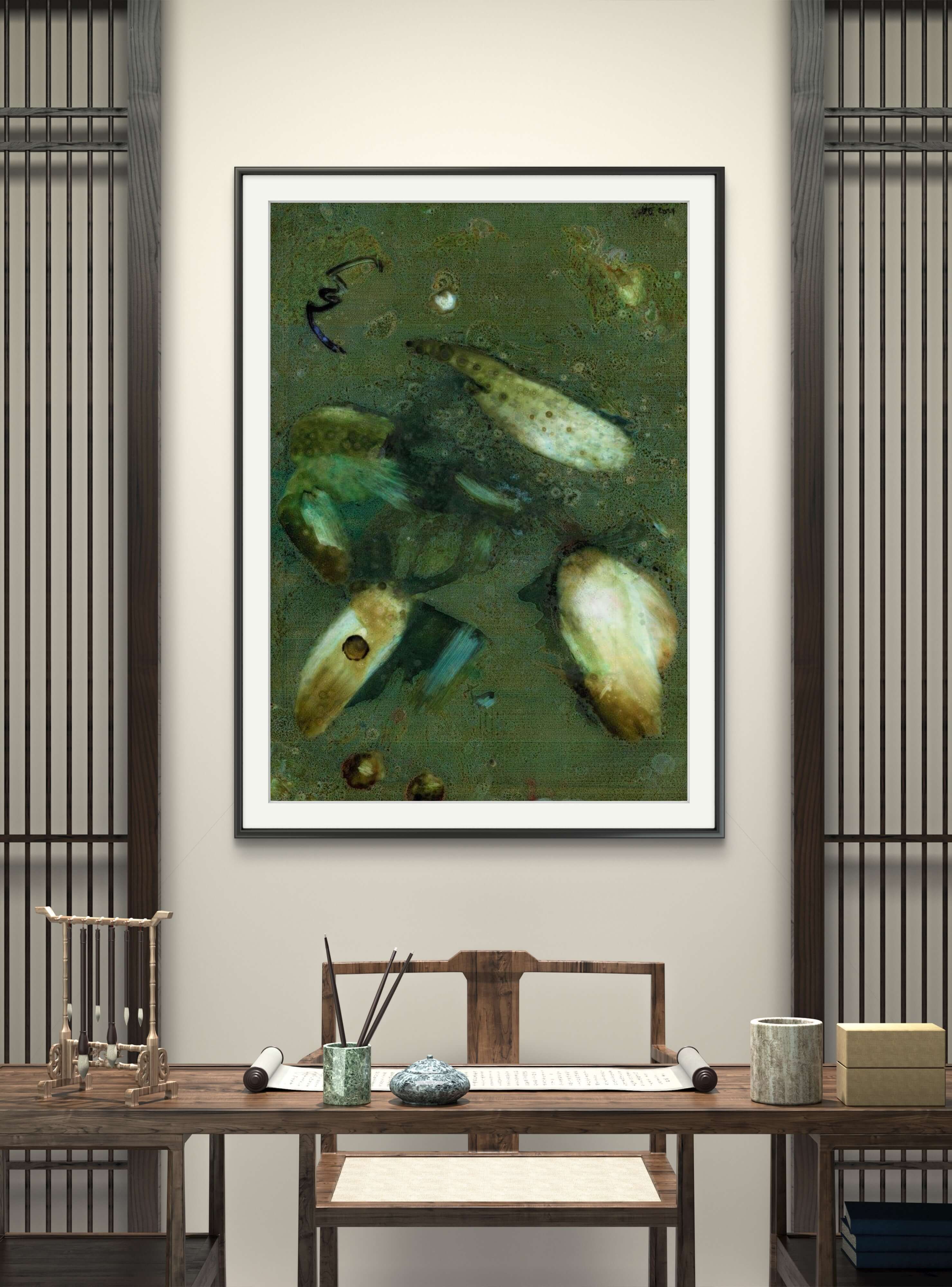
Daoist Influences and the Pursuit of Nothingness.
Daoist Elements in My Paintings: Today’s article is divided into two interconnected parts. The sequence of images, all recent works, illustrates my approach to the concept of Nothingness. I aim to reflect on and deepen my understanding of this profound topic through these works.
Representing Nothingness visually poses a philosophical challenge. How can one depict Nothingness while incorporating elements from Zen, Daoism, and quantum physics?
Recently, Donald S. Yarab, a blogger I mentioned in my last article on Nothingness, published a supplementary piece on the subject. I highly recommend it to anyone interested: Exploring Consciousness in the Block Universe
My last article on this was: What is Reality? What is Nothingness?
Part 1: Delving into Daoism
I have extensively covered the topic of opposites in Daoism in previous articles. I therefore need not go into this further. (Daoist Talks I – X). Recently, I have expanded on this theme, focusing on pairs such as calm :: movement, silence :: noise, and meditative :: agitated…..

Emptiness in Art
In many of my works, emptiness (unpainted areas) is a central theme, with over 90% of the sheet often left blank. The few lines that remain must convey significant meaning.
What contrasts with a picture dominated by “meaningless” emptiness? A picture filled with “meaningless” black. Here, the remaining white space serves the same function as the black in the first image.

When we adapt this idea to a more visually pleasing image, such as an autumn scene, we get an image that appears “empty” despite being fully painted. A profoundly Daoist approach, which does not forget the aspect of transience and poetry inherent in Daoist images.

Music and Minimalism
As mentioned before, my engagement with music plays a role in my artwork. This time, instead of focusing on a genre or song, I use a bar from a piece of music to highlight a minimalist approach.

Moving Beyond Attachment
The final image in the first part explores the concept of detachment in a Buddhist sense [1]. While nothing is concrete, there is an organic, real quality to it. This work attempts to give form and body to emptiness.

Part 2: Additional Thoughts on Quantum Physics
The first part was straightforward, as it covered well-known concepts. In this second part, we will explore some aspects of quantum physics too.
This summer, I spent a remarkable amount of time engaging in what could be seen as destructive activities—though only in my paintings. To provide some context, let’s discuss Glenn Gould [2], arguably the most significant interpreter of Bach. I’ve listened to his Goldberg Variations over 100 times, and they remain as thrilling as ever.
“After thoroughly analyzing and researching Bach’s music, Gould reassembled it in his unique way. His interpretations were often unusual and provocative, yet always deeply thought-out and full of musical insights.” [3]
This approach has influenced me for many years. Now, as quantum physics and AI increasingly redefine our reality, this topic has become particularly fascinating for me. Consider my humble attempts more as studies, as the subject is too vast to be transformed into high-quality art in a short time. As always, our focus is on the underlying ideas.
Painting Nothingness
Let’s start with a simple exercise—a study. This piece aims to summarize what we learned about Nothingness in quantum physics last time. One key takeaway is that everything around us is Nothingness, and it only becomes reality when we make a decision or a result emerges.
The following image is abstract, and most viewers might see nothing but a blur of lines. However, if I mention that a young lady stands in the middle left, a new perception of the image emerges.
The young lady exists in her world, her reality. She is surrounded by a colossal Nothingness, which is the absolute fullness of possibilities, becoming reality only through perception or action. Proximity and distance are as inherent as rock and mist.


BTW: When painting, I don’t just start randomly; I follow specific ideas that often reveal themselves in the details. Classic portrait elements or hints of landscape scenes frequently appear.

Einstein’s “Spooky” Quantum Physics: An Artistic Exploration
Many people know that Albert Einstein was not entirely negative about quantum physics, but he did describe it as “spooky.” [4] This description is quite accurate when we approach quantum physics with our traditional knowledge. The abstract image below is somewhat spooky and not entirely serious, but it is dedicated to some intriguing facts from quantum physics.
For instance, it points to the simultaneous existence of all forms of appearance. This includes the phenomenon where spatial extension takes on a new meaning, allowing things that are close and distant to exist side by side.

Bringing It All Together
In this final study, we aim to combine some of the approaches discussed earlier. The Zen aspect is evident through the powerful brushstrokes in the upper part, while the Dao aspect is reflected in the interplay of yin and yang, the opposites.
Entanglement has always been a central theme in Asian philosophies, but it has only been confirmed by quantum physics. In our specific case, it means that every place on the picture, indeed every point, is connected to everything, and resonates with everything. Ideally, we can take any point in the picture and check its resonance with other areas, including the lights.
This brings us back to one of the main principles in Chinese xieyi painting, which is Daoist: qi yun sheng dong (气韵生动). It is usually translated as “spiritual resonance,” but literally, it means: “Bring the two forces (yin and yang) into harmony and thereby create life..”

The pink line could be high in the skies, even in space – and at the same time deep in the sea.

Latest scientific articles on this topic:
The rapid progress we are currently making in our understanding of the universe, our concept of reality, and the like is shown by five articles that have appeared in the last few days only:
Big Bang theory of how the universe began is refuted by Webb telescope study https://www.earth.com/news/new-observations-disprove-big-bang-theory-universe-began-tired-light-theory/
Open problem in quantum entanglement theory solved after nearly 25 years https://physicsworld.com/a/open-problem-in-quantum-entanglement-theory-solved-after-nearly-25-years/
Our reality seems to be compatible with a quantum multiverse: https://www.newscientist.com/article/2447863-our-reality-seems-to-be-compatible-with-a-quantum-multiverse/
Quantum computers teleport and store energy harvested from empty space: https://www.newscientist.com/article/2448037-quantum-computers-teleport-and-store-energy-harvested-from-empty-space/
Experiments provide evidence of negative time (Experimente liefern Hinweise auf negative Zeit) https://www.spektrum.de/news/kann-zeit-auch-negativ-sein-ja-sagen-neue-quantenexperimente/2232040
extra:
An absolute gem that shows Glenn Gould at work and demonstrates well what was discussed above:
footnotes:
[1] For Buddhists, non-attachment or detachment (viraaga) does not mean a withdrawal from striving for truth but a movement towards seeing the true nature of things more clearly.
[2] Glenn Gould’s unique interpretations of classical music, particularly the works of Johann Sebastian Bach, often sparked controversy and debate among music critics and audiences. His unorthodox playing style, unconventional tempos, and idiosyncratic phrasing challenged traditional notions of musical performance.
[3] Info by Gemini.
[4] Despite his reservations, Einstein’s work on quantum physics was groundbreaking. One of his best-known statements is that God “plays dice with the universe.”
Shops: FriedrichZettl.com – Saatchiart . Media: Blog – Youtube – Instagram


Leave a Reply