
Exploring Music, Rhythm and Sound in Visual Art
Can we hear a painting? The idea of paintings creating music has captivated artists for centuries. While some might scoff at the notion, for those open to artistic exploration, the question becomes: how can we translate the emotions and sounds of music into visual art? And what would be even more exciting: can you create images that have a musical effect on the viewer?
The more interesting question, however, is not whether images can technically be converted into sound, but whether a painting can evoke something comparable to musical experience: rhythm, tension, silence, repetition or resonance.
Music and Painting Across Art History
Historical evidence suggests this pursuit stretches back millennia. For example, certain rock paintings seem to embody the essence of music and dance [1].

Throughout art history, countless painters have tackled this challenge. Recently, I was struck by the surrealist interpretations of Mozart’s music by Roberto Matta in a Vienna exhibition [2].

Personal Experiments: From Opera to Ambient
My ongoing project, “The Magic Sea,” explores the interplay between music and visual art. Richard Wagner’s concept of the Gesamtkunstwerk – a synthesis of music, poetry, drama and visual art – has fascinated me for many years. This initial effort focused on capturing the mood and world at the bottom of the Rhine, where the Rhine daughters guard the gold.

A subsequent work titled “Overture” delves deeper into the concept of translating sound into image. Here the audience imagines that they are sitting in an opera house and the tension is rising as the conductor raises his baton and the curtain gradually rises.

Challenges and New Directions
Further explorations within the “Ring” cycle proved the difficulty of expressing music through an expressionist style, especially with Wagner’s complex compositions.

I have varied my attempt a little and tried to capture the essence of Bruckner’s 9th Symphony. While the green tones capture a sense of Bruckner’s music’s complexity, power and compactness, the work remains largely descriptive.

Finding Harmony Through Reduction
I think I’ve already mentioned that I tried to pay attention to the (time) space between the tones as part of mindfulness exercises. Certain traditions of Japanese music, particularly Shakuhachi, offered a more suitable source of inspiration because of their emphasis on individual tones, breath and silence. Shakuhachi flute music [4] exemplifies this attempt quite well. (→music sample).
In Shakuhachi music, silence is not simply the absence of sound. The intervals between tones become part of the musical experience. This idea of active emptiness has obvious parallels with the unpainted space that plays such an important role in ink painting.

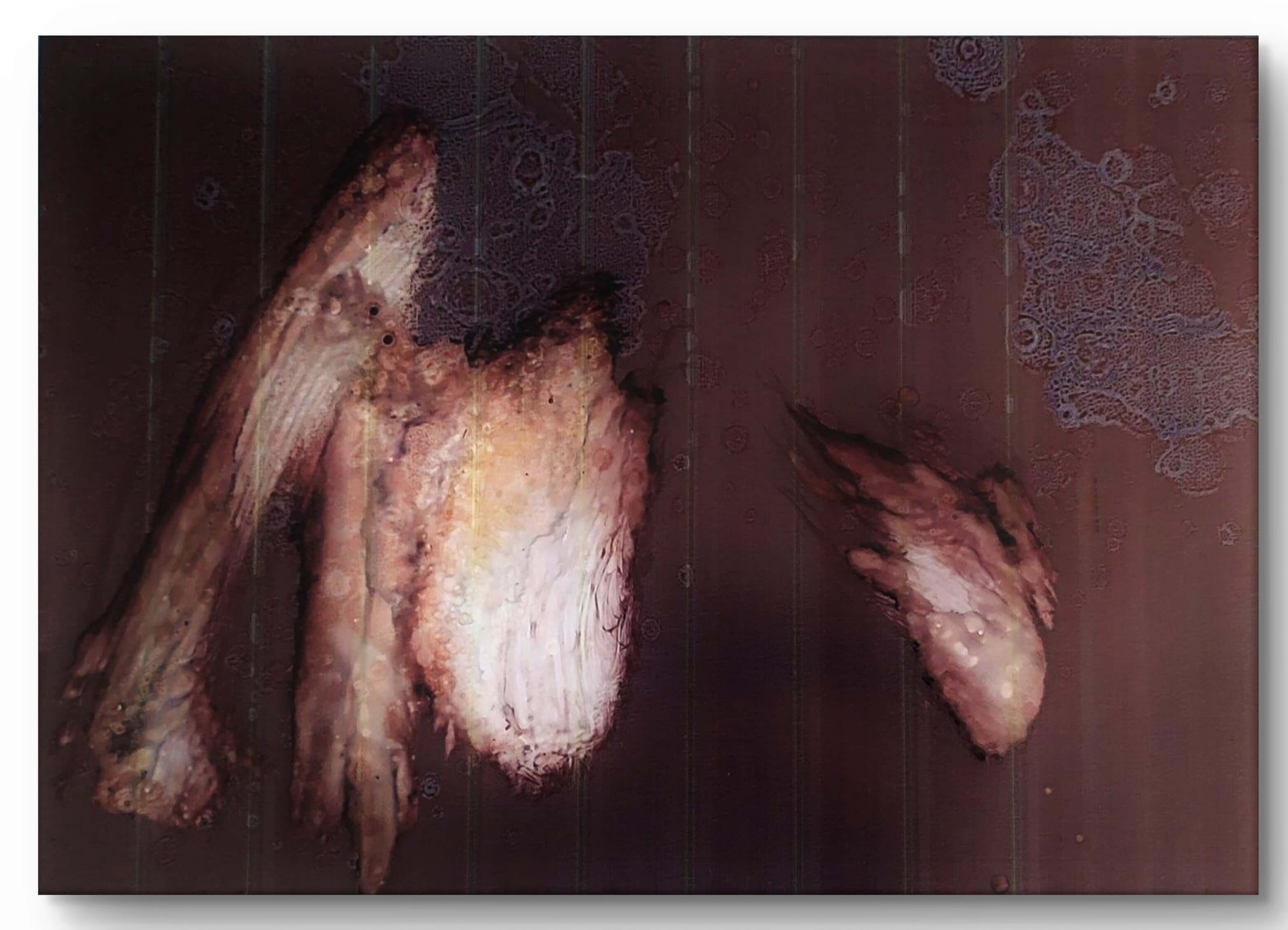
To return to Western music, I studied Bach’s “Music Book for Anna Magdalena Bach” and captured the childlike innocence of this music in a piece that could easily serve as an album cover. Bach’s perfect harmony, sparkling tones, and depth in simplicity have not lost their charm to this day.

Embracing Complexity and Modernity
Taking this approach further, I tackled the work of Arvo Pärt, particularly “Spiegel im Spiegel”, his most frequently played work. The aim was to capture both the content and form of the music within the painting. Pärt’s use of reduction and repetition interested me particularly because musical simplicity can create an intensity comparable to the use of empty space and restrained gesture in painting.

While some sounds seem to me to be floating, I see the sounds of the xylophone as jumping. Only when they are in the air do they tell their story.

In a previous article, “Emptiness, Space, and Depth,” I introduced similar monochrome works from this series. Today, I revisit a piece inspired by Brian Eno, a contemporary musician who frequently influences my work. This final painting attempts to capture the sound of ambient music during a live performance (My Life in the Bush of Ghosts by Brian Eno and David Byrne).

The Experiment Continues
I do not expect a painting to reproduce music. What interests me is whether visual elements – rhythm, repetition, gesture, color and empty space – can evoke something comparable to the experience of listening. Music unfolds in time; painting appears to exist in space. Somewhere between the two, however, there may be a shared language of movement, tension and silence.
For me, this remains an open experiment.
footnotes
[1] A section of the Cederberg rock painting was digitally enhanced to enhance the colors red-ochre. © Neil Rusch. This processing helped to emphasize the character of the music.
[2] Roberto Matta exhibition at the Bank Austria Forum, February 24, 2024 – June 2, 2024
[3] Wagner’s idea of the Gesamtkunstwerk (total work of art) has fascinated me since my youth and still influences a large part of my work today. The same applies to his method of depicting people and objects in his operas in themes.
[4] The primary genres of shakuhachi music are: Honkyoku (traditional, solo) Sankyoku (ensemble, with koto and shamisen) Shinkyoku (new music composed for shakuhachi and koto, commonly post-Meiji period compositions influenced by Western music)
Related articles: and-the-beat-goes-on I the last rag I ophelia_painting-2022
Explore Art & Writing
Art Portfolio → Featured Artworks → Arts & Philosophy Journal → All Articles
Explore Asian Art Essays for writing on Chinese painting, calligraphy, aesthetics and art history.
Available Artworks
Original works are available on FriedrichZettl.com and Saatchi Art


Leave a Reply