Bada Shanren & the Daoist Concept of Ziran (Naturalness)

Naturalness (自然) in Painting

We tend to assume that “natural” means much the same thing to everyone. A friend’s young daughter taught me otherwise. She loved strawberry yoghurt and knew exactly which supermarket brand she preferred. Her mother bought fresh strawberries at a farmers’ market and made some at home. The girl tasted it sceptically and refused any more. Why? “It doesn’t taste natural.” Her favourite brand was advertised as the one with the natural taste.

That small story makes a useful starting point for thinking about naturalness in painting. A familiar manufactured flavour can come to seem more natural than fresh fruit. In looking at a painting, too, we may mistake an effect we have learned to expect for something unforced. Here I mean the difference between naturalness and contrivance, rather than simply between natural and artificial materials. [2]

Naturalness in the Daoist Sense

Ziran (自然) is often translated as “naturalness” or “spontaneity”; more literally, it means “self-so”. In Daoist thought, it points to what is so of itself, rather than being forced to conform to an imposed pattern. The related concept wuwei concerns action without coercive striving; the two belong together, but they are not interchangeable. [3]

For a painter, this raises a practical question: how can a mark feel unforced without being careless? Naturalness is not a substitute for skill. A brushstroke may look immediate precisely because long practice has made the movement possible.

Rather than attempt a complete account of the subject, I want to look closely at fish paintings by Bada Shanren, also known as Zhu Da (1626–1705). [1] His life included many years as a Buddhist monk, so calling him simply a “Daoist painter” would be too narrow. I am approaching his brushwork through the Daoist idea of ziran, as a way of looking rather than a claim to explain his entire art.

The Appearance of Simplicity

I once looked at paintings like these and thought: “A few brushstrokes—I could do that too.” Trying to copy one soon changes the picture. The difficulty lies in what each stroke accomplishes: the curve of a belly, the weight of a body or the movement of a tail. As with Zha Shibiao’s apparently simple painting, economy becomes more demanding the longer one looks.

Brushstrokes and Composition

The strokes do more than outline a fish. Their changes of pressure and ink give the body weight and direction. The untouched paper becomes a space through which it moves. I read it as a fish in water, although there are no waves, plants or bubbles to tell me so.

The composition matters just as much. My diagram below follows the eye’s movement around the fish and the open centre. I understand that circulating movement in terms of qi, the vitality of the picture. The red circle is my analytical overlay, recalling an ensō to me; it is not a circle painted by Bada Shanren, nor evidence that he intended that Japanese Zen form. Much of the paper remains untouched, yet this open area holds the composition together.

My Own Experiments

I chose fish partly because I have been working with them myself. The encounter between a Chinese master’s economy and my own more abstract painting gives me something concrete to test.

I have practised copying old masters, but imitation is not the aim here. I want to explore ziran in a contemporary painterly language, several centuries after Bada Shanren. The following collages contain details from paintings and studies. Some retain a recognisable fish; others are attempts to convey what I call “fishness”. [4]

Levels of Abstraction

In the first group, the fish remain recognisable in shape and colour. Mouth and tail are still fairly easy to locate. In my Magic Sea paintings, such forms act almost as extras: they animate the water and give a viewer a foothold in an otherwise abstract composition.

A step further, the fish lose their clear outlines. They begin to merge with their surroundings, so that the movement of the water matters as much as the individual creature.

The darker passages in the collage below explore what I associate with yin: obscurity, depth, mud and submerged life.

In the next group, a fish may be scarcely more than a movement of the brush. These strokes help carry the picture’s energy. Within the larger painting, I still read them as fish, although the isolated detail may suggest something else entirely.
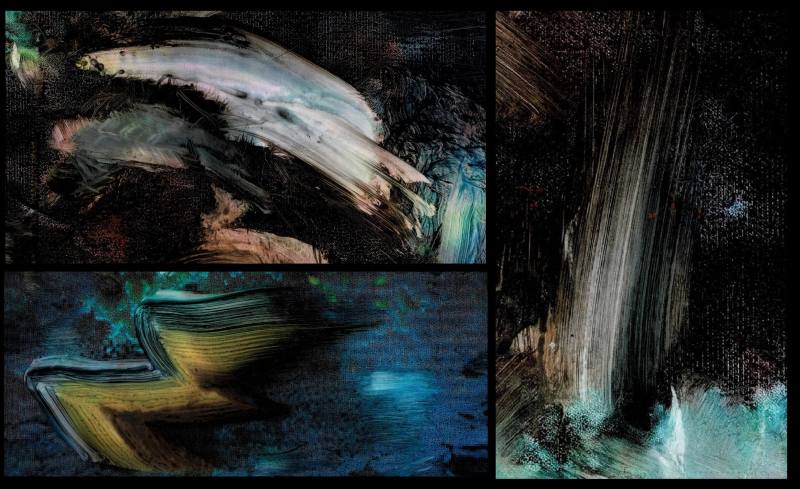
One Step Further

Have these experiments taken me too far from the naturalness I admire in Bada Shanren? I do not think the question can be settled by measuring resemblance alone.

A passage in chapter two of the Zhuangzi returns to beginnings, what precedes them, being and nonbeing, before questioning whether the speaker has really said anything at all. [6] I read this as a challenge to the confidence with which we draw distinctions. It is not a set of instructions for painting, but it gives me a way to think about what happens when an image resists a single name.

That uncertainty interests me in the painting below. [5] One viewer may see a fish: head, body and tail. Another may see a cloud and ask what a fish could be doing in the sky. The marks remain the same; the reading changes.

“Fishness”

When I insist that the image is a fish, or is not a fish, I risk closing down that encounter too quickly. Zhuangzi’s questioning encourages me to loosen my grip on the label. I do not take this to mean that every distinction is useless, or that Daoism and Buddhism offer an identical teaching. It is a painter’s invitation to look again.

“Fishness” is my working word for the presence I am trying to convey, rather than a technical Daoist term or a hidden essence I can prove. The image has no interest in the name I give it. A few marks may suggest a living movement before they resolve into a creature. That is where naturalness becomes interesting to me: can the painting remain convincing while leaving the question open?

The other essays in this series are gathered in Daoist Talks.


Footnotes

[1] Bada Shanren (八大山人), born Zhu Da (朱耷), lived from 1626 to 1705. For his Ming imperial background, Buddhist monastic life and later career, see the Smithsonian’s Enigmas: The Art of Bada Shanren.

[2] “Contrivance” is used here in the ordinary sense of an affected or deliberately manufactured effect, not as a single canonical Chinese opposite of ziran.

[3] For ziran and its relationship to wuwei, see Alan Chan, Laozi, section 7: Naturalness and Nonaction, in the Stanford Encyclopedia of Philosophy. The application to painting is my own.

[4] I use “fishness” as an exploratory description of my paintings, not as an established translation of ziran or a claim that fish possess a permanent essence beyond their forms.

[5] The fish-like form was made in one continuous brush movement: the tip did not leave the paper, and I made no subsequent changes to that form. The image is a detail from a work in the Magic Sea project.

[6] See the Zhuangzi, chapter 2, The Adjustment of Controversies, with James Legge’s translation. The passage is paraphrased above rather than presented as a verbatim quotation.

Related Articles

Zha Shibiao: A Simple Painting and Yet a Treasure · The Essence of Chinese Painting (III) · The Magic Sea

Explore Art & Writing

Art Portfolio → Featured Artworks → Arts & Philosophy Journal → All Articles

Explore Asian Art Essays for writing on Chinese painting, calligraphy, aesthetics and art history.

Available Artworks

Original works are available on FriedrichZettl.com and Saatchi Art


Posted

in

by

Comments

62 responses to “Bada Shanren & the Daoist Concept of Ziran (Naturalness)”

  1. diespringerin avatar

    🙏🪷

  2. Zettl Fine Arts avatar

    Vielen Dank! 🙏 Schoene Pfingstfeiertage!

  3. Traum(A)Kinder avatar

    Danke! Da wird etwas tief in meinem Inneren berührt.
    Vermutlich können Bilder etwas ausdrücken, was mit Worten nicht geht.
    Das Denken in Gegensätzen widerstrebt mir oft, aber meine Umwelt versteht es nicht.

    1. Zettl Fine Arts avatar

      Danke vielmals! Ja, mit guter Malerei ist es wie mit guter Musik, beide können in uns Türen zu neue Welten öffnen, wenn wir uns darauf einlassen. Mit unserem polarisierenden Denken habe wir schon viel Schaden angerichtet, bei anderen und bei uns selbst.

  4. Mike U. avatar

    While reading this fascinating discourse, I sat shaking my head in wonder and awe at your illustrations. You’re a veritable treasure trove of knowledge, Friedrich, and your generosity in sharing that knowledge is a wonderful thing. It’s incredibly captivating. I’ll be thinking about “fishness” for awhile now, thanks to you! 🙂

    1. Zettl Fine Arts avatar

      Thank you so much, Mike for your kind words! Yes, I think if we understand “fishness” we’ll all get along better. The older you get, the easier it is for us not to overestimate scales and caudal fins.

  5. swabby429 avatar

    You artistically present food for contemplation. The fish does not trouble itself with being a fish, nor does a cat worry about being a cat. They simply are. We humans need to be nudged about how to be human.

    1. Zettl Fine Arts avatar

      Thanks very much! Obviously, it’s human nature that we can’t just be who we are or give others their freedom. But just being aware of it can make life easier.

      1. swabby429 avatar

        This is our conundrum.

  6. babsje avatar

    Your post is a masterclass in several ways, and I learned so much. Thank you for your generous sharing.

    1. Zettl Fine Arts avatar

      You are very kind ☺️! Thank you very much 🙏 I just watched your masterclass hawks: gorgeous 🥰

      1. babsje avatar

        You’re welcome and thanks for the kind words. 🙏

  7. julianeus avatar

    COOL, VERY INTERESTING THINGS!! .🎈✨🌈✌😊👍

    1. Zettl Fine Arts avatar

      Thank you so much 🙏😊☀️🍸

  8. rabirius avatar

    I noticed it quite often that things have different meanings for different people. You can notice it quite often between people from different cultures where sometimes even the concept behind a word from one culture doesn’t exist in the other.
    The same exists with people from the same culture as well, as people experience the world around them differently.
    However, if a yoghurt is advertised as tasting natural I wouldn’t really believe it. 🙂

    And, certainly, your fishes look fantastic!

    1. Zettl Fine Arts avatar

      Thank you very much 🙏 Right, different cultures – different jokes 🙂 All is fine as long as we laugh about it.

  9. The Sicilian Storyteller avatar

    “Fishness” is glorious!

    1. Zettl Fine Arts avatar

      Thank you very much 😊🙏

      1. The Sicilian Storyteller avatar

        My pleasure, Fred! I wonder if you realize that there seems to be a problem with your site. The last few posting, when I tried to “LIKE” the post, your page just kept loading and the “LIKE” option never appeared. Leaving a comment is no problem; leaving a “LIKE” is impossible. I just wanted you to be aware.

  10. annieasksyou avatar

    Fascinating! Once again you help me peer into areas I could never otherwise access—or even ponder.

    1. Zettl Fine Arts avatar

      Thank you very much, Annie! Your kind words make me happy 😊

  11. Dana at Regular Girl Devos avatar

    Beautiful, informative, and thought provoking. Always a pleasure reading your posts, thank you!

    1. Zettl Fine Arts avatar

      I thank YOU! I am happy you like it! Enjoy a great weekend! 🙂

  12. Emma Cownie avatar

    Fascinating. I was particularly taken with the composition with “nothing” in the centre. I have painted fish, years ago, and was disappointed with the results. I appreciate now that I had neglected their “fishness”. Your fish very the essenence of fishness. I think I will have to read this post several times to truly appreciate what you are writing about.

    1. Zettl Fine Arts avatar

      Thank you so much for your kind words 🙏 Yes, it seems so easy, doesn’t it?! But it is not even easy to describe what it is that it makes those paintings so meaningful as we have to experience it. And this experience has to be made out of our spectrum we clinch to. Anyway it is a rewarding trip, I think. 🌹🍸🙏

  13. JMN avatar

    Lovely essay, Zettl. Eminently fishy — in a good way, of course! You are painter, scholar, linguist, sinophile, philosopher, mystic and sojourner of the ethereal all in one. Cheers and regards.

    1. Zettl Fine Arts avatar

      Thank you very much 🙏 I wished that was true but I will try my best to improve 😎 All my best wishes and thanks 🌹🍸

  14. Rosaliene Bacchus avatar

    What a fascinating and enlightening study of your work in progress!

    1. Zettl Fine Arts avatar

      Thank you so much🌹 It’s probably a never ending road – but there are enough flowers alongside 😊☀️

  15. Ashley avatar

    In your last painting, I could say that I feel like a “fish out of water” because the supposed fish appears to be in the sky, however, in some of the seas there are subterranean pools which look just like your painting, seas below the seas! Then I wonder if you’ve been deep-see diving! A really thoughtful and thought provoking post. Marvellous! 🙋‍♂️

    1. Zettl Fine Arts avatar

      Thank you very much, Ashley 🙏 I tried deep-sea-diving again this March – and did some snorkeling. Now I know that I am an old man 😊 But the little I did was very useful and left a deep impression. Especially since I love to explore new territories. Thanks again 🌼🙏🍸

      1. Ashley avatar

        I imagine that “seeing” under water is very different from “seeing” on land! I doubt if I will ever go deep-SEE-diving! 🤿

      2. Zettl Fine Arts avatar

        Yes, it’s a different kind of “seeing” but most of all a different kind of overall feeling and perception. And a wonderworld of colours.

      3. Zettl Fine Arts avatar

        Sorry, too late I realized your 🤣 Deep-see doesn’t work well on my small cell-phone 😀

  16. Dominik Alexander avatar

    On your term “fishness” I automatically thought of Platon’s ideas. In German, I would say “Fischheit”, the essence of a fish (has an oval body, swims in water). The idea of the fish is all existing fish concluded into one or reduced to what all the fish have in common. Saying that, I wonder, if Platon’s / Socrates’s ideas do have connections with daoism?

    1. Zettl Fine Arts avatar

      Thank you! You are absolutely right with Platon. What I find extremely interesting is the fact that Platon and Laozi lived at the same time 😊 I wonder if you are familiar with the German term “Sesselheit” by Husserl. He comes very close to the Daoist concept. But of course Platon, Socrates or Husserl follow Western Philosophy and, as I see it, only deal with parts whereas Laozi or Zhuangzi go much deeper.

      1. Dominik Alexander avatar

        I’ve had a whole semester-long seminar about grey tables (“Tischheit”) and burgunder chair (“Stuhlheit”). I’m not sure, if Husserl was part of it. I think, it was only about ancient philosophy but it would have been interesting to compare European ph. with the Far-Eastern one. Unfortunately, German universities are highly euro-centristic. But, I will take the names you mentioned to do my own research. Thanks for the post, the names and, of course, for all the fish!

  17. Edith avatar

    Lieber Friedrich,starke Kost zu Pfingsten. Neulich sah ich einen Fisch am Himmel,nicht als Wolke,nein, es war ein Ballon in Fischform.
    Die Natur ist und bleibt uns eine großes Rätsel – immer wieder. Wir Menschen bedienen uns gern an ihr, und wenn es nur auch eine Nachbildung eines Fisches ist, das Auge sieht es erst einmal als Fisch. Da kommt kein Gedanke auf, dass der doch ins Wasser gehört, ja gut, es gibt ja auch fliegende Fische, lächel…
    Der Mensch schöpft aus der Natur. Nur gut, dass wir alle mit anderen Augen schöpfen, sonst wäre die Welt nur einseitig belastet..
    Und, egal wie du die Fische malst, sie sind erkennbar als Fische. Da hilft kein Schlamm,kein Schleim, die Fische sind erkennbar. Alles drum herum ist in meinen Augen zweitrangig. Das Detail wird dann umspielt von deinen Farben, welches frei für jegliche Interpretation ist.
    Danke für deinen so tollen Beitrag, der sämtliche Hirnwindungen angeregt hat, zumindest meine… Die Philosophie dahinter geht sooo tief…
    Herzlichst, wie immer,
    Edith

    1. Zettl Fine Arts avatar

      Vielen herzlichen Dank! Es freut mich, dass Du mit dem Artikel etwas anfangen kannst. Ja, diese Philosophie geht seeehr tief, in einem Beitrag kann ich immer nur ein, zwei Aspekte anschneiden. Frohe Pfingsten! Ich hoffe, Du kannst die Natur geniessen! LG f

  18. Edith avatar
    Edith

    Oh ja, unser Grundstück misst 4.500 Quadratmeter, Natur pur, ohne Gifte und dergleichen. Ein Paradies zum Auftanken. Und vielleicht sehe ich heute einen Wolkenfisch, der dann ganz sicher von dir kommt, lächel..

    1. Zettl Fine Arts avatar

      Wow! Herrlich! Klingt aber auch nach Arbeit 🙂 Fisch ist unterwegs. Bleibt hoffentlich nicht im Pfingstverkehrs-Stau haengen 🙂

      1. Edith avatar
        Edith

        Er ist daaa, lächel. Ich schicke dir meinen Rosenduft aus dem Garten auf vielen Sonnenstrahlen…

      2. Edith avatar
        Edith

        Herz

  19. luisa zambrotta avatar

    I found this post really fascinating and learned a few things that were unfamiliar to me

  20. Cindy Georgakas avatar

    I love your philosophical art lesson and yin yang of these wonderful pieces Fredrick!
    THAKS for the morning lesson!
    💗
    “Like any other phenomenon or object in the universe. it doesn’t matter to this “fish” whether it is seen as such or not. He’s just there. Only we, in our separating, evaluating, and excluding, see it as IS or IS NOT. So it IS fish and is NOT fish at the same time. After Daoism, it’s the level beyond, beyond external form, that makes the fish. ‘

    1. Zettl Fine Arts avatar

      Thank you very much, Cindy😃 I am happy to hear you understand it the right way 🙏☀️🌹

      1. Cindy Georgakas avatar

        It’s my honor dear friend❣️

  21. Renee Espriu avatar

    I quite enjoyed this Daoist talk and your paintings by way of explanation. People, to my way of thinking, (at least some) see things in terms of black and white, right and wrong and fail to see the inherent gray within, the sameness that seamlessly is within all that is. Like the ‘fish’ we are both and not either/or, one or the other. Hope you are well.

    1. Zettl Fine Arts avatar

      Thank you very much! Yes, we too easily fall into black and white thinking. But some of this thinking can be changed, I think. When I was little left-handers were treated like a cow with five legs. Now nobody really cares. I am well, thank you 🙏 I hope you too! ☀️

  22. Spira avatar

    The discussion following your in depth presentation/analysis is indicative of the quality of your generous sharing.

    Two things came to mind as I was reading your words:
    First, the equivalent of detachment by Epicurus, ” απλανής θεωρία” (Letter to Menoikea, #128)
    And from Tao Te Ching, that the empty space of the center of a wheel is what makes it useful.

    Finally, may I just say that your use of light in your brush strokes is superb.

    1. Zettl Fine Arts avatar

      Thank you very much! Yes, you are absolutely right. I wrote about this Dao de Jong aspect before. The center of the wheel….

  23. 100 Country Trek avatar

    This was such an amazing Treasures of knowledge .. Thanks .for sharing this.
    Let’s follow our blogs. Anita

    1. Zettl Fine Arts avatar

      Thank you Anita! I am happy you like it. Yes, let’s follow 🙏☀️🐞

      1. 100 Country Trek avatar

        Can you follow my blog?

      2. Zettl Fine Arts avatar

        Following

      3. 100 Country Trek avatar

        100countrytrek.com

      4. 100 Country Trek avatar

        It doesn’t show up. Click below
        https://100countrytrek.com/
        On the front page on the bottom right side click the follow button.

  24. Bridgey avatar

    Friedrich — thank you for an illuminating, informative and inspiring post. I think your work has not only captured the essence of fish (their fishness) but also I’d venture something of the emotion of fishness; suggesting the joy and feeling of slipping through the waters; the tides of life. I loved this.

    1. Zettl Fine Arts avatar

      Many many thanks! I’m really happy that you noticed the “joy of the fish”! Actually, I wanted to quote a fairly well-known story by Zhuangzi: “The Joy of the Fishes”. But Then I didn’t want to complicate the post even more.

  25. agndoden avatar

    How great photo: If you are interested in light subject welcome on my blog: chapitrelumiere.wordpress.com

  26. Courtz’ Studio Kreations avatar

    Wow!! Very interesting and informative post! Loved reading this, very reflective piece

    1. Zettl Fine Arts avatar

      Thank you very much! I am glad you like it! 🙂

Leave a Reply