
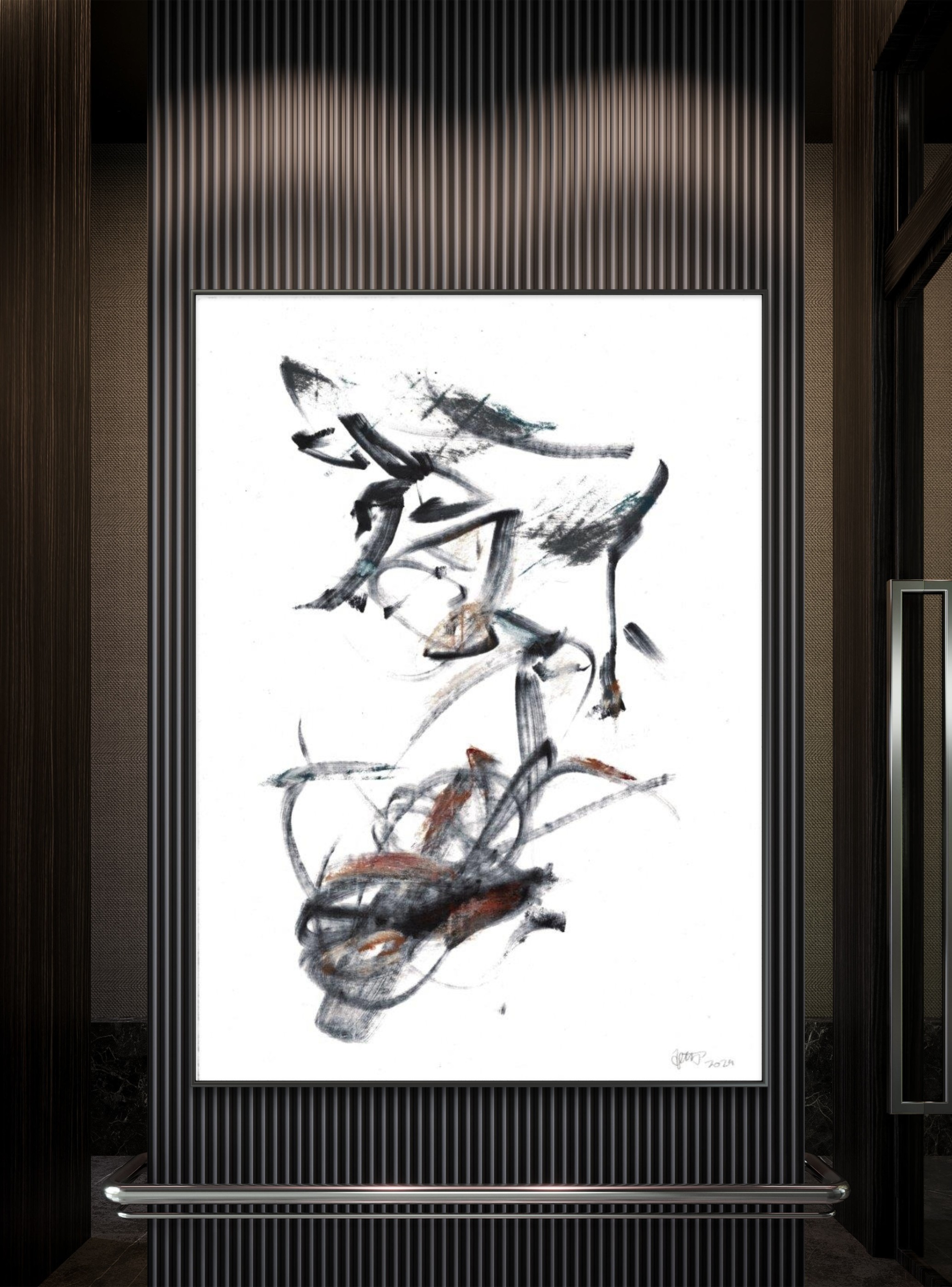
Contemporary Ink Art Inspired by Zen
These Zen paintings form part of my exploration of contemporary ink art, combining spontaneous brushwork, abstraction and the expressive possibilities of empty space. For me, Zen is not a stylistic trend but an attitude toward artistic practice that has developed over five decades.
The works do not attempt to illustrate Zen philosophy. Instead, they explore presence, spontaneity and emptiness through ink, gesture and reduction. The void is not simply an absence of form, but an active space in which movement, energy and perception can emerge.
The Process: Zen Brut
In this series, I often work with what I call “Zen Brut”. There is no preliminary sketch, no correction, and no hesitation. The brush touches the paper, and the ink records the state of the mind in that exact second. If the mind is cluttered, the stroke is cluttered. If the mind is clear, the image resonates. This unforgiving process demands total presence.
Gesture, Emptiness and Form
Many works in this portfolio feature vast black spaces interrupted by spontaneous gestures. These scattered marks are not objects; they represent fleeting moments of insight and energy. They invite a meditative gaze, exploring the impermanent dance between form and silence.

Flickers in the Void

black and blue
Dialogue with Tradition
While my technique is grounded in traditional Chinese training (Central Academy of Fine Arts), my approach integrates Western abstraction. You will find references to classic themes like Bodhidharma or the Enso circle, but interpreted through a contemporary, often minimalist lens.

This picture When the Zen Master Meditates is part of a three-part article about a fictional journey to a fictional Zen master, analyzed with the help of AI. An exciting experiment.
Whole article series: part I – part II – part III


Sumi-e & Zenga Reimagined
Traditionally, Zen art divides into styles like Sumi-e (ink wash) or Zenga (monk painting). I do not strictly separate them. Instead, I combine the minimalist aesthetic of Sumi-e with the rough, direct power of Zenga. Whether I am painting a landscape or an abstract “Sound of Zen,” the goal remains the same: to reduce the image to its absolute essence.


Philosophy in Practice
If you want to understand the theoretical background of these works, I recommend reading my article series on Asian Art Theory. For a deeper look into specific works like the “Flickers in the Void” series, please visit the Journal.


Video: Zen Paintings
Explore Friedrich Zettl’s Art and Ideas→
Art Portfolio → Asian Art Essays → Journal → Articles Archive