
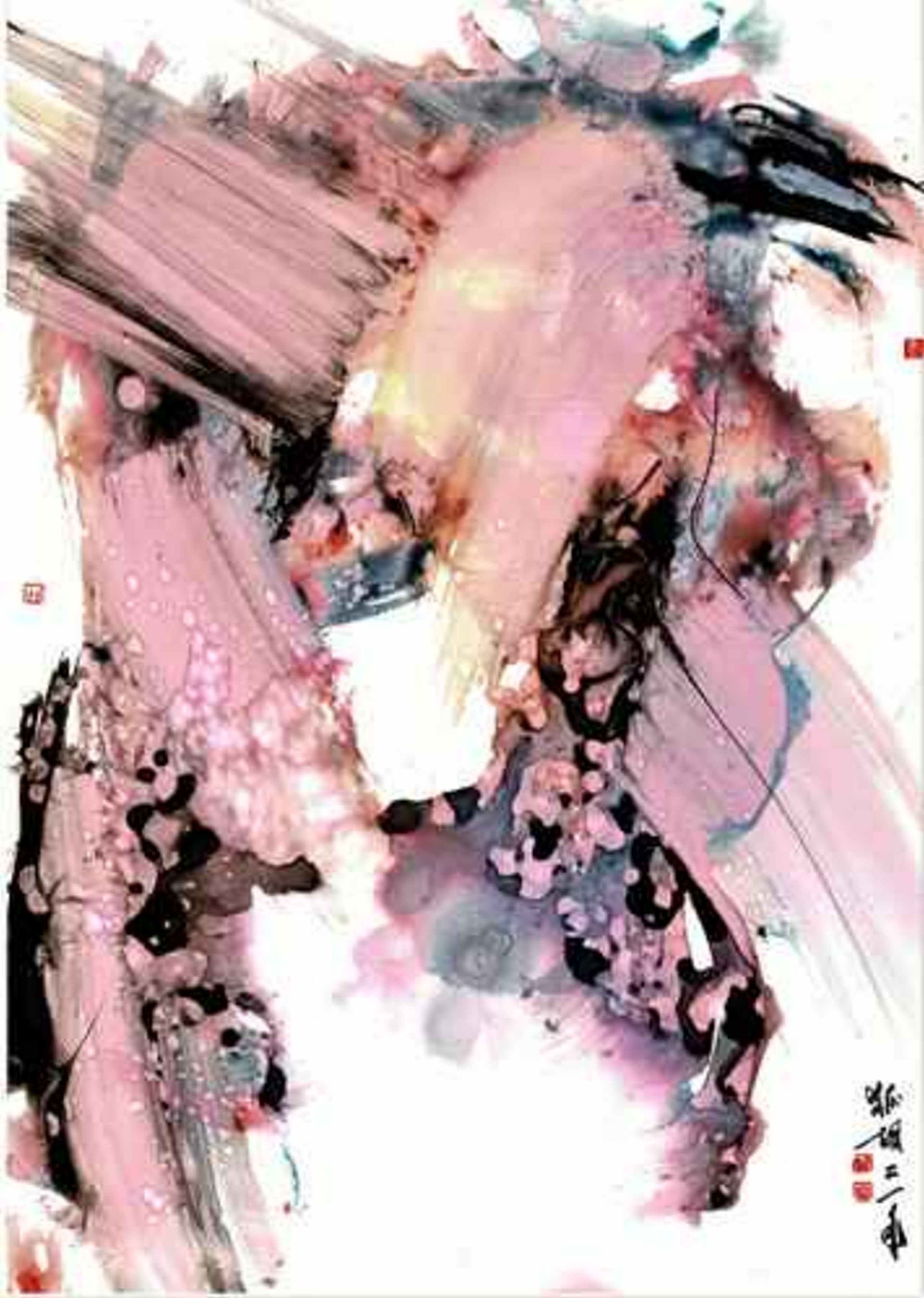
Contemporary Ink Art, Gesture and the Flow of Qi
Gestural abstraction is often associated with the physical act of painting and the Action Painting of the New York School. My own approach shares this emphasis on movement and immediacy, while drawing strongly on Chinese calligraphy, ink painting and the concept of qi.
For me, the gesture is more than a movement of the hand. The brush records speed, rhythm, pressure and changes of direction, turning the act of painting into a direct trace of a particular moment. In this sense, gestural abstraction becomes a meeting point between Western modernism and the expressive traditions of Chinese brushwork.
1. Gestural Landscapes

Nature’s Energy: These works do not depict a specific place, but the feeling of a landscape. I use ink and pastels on handmade paper to capture the raw forces of nature—wind, rain, geological forces, and the slow formation of mountains. It is landscape painting reduced to its energetic essence.
2. Zen Brut & Art Brut
Raw Power: This series represents the unpolished, raw side of my work. Inspired by both Western Art Brut and the roughness of Zen aesthetics, these images on Yupo paper are bold and unapologetic. They accept the “happy accident” and find beauty in the chaotic and the unfiltered.

3. Organic and Constructivist Forms

Structure vs. Growth: These works explore the tension between organic growth—the Dao of Flora—and constructive strictness. Whether through abstract blossoms or geometric compositions based on calligraphic principles, the focus is always on the dynamic balance of the elements.
4. Abstract Calligraphy as Gestural Abstraction
Writing the Void: Based on the laws of Chinese calligraphy, these works strip away the meaning of the characters to focus purely on the stroke. It is writing without words—a visual language that speaks directly through rhythm and form.

5. Myth & Motion: The Dragon Series

The Symbol of Change: In Daoist philosophy, the Dragon is not a monster, but a symbol of change and fluid energy. This series starts with sketchy dragons and evolves into pure motion. It is a study of dynamic lines and the power of transformation.
Across all these series, gesture is not merely a formal device but a means of recording experience. Whether inspired by nature, mythology or calligraphy, each brushstroke becomes a trace of lived perception.
6. Early Experiments: Series I & II
This selection marks the beginning of the journey. Working with Western and Indian ink on glossy photographic paper created a unique resistance and flow. These early experiments laid the foundation for the later series, combining Western materials with the emerging influence of Chinese calligraphy.

East meets West
While visually reminiscent of artists such as Franz Kline or Mark Rothko, the theoretical foundation of these works lies in the East. To understand the concept of Qi (气) in painting, I recommend my articles on Asian Art Theories. Rather than imitating Chinese painting, these works explore how its principles can be translated into a contemporary visual language.
Gesture as a Visual Language
Across these series, gesture becomes a connecting element between landscape, calligraphy, abstraction and the human experience of movement. A brushstroke can suggest a mountain, a character, a body or nothing representational at all. What remains constant is its ability to record an action in time.
About Gestural Painting
Gestural abstraction is closely associated with postwar American Abstract Expressionism and artists such as Jackson Pollock and Willem de Kooning. Pollock’s drip paintings emphasized movement and process through dripping, pouring, and splashing paint across the canvas, while de Kooning developed an intensely physical and expressive form of brushwork.
My own work approaches gesture from a different direction. Its foundations lie not only in Western abstraction, but also in Chinese calligraphy, Daoist thought, and the concept of Qi (气). The spontaneous brushstroke therefore becomes a meeting point between two artistic traditions.
Related articles: The Essence of Chinese Painting: Emptiness and the Meaning of White I Why I Practice Painted Calligraphy I Wabi Sabi and the Aesthetics of Imperfection
Explore Art & Writing
Art Portfolio → Featured Artworks → Arts & Philosophy Journal → All Articles
Explore Asian Art Essays for writing on Chinese painting, calligraphy, aesthetics and art history.
Available Artworks
Original works are available on FriedrichZettl.com and Saatchi Art