
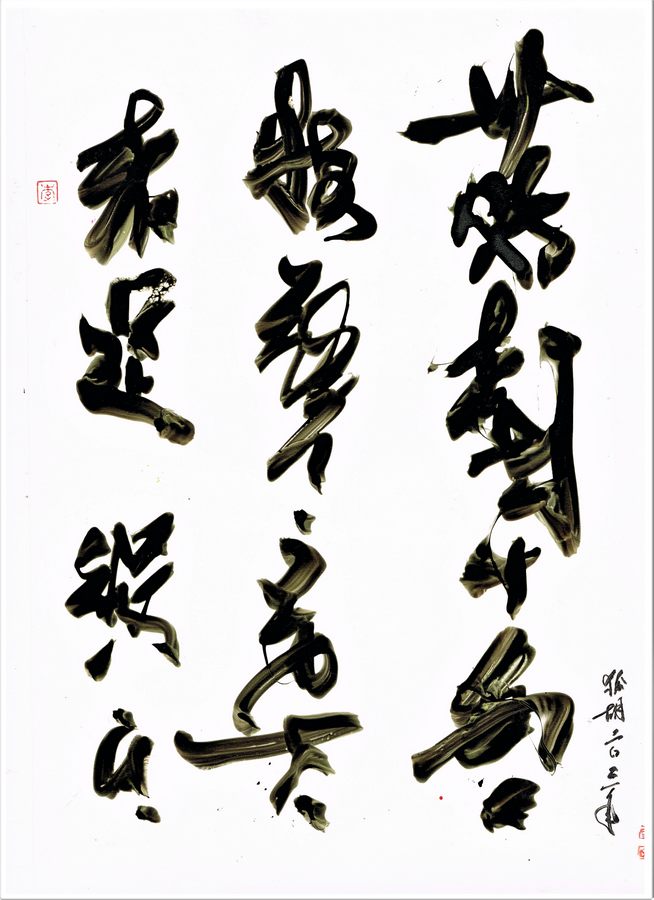
Action Painting with a Brush
This series with Gestural Calligraphy bridges the gap between traditional Chinese calligraphy and Western Action Painting. While the works may look like written characters at first glance, they are purely abstract compositions. Here, the focus is not on the form of the character, but on the act of writing itself. The brush becomes an extension of the body, recording the speed, rhythm, and energy (Qi) of the moment in a single, uncorrectable motion.
Asemic writing
Asemic calligraphy is a series of works that at first glance may appear to be Chinese calligraphy. Although rooted in the principles of traditional Chinese calligraphy, these works are free compositions that follow different visual and expressive criteria.
Asemic Calligraphy is an ongoing series with varying emphases. The examples below show some of its general directions, with the most recent works at the top of the gallery.
1. Visual Sound (Calligraphy & Music)
Rhythm on Paper – Gestural Calligraphy
Music and calligraphy share the same terminology: rhythm, tempo, flow, and pause. In these works, I translate sound into visual structures. The ink lines dance across the paper, sometimes staccato and sharp, sometimes legato and flowing. It is “visual music” that bypasses the intellect and speaks directly to the senses.


2. The Seismograph of the Soul
Inner Landscapes in Gestural Calligraphy
Gestural calligraphy is an honest recording of the artist’s state of mind. There is no hiding. If the mind is agitated, the stroke is jagged. If the mind is calm, the ink flows smoothly. These works are psychological snapshots—abstract diaries written in a language that needs no translation.


3. Energy Fields (Qi)
Beyond the Symbol
While traditional calligraphy is bound by the rules of legibility, gestural calligraphy is bound only by the laws of energy. I use the principles of Cao Shu (Cursive Script)—speed and connection—but liberate them from meaning. The result is a field of pure energy, where the viewer can feel the physical presence of the artist.


Asemic Writing vs. Gestural Abstraction
Is it writing or painting? It is both. In the art world, this is often called Asemic Writing—writing without semantic content. But unlike purely graphic experiments, my work is rooted in the physical discipline of the Chinese brush. It is the result of decades of muscle memory, released in a moment of total freedom.
Related articles: Traditional Calligraphy: The Roots of the Brush I Portraits III: The Ink Revolution (1984–1986) I Gestural Landscape: The Landscape Within
Explore Art & Writing
Art Portfolio → Featured Artworks → Arts & Philosophy Journal → All Articles
Explore Asian Art Essays for writing on Chinese painting, calligraphy, aesthetics and art history.
Available Artworks
Original works are available on FriedrichZettl.com and Saatchi Art