
謙受益 (qiān shòu yì ): A Daoist Reflection on Abundance
The Abundance of Modesty: When one takes on a topic like modesty and abundance, it’s easy to be perceived as a moralist. While I’ve noted in the past that I don’t see myself as a moralist or any other kind of any “-ist”—and certainly not as a “missionary” for any particular worldview—I want to reiterate this for my newer readers. Such rigid thinking would only be a stumbling block on our spiritual path.
I am generally perceived as a modest person, sometimes even as someone who “doesn’t take enough for himself.” In common thinking, after all, modesty doesn’t seem to buy you much. My reflections today, however, move in a very different sphere and might at first sound unusual.

謙受益 (qiān shòu yì – Modesty Brings Abundance) by 程与天 (Cheng Yutian)
The Paradox: Modesty Brings Abundance
How can this be? During my second stay in China between 1982-85, I was introduced to a remarkable artist, Cheng Yutian, with whom I developed a close connection. I have mentioned Cheng in a previous post [1]; he is primarily a calligrapher and seal carver. Since that time, I have come to own one of the most extensive collections of his seal impressions, alongside many seals he carved for me.
Among other works, he wrote several calligraphies for me and carved a seal with three characters that invite deep reflection, for they seem to contradict each other: 謙受益 (qiān shòu yì) — Modesty Brings Abundance.
To understand this profound statement, we must first unpack the wisdom held within the characters themselves, starting with the last one: 益 (yì)
Unpacking Overflow
When we in the West write the word “overflow,” it is a sequence of letters from an alphabet, each meaningless on its own. The Chinese language operates differently. Its characters are carriers of thought, opening up entire worlds of meaning through their graphic representation alone. The character for abundance is a perfect example.

[Image showing the etymology of 益 (yì) and 溢 (yì)]. source: https://www.zdic.net/hans/%E3%B3%91
The etymological root of abundance, (yì), is the image of a vessel whose contents are breaking its boundaries. This powerful metaphor of “transcending limits” forms the basis of all its modern meanings, from a literal flood to an abstract overflow of emotion or talent.
In its earliest pictographic form (oracle bone script 甲骨文), the character was a clear visual: a vessel (皿, mǐn) so full that its contents spill over the top. The original character for this “overflowing vessel” was 益 (yì). Later, to specify the meaning to the overflow of water, the water radical 氵 (shuǐ) was added to the left side, creating the new, clearer character 溢 (yì).

image altered from https://kknews.cc/zh-cn/n/43lza23.html
The Philosophy of the Vessel
This ancient image of the vessel is the key to understanding the full proverb from which our phrase is taken. The expression comes from the Shujing (書經), the “Book of Documents,” [2] one of the oldest and most important classics of Confucianism. It is part of the famous sentence:
滿招損,謙受益 (mǎn zhāo sǔn, qiān shòu yì)
- 滿 (mǎn): Full, arrogant, self-satisfied.
- 招損 (zhāo sǔn): Invites loss or damage.
- 謙 (qiān): Modesty, humility.
- 受益 (shòu yì): Receives benefit or gain.
The literal translation is: “Arrogance leads to loss, while modesty brings benefit.”
This is more than mere advice; it is a central ethical principle in Daoism, Confucianism, and Buddhism. The idea is that modesty is not simply a virtue, but a prerequisite for growth and abundance.
- The Arrogant Person (滿) is like a vessel that is already full. They believe they know everything and have everything. There is no room for anything new—no space for learning, no need for help from others. This attitude inevitably leads to stagnation and, ultimately, loss.
- The Modest Person (謙) is like an empty or only partially filled vessel. They are aware of their limits and remain open to knowledge, advice, and the support of others. It is this very openness that allows them to be constantly filled, to learn, and to grow.

another calligraphy of 謙受益 (qiān shòu yì) by 程与天 (Cheng Yutian)
Benefit and overflow
This brings us back to the beautiful connection between “benefit” (益) and “overflow” (溢). Although the direct translation is “modesty receives benefit,” the etymological root of 益 as an “overflowing vessel” resonates deeply. We can, therefore, interpret the phrase poetically as “modesty receives fullness.” The “benefit” gained through humility is not a small, limited profit. It is an abundance so great that—like the water in the original pictogram—it breaks its own boundaries and leads to true overflow (溢).
The phrase 謙受益 (qiān shòu yì) is a dynamic formula: the emptiness of modesty creates the very space that makes it possible to receive true, overflowing wealth—be it material, intellectual, or spiritual.

2 seals by Cheng Yutian of 謙受益 (qiān shòu yì)
The Harvest of Humility: A Personal Reflection
This principle may seem academic, but it has been a deeply practical guide in my own life. Before I conclude, I want to introduce my late friend, Wang Jinhuai. Memories of him always come to the forefront when I think of humility and my early years in China. He was my first calligraphy teacher and quickly became my most important mentor and a dear friend from whom I learned so much about Chinese thought.

My calligraphy teacher 王金怀 (Wang Jinhuai)
This photo is from 1978. The Cultural Revolution had ended only 2 years prior, and traditional thinking like Daoism or Confucianism was not only frowned upon but had been forbidden. And yet, these were always the main topics of our unforgettable walks and conversations.
That a Western student like myself could cultivate such strong friendships during a difficult time had everything to do with a modest approach. In that era, far too many Westerners felt it was their duty to explain to the Chinese how backward they were. No one in the world is interested in such contests of arrogance, least of all people from a country with millennia of uninterrupted culture. [3] “Peasants” anyone?
humble gifts
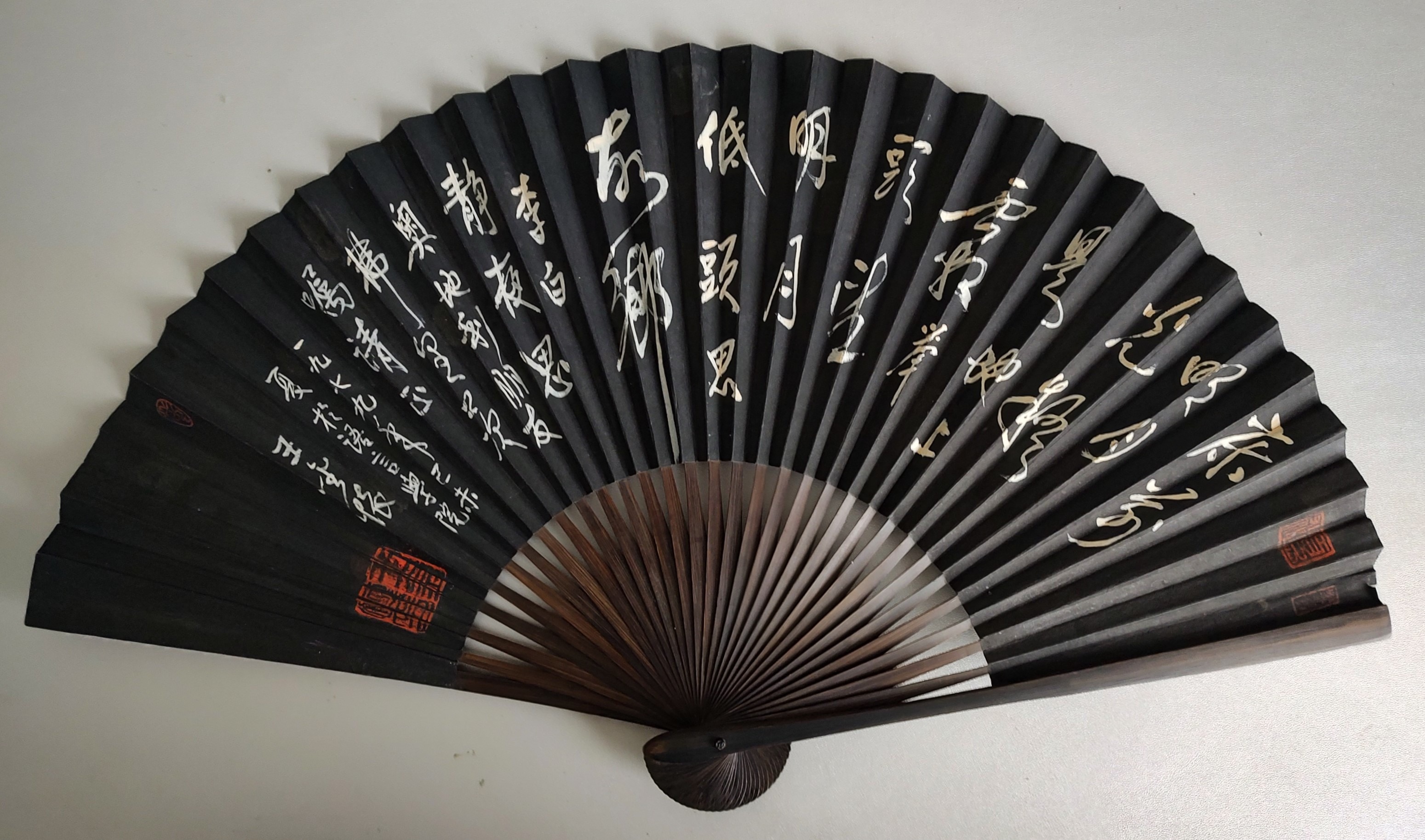
As a token of our mutual respect, we often exchanged gifts, such as this fan.

fan with poem by Li Bai, calligraphed by Wang Jinhuai 王金怀
On one side, Wang calligraphed one of my favorite poems by Li Bai [4]; on the other, I placed my seal impressions.

It is a symbol of a friendship built not on arrogance, but on a shared appreciation for a deep culture. This humility, this willingness to be a guest and to learn, opened doors. Over the decades, I have had the privilege of meeting many significant figures—artists, filmmakers, scientists, and politicians. As I understand it, “modesty” had something to do with it.
The list of all that one receives through humility would be a very long one. What it most certainly grants you is a greater bandwidth in your own perspective. This thinking is, of course, also relevant to my artistic work.
Trip ahead
As we plan to spend two months in Yunnan this coming winter, I go without specific expectations, aware that much has changed since my last visit.

The village Teng Chong will be aour base. credits: dreamstime.com
I arrive as an empty vessel, and I would not be surprised if I return with profound impressions—not just of landscapes and good food, but of human connection. So there is a chance I will return with a great deal of Yi 溢. 😊
extra: working on a new series
I’ve recently started a new series, and the works have, quite unintentionally, taken a very dystopian turn. While I’m still not sure if they fit the theme of this article, I would like to end by sharing three details from one of the larger paintings.


Until next time, stay safe and be well!
footnotes
[1] article: Delving into the Realm of Seals on Artwork
[2] The Book of Documents 書經 Shūjīng) or the Classic of History, is one of the Five Classics of ancient Chinese literature. It is a collection of rhetorical prose attributed to figures of ancient China, and served as the foundation of Chinese political philosophy for over two millennia.
[3] The oldest known examples of Jia gu wen (甲骨文), the Chinese oracle bone script, date from the late Shang Dynasty. This means that Cheng Yutian is continuing a culture that is over 3,000 years old.
[4] Li Bai: Quiet Night Thought 《静夜思》jìng yè sī
床前明月光,疑是地上霜。
举头望明月,低头思故乡。
Before my bed lies a pool of moonlight
I could imagine that it’s frost on the ground
I look up and see the bright shining moon
I bow my head I am thinking of home
Shops: FriedrichZettl.com – Saatchiart. Media: Blog – Youtube – Instagram


Leave a Reply