
Exploring the Soul Through Minimalism and Eastern Inspiration
Essence in art: Thanks to your requests, I’m excited to dive into the topic of the soul in Daoism. In this and the next post, we’ll explore the Daoist concept of the soul. We’ll take a playful yet meaningful approach to keep things engaging and far from dry – hopefully.
This artistic method will guide us in understanding our topic more deeply. We’ll be inspired by the great Tang Dynasty Daoist Lü Zu [1], whom I’ll discuss in more detail in the next post.
Stay tuned for an insightful and creative exploration of the soul in Daoism!
Western Soul vs. Daoist Soul: A Comparative Exploration
The Western Soul
In Western religions, the soul is closely tied to monotheistic beliefs and is therefore a matter of faith, similar to the belief in a monotheistic God. This approach can feel static and cemented, leaving little room for spiritual development. However, spiritual growth becomes possible when we begin to doubt. This space between faith and doubt allows for personal and spiritual evolution.
The Daoist Soul
Daoism views the soul as an integral part of the cosmos, governed by transformative processes. The ultimate goal in Daoism is to align with the Dao, achieving harmony that transcends physical death. Unlike the static concept of the soul in Western thought, the Daoist soul is dynamic and evolving, reflecting the ever-changing nature of the universe.
A Playful Approach to Understanding the Soul
To delve into the concept of the soul without becoming too dry, we’ll use a playful yet meaningful approach, inspired by the great Tang Dynasty Daoist Lü Zu. This method will help us explore the topic creatively and engagingly by using the technique of brainstorming.
Brainstorming is a well-known technique for fostering creative thinking and problem-solving. It encourages free and open communication without judgment, allowing for innovative
solutions. While traditionally done in teams, I approach brainstorming as a one-man show, drawing from various styles, themes, and ongoing projects, and expanding my “team” with inspirations like Lü Zu.
Embracing Abstraction
Discussing the soul leads us into abstract territory. Souls are light and unburdened, suggesting we must let go of decorations and superfluous things to grasp their essence. [2]
Haiku paintings
If I were to make a living from my art, creating a new art form like Painted Haiku could be a compelling idea, especially on social media. In a previous article, I discussed turning one of Ashley’s haikus into calligraphy and received positive feedback. Thank you for this! Painting such haikus would be a logical next step, but I have no intention of positioning myself as “Friedrich the Haiku Painter.”
The Essence of Art: Stripping Down to the Basics
A popular Daoist is saying: “Pure water has no scent” (真水無香). No matter how much we may love Poopsy-Cola & Co., it is not essential for our survival or existence. But pure water is.

When we think about this and apply it to painting, a question inevitably arises: “How much can I leave out, like stimuli such as ‘sugar’ and ‘flavorings,’ before there’s no art left?” After a few more considerations like this, we can make our first attempt.
Capturing the Essence in Art with Haiku
As we know, Haiku captures the ephemeral, the fleeting beauty of the world in a few words, making the reader pause and reflect. Haiku focuses on the essential, triggering deep reflection with minimal elements. That’s what we’re trying to achieve now.
1 – Walking through the Park
Imagine you’ve chosen an old man’s walk through a deserted park in late autumn as the subject of a painting. It is perhaps a somewhat boring topic, but it has a lot to offer: an avenue in the park, the last leaves on the trees sparkling golden at dusk, a carpet of leaves on the ground, maybe a dog running after the man for a few steps. Now, start your work by leaving out everything that obscures the essence of the subject. Exclude academic techniques, perspective drawing, color theory, and elegant strokes—essentially everything in your painter’s toolbox.
Since I’m neither a poet nor an expert in haiku, let’s call these examples semi-haiku. They will suffice for our purposes. Our semi-haiku goes:
Leaves crunch underfoot,
Old man strolls, autumn whispers,
Twilight years in gold.

The Abstract Realm: Capturing The Essence
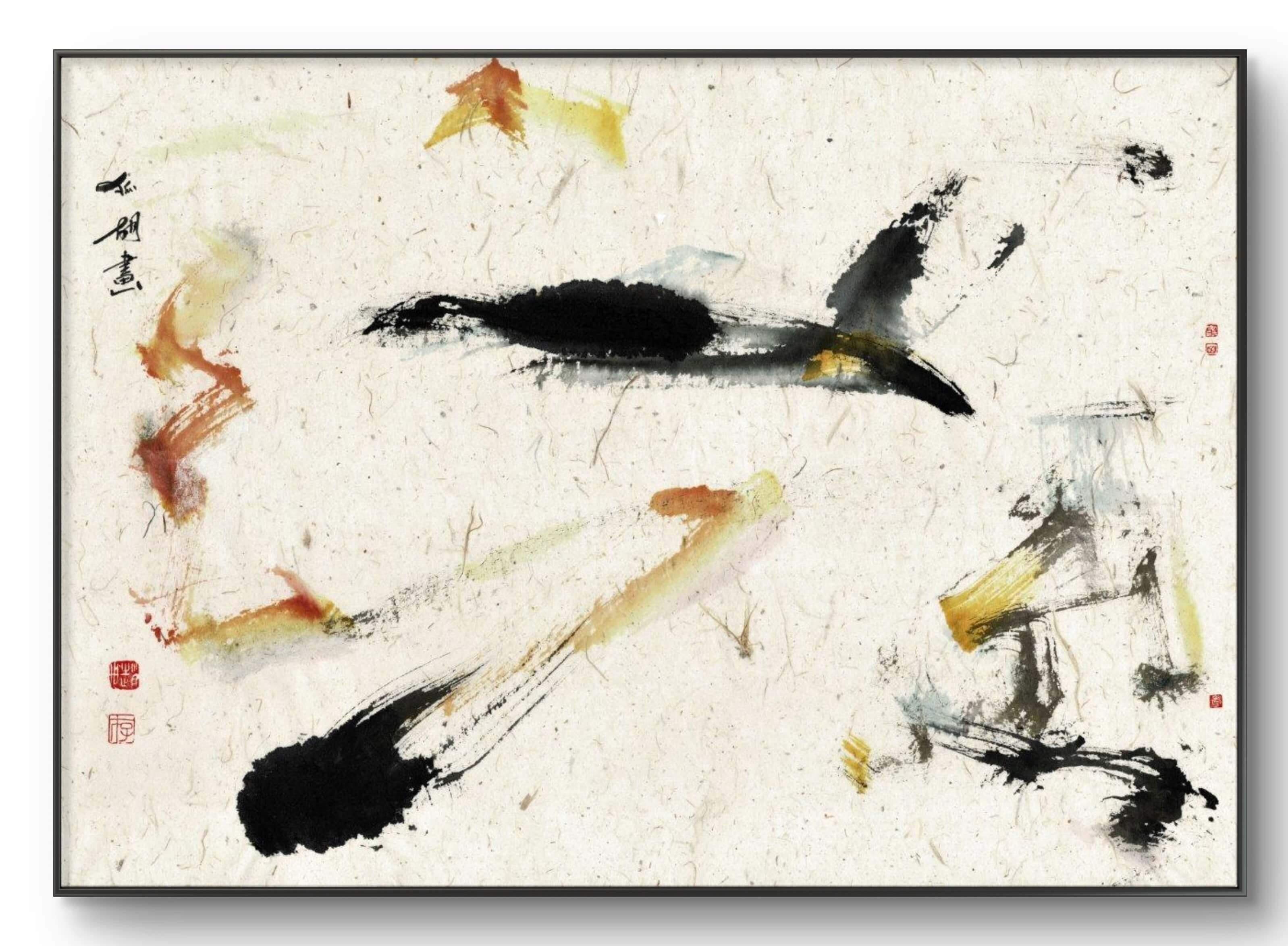
In our abstract experiment, no line or surface attempts to represent anything real. Even the paper used is made of elephant dung. Yet, we can still envision the scene. No leaf shines gold, but the picture is imbued with a golden autumn light. Nothing in the painting triggers immediate enthusiasm, allowing for detachment in the Buddhist sense (Upādāna).
The painter does not pretend to have mastered painting and does not seek to impress. What remains, and is hopefully understandable, is a poetic touch of our theme. The picture exists simply as it is, ideally conveying the “soul” of our theme.
2 – Exploring Enso: The Next Brainstorming Session
Let’s return to lighter fare. Despite its high level of abstraction, this approach fits well with the traditional understanding of haiku. Here, too, we abstain from pleasing representation in favor of capturing the essence. We’ve discussed Enso many times. In this case, the Enso is not a continuous, circular ink line but consists of indefinable segments arranged in a circle, attempting to express the spirit of an Enso.
To start, we’ll use a semi-haiku again:
Eternal Enso,
Birds and fish souls glide within—
Imperfect joy found.

Instead of offering my own commentary—I’ve written extensively about this type of image—let’s allow our master Lü Zu to speak and let his words sink in deeply: [3]
“Therefore you only need to bring the light into circulation; that is the highest and most wonderful secret. The light is easy to move, but difficult to fix. If you let it run in circles long enough, it crystallizes; that is the natural spirit body… That is the state of which it is said in The Book of the Seal of the Heart: ‘In silence, you fly up to the moon‘.”
3 – Jazz: A New Brainstorming Session
Most haikus we know follow traditional patterns and rules, which is perfectly fine. However, it becomes even more interesting to approach an unfamiliar topic, such as Jazz. The Semi-Haiku goes:
Jazz, black as night’s veil,
Tiger blood and coffee blend—
Whiskey, pulse, immerse.

Extra
Exploring the Soul: Asian Inspirations and Picasso’s Minimalism
In our approach to understanding the soul, we focused on leaving things out and drew inspiration from Asian ideas. However, this is a topic that of course also concerns many Western artists. A particularly suitable example comes from Picasso.

Picasso’s work is especially relevant because it demonstrates how he progressively omitted more elements to reach the “essence” of his subjects, while often staying within the realm of external appearances.
Remember the great Daoist Lü Zu’s saying: “In silence, you fly up to the moon” when things become too difficult around us.

footnotes Essence in Art:
[1] Lü Dongbin (Chinese: 呂洞賓 / 吕洞宾, Pinyin Lǚ Dòngbīn, also Lǚ Yán, Lǚchúnyáng or Lü Zu (呂祖, Lǚzǔ) is one of the Eight Immortals.
[2] Previous articles on the topic of “letting go”: Gaining by Letting Go, About Letting Go,
[3] C. G. Jung – Richard Wilhelm: Das Geheimnis der Goldenen Blüte. Walter Verlag Olten 1973. page 77
Shops: FriedrichZettl.com – Saatchiart . Media: Blog – Youtube – Instagram
related posts: Not nothing this time, Daoist Aspects in my Work


Leave a Reply