
The Discovery of the Brush
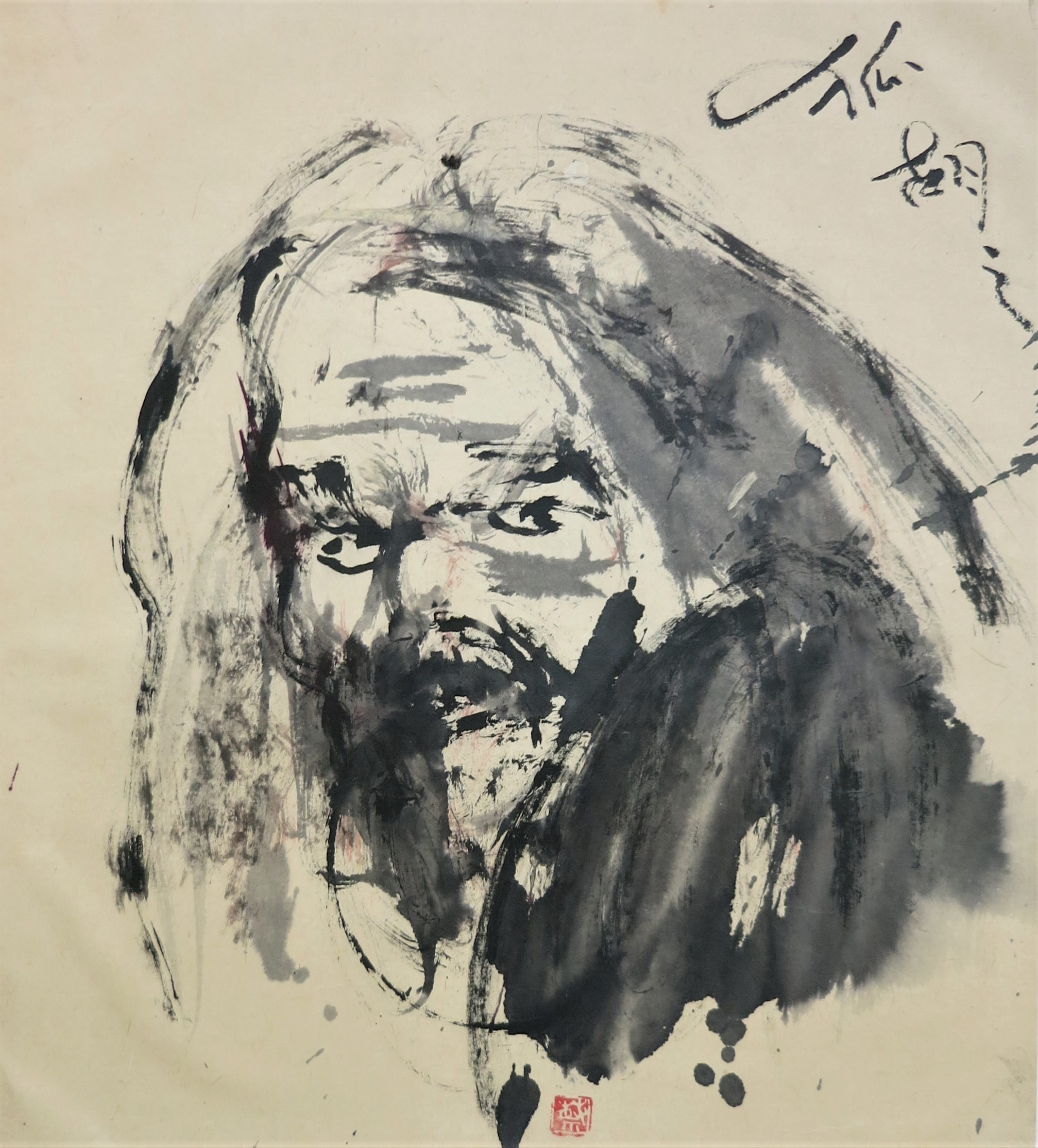
By the mid-1980s, my transition was in full swing. I had abandoned the rigid control of the Western pencil and embraced the unpredictable nature of the Chinese brush. This portfolio of Expressionist ink paintings documents my first large-scale experiments with Indian ink on delicate rice paper (Xuan Paper 宣纸). It was a period of liberation: the heavy, expressive strokes of Western Modernism were now being executed with the fluid tools of the East.
1. Large Format Ink
Breaking the Frame
Traditional Chinese portrait painting is often small and intimate. I broke this rule by creating Expressionist ink paintings in large formats. Using buckets of ink and large brushes, I attacked the paper with the energy of Action Painting. The result is a fusion: the scale is Western, but the medium is purely Chinese. The ink bleeds into the paper, creating textures that oil paint could never achieve.


2. The Dialogue of Water and Ink
Controlled Accidents
Working on rice paper requires speed. There is no erasing, no overpainting. Every stroke is final. In portraits like “Black and Blue,” you can see the interplay of wet and dry ink. I allowed the water to dictate the form, letting the Qi (气)—the vital energy—flow freely. It is a dialogue between the artist’s intention and the water’s will.


3. Faces of the Soil
Spirit Resonance in expressionist ink painting
I was no longer interested in mere likeness. Following the first principle of Chinese painting, Qi Yun Sheng Dong (气韵生动, Spirit Resonance), I sought to capture the vital spirit of the subject. Whether painting a musician or a peasant, the goal was to capture their inner vibration. The faces are often distorted, not out of error, but to reveal the emotional truth beneath the skin.


Expressionism with a Chinese Heart. These ink portraits are the missing link. They show how I applied the emotional intensity of Austrian Expressionism—Kokoschka and Schiele—to the disciplined medium of Chinese ink painting. It was here that my signature style—Zen Brut—began to take shape.
Related articles: Portraits VI: Philosophical Ink (1990–1992) I Gestural Calligraphy: The Kinetic Stroke I Landscapes V: Dreamscapes (1998–2005)
Explore Art & Writing
Art Portfolio → Featured Artworks → Arts & Philosophy Journal → All Articles
Explore Asian Art Essays for writing on Chinese painting, calligraphy, aesthetics and art history.
Available Artworks
Original works are available on FriedrichZettl.com and Saatchi Art