
The Discipline of Copying
My time at the Central Academy in Beijing was defined by the traditional method of Lin Mo (临摹 – copying the masters). To the Western mind, copying often implies a lack of originality. In Chinese art training, however, it is an essential foundation. In this portfolio of traditional Chinese landscape studies, I present works based on both Old Masters, such as Shi Tao (石涛), and modern Chinese masters. The goal was never simply to reproduce an image, but to internalize the logic of Chinese landscape painting.
1. Anatomy of the Landscape
Structure and Sequence
How does one build a mountain? In Chinese landscape painting, this is a question of sequence and structure. These works are analytical studies. I dissected the masterpieces stroke by stroke to understand the use of the brush (Yong Bi 用笔) and the layering of ink washes. It was a process of reverse engineering: I had to learn the architecture of the painting before I could inhabit it.


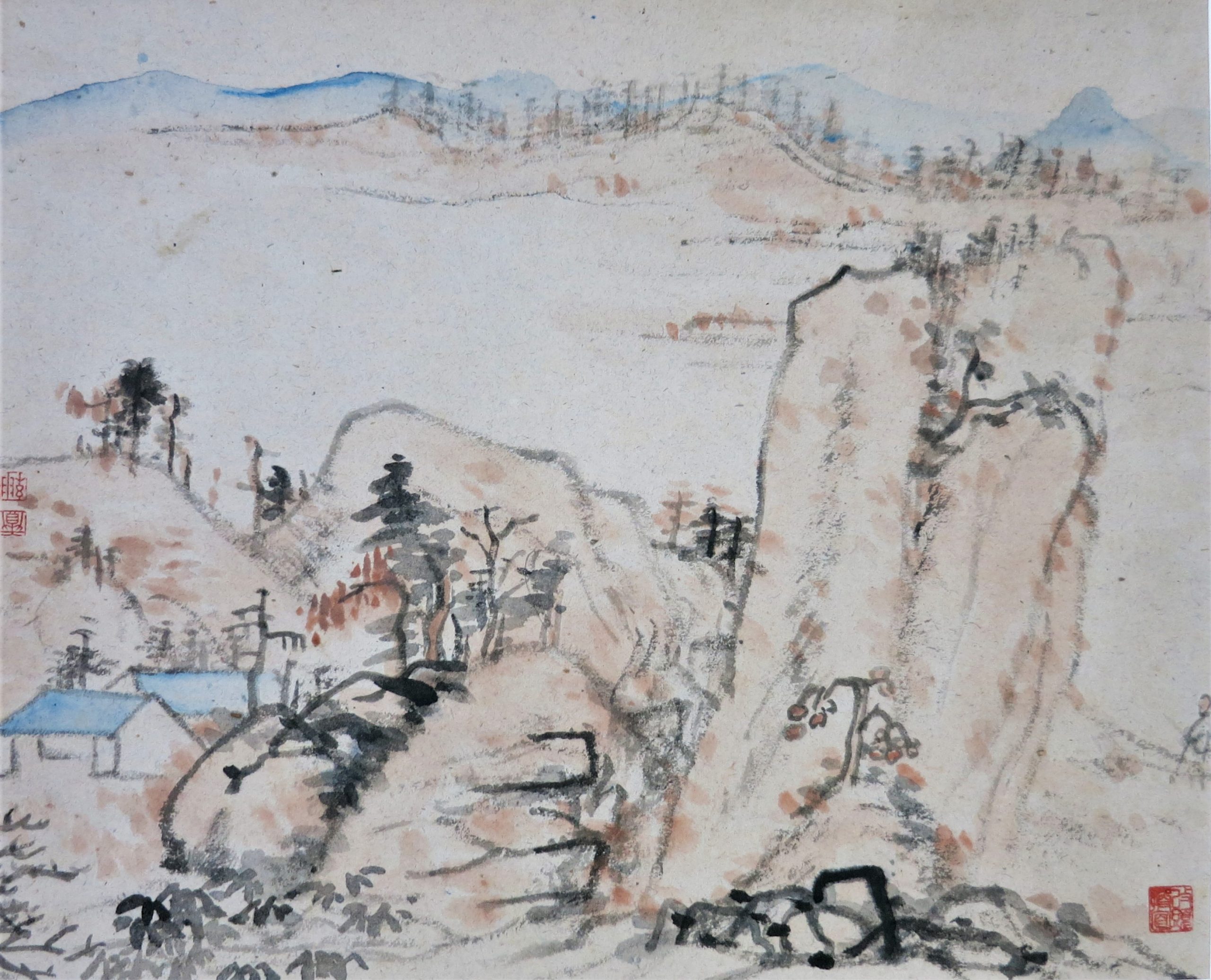
Traditional Chinese landscape studies in ink and brush, exploring Shan Shui 山水 and classical brushwork
2. Manifesting the Spirit
Capturing the Qi (气)
Technique is only the vessel. The true goal of Lin Mo (临摹) is to connect with the Qi (气 – spirit or vital energy) of the master. It is about more than visual resemblance; it is about recognizing the spirit behind the ink and manifesting it in one’s own work. These Chinese landscape paintings are my attempts to channel that ancient energy. They are not merely copies of forms, but attempts to capture a state of mind.


Chinese ink landscape after Lu Yanshao 陆俨少, Mountain ridge with a solitary tree, and a landscape study exploring Bi Mo 笔墨, the interaction of brush and ink
3. The Moving Perspective
San Yuan (三远)
Abandoning the fixed perspective of the West, I embraced the “Three Distances” (San Yuan 三远). In these traditional Chinese landscape studies, the fixed horizon disappears and the landscape becomes a journey. The eye is guided up the mountain path, through mist and valleys. It is an invitation to wander through the painting rather than simply looking at it from the outside.


Chinese landscape study exploring San Yuan 三远, and a Traditional Chinese ink landscape on Western paper with layered mountain forms
The Living Tradition
Standing on the shoulders of giants. By copying the masters, the artist becomes a link in a chain that stretches back over a thousand years. These works document both my humility and my ambition: to master the principles of Bi Mo (笔墨 – brush and ink) so that I might one day break them.
Related articles: Copying Old Masters: Huang Binhong – 黄宾虹 I The Essence of Chinese Painting (III) I Daoist Talks
Explore Art & Writing
Art Portfolio → Featured Artworks → Arts & Philosophy Journal → All Articles
Explore Asian Art Essays for writing on Chinese painting, calligraphy, aesthetics and art history.
Available Artworks
Original works are available on FriedrichZettl.com and Saatchi Art