
From Austrian Landscapes to Chinese Ink Art
This landscape painting archive moves from colour-rich studies made in Austria to Chinese shan shui and later ink dreamscapes on glossy paper. Five groups trace changes in brushwork, light and pictorial space.
The sequence is a dialogue between ways of working rather than a simple replacement of one tradition by another. Colour, observation, brush structure and open space remain important in different proportions throughout.

1. Western Roots: Austrian Expressionism
Capturing Light and Landscape
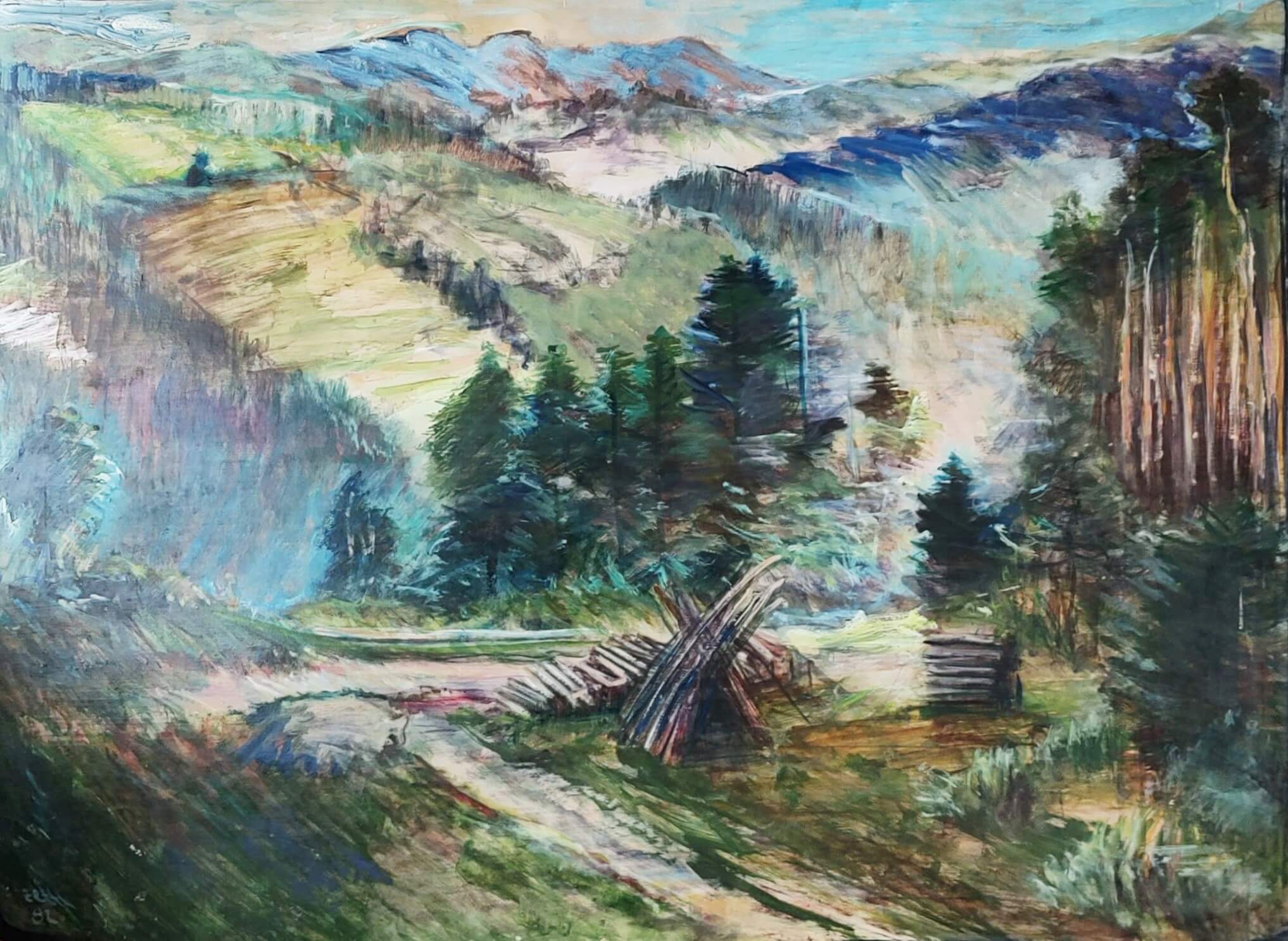
The early Austrian works explore the Vienna Woods through pastel, watercolour and oil. Trees, paths and shifting light are built from active colour rather than tightly enclosed contours.
The example shown here sets tall green and blue trees against a warm dark ground. A narrow red-and-yellow strip and a small white structure establish a contrasting horizontal rhythm below.
Early Austrian landscape painting — colour and light organise the trees and the narrow horizontal band below.
2. The Chinese Turn
Learning to Read Nature
The years spent in Beijing brought sustained study of Chinese painting and calligraphy. The landscape studies examine how rocks, trees and buildings can be articulated through a sequence of brush marks.
The work shown here, after Shitao, combines pale mountain contours with darker trees and small buildings. The second and third series follow the movement from studies after earlier models towards more independently constructed landscapes.

Study after Shitao — Chinese landscape painting developed through contours, dark accents and open space.

3. The Huang Binhong Phase
The Beauty of Blackness
A further group reflects a sustained engagement with Huang Binhong’s landscape painting, alongside his academic research into Chinese freehand painting.
Layered strokes and dense clusters of marks give these landscapes their structure. The example preserves an open band between a dark foreground and distant mountains, showing how small areas of light can organise an otherwise intricate surface.
Landscape in the manner of Huang Binhong — layered ink keeps a broad passage of water open.
4. Dreamscapes
Beyond Geography
The Dreamscapes of 1998–2005 explore ink on glossy paper. Pooling, spreading and translucent passages help produce spaces that are less securely attached to a particular place.
In the pale horizontal example, vertical washes and reflected forms suggest a watery setting. The image can be read as landscape while remaining open to other associations.

Dreamscape No. 2 — ink on glossy paper, with translucent washes opening into a fluid, imagined space.
Landscape as Experience: The Legacy of Shan Shui
Across the archive, landscape becomes less dependent on describing a single view. Trees, rocks and water can give way to the directional movement of a stroke or the interval between painted areas.
The relationship of dark marks to open paper remains central, whether the composition is densely worked or reduced to a few forms.
The linked series allow these differences to be followed through individual works rather than through a fixed opposition between Western and Chinese painting.
Landscape as a Continuing Practice
Landscape remains a reference in the later abstract work, even where recognisable mountains or trees have receded.
The connection lies in rhythm, space and the movement of the brush. Earlier observation and later material experiments continue to inform one another.
The contemporary Gestural Landscape selection extends this development into more layered and colour-driven compositions.
Related articles: Early Western Landscapes | The Chinese Turn | Dreamscapes
Explore Art & Writing
Art Portfolio → Featured Artworks → Arts & Philosophy Journal → All Articles
Explore Asian Art Essays for writing on Chinese painting, calligraphy, aesthetics and art history.
Available Artworks
Original works are available on FriedrichZettl.com and Saatchi Art