
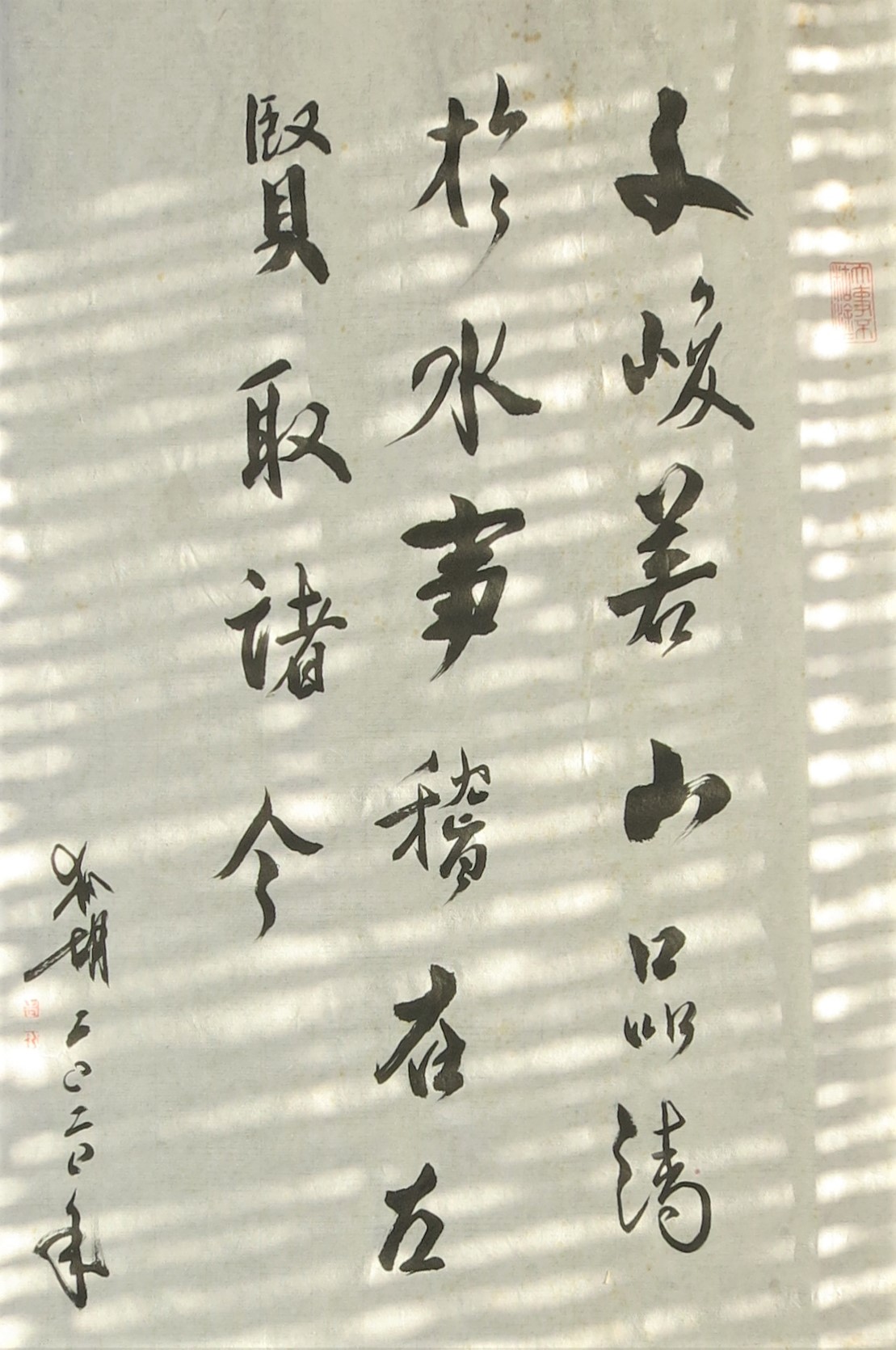
Chinese Calligraphy between Tradition and Contemporary Ink Art
For me, Chinese calligraphy (中国书法) is more than beautiful writing; it is a direct record of the artist’s inner state. Unlike forms of painting that allow repeated correction, calligraphy captures the immediacy of the brushstroke. This portfolio traces my journey from the discipline of classical Chinese calligraphy to painted, experimental and gestural approaches that connect calligraphy with contemporary ink art.
1. Traditional Calligraphy
The Foundation Before one can break the rules, one must master them. My work is rooted in the study of traditional scripts, particularly the Running Script (行书). These works are a practice of rhythm, discipline, and mental clarity. They represent the technical backbone of my art.

2. Painted Calligraphy
Blurring the Lines: In this series, the boundary between text and image dissolves. I treat the Chinese character as a visual structure, often incorporating color or breaking the traditional grid. The aesthetic impact takes precedence over legibility.

3. Experimental Calligraphy
Breaking the Mold: This series takes classical forms and pushes them into unconventional territory. By experimenting with non-traditional materials, alternative supports, and altered structures, these works question the rigid rules of traditional writing while still retaining a playful or structural link to the written sign.

4. Gestural Calligraphy
Writing Without Words: This is the purest form of energy transfer. Semantic meaning is abandoned entirely, shifting the focus entirely to the Qi (energy) of the stroke itself. These works document the raw physical act of writing—speed, pressure, and body movement—as an action-painting approach rooted in Eastern philosophy.

5. Calligraphy, Poetry and Mixed Media
Layering Time & Meaning These specific projects extend calligraphy beyond the traditional page, bringing together brushwork, poetry, found materials and mixed media.
- Overpainted Antique Prints Using 19th-century documents as a canvas for expressive brushwork.
- Painted Haiku: Visual Poetry Translating the brevity of short poems into minimalist ink textures.

Understanding the Art Form
To appreciate these different approaches to calligraphy, it helps to understand the artistic and philosophical traditions behind them. My Art Theory pages explore Chinese painting, calligraphy, aesthetics, Daoism and Zen, while the Arts and Philosophy Journal contains articles on the historical and philosophical context of my work.
To get a quick overview, there are short videos on various topics including calligraphy at:
Explore Friedrich Zettl’s Art and Ideas→
Art Portfolio → Asian Art Essays → Journal → Articles Archive