
Notes from the La Gacilly-Baden photo festival
“One Planet, Many Perspectives” is my personal title for the photo exhibition that stands at the center of this article [1]. Following my last article, “Be Kind,” which explored some aspects of Buddhism, I want to pursue that core idea of mindfulness in a different yet no less powerful way. What does it truly mean to be mindful in our complex world? And what, if we are not mindful?
If you don’t have time to read the entire article, I still recommend the extra at the end. Misky, a co-blogger I particularly admire, commented on my last article and wrote something particularly valuable.
What is this festival all about?
Sometimes, a single image says more than a thousand words—and nowhere is this clearer than at the annual La Gacilly-Baden Photo Festival. For those who are not yet familiar with it, this is Europe’s largest open-air photography festival. Originating in La Gacilly, France, it has, for several years, also transformed the imperial city of Baden bei Wien into a vast open-air gallery. The concept is as simple as it is brilliant: along a route of over seven kilometers, large-format photographs from the world’s best photographers are displayed in the city’s gardens, parks, and alleyways. Each year is dedicated to a different theme, always focusing on the complex and vital relationship between humanity and the environment.
A journey through culture and history
Yet, before one dives into the world of these powerful photographs, the city of Baden itself offers a wonderful overture.

A stroll through the town is a journey into the Biedermeier era, past magnificent ochre-yellow facades and the venerable Beethoven House, where the composer wrote the greater part of his Ninth Symphony.

On the way to the expansive parks [2] that serve as the festival’s main stage, the transition from urban culture to nature and art becomes seamless. Along the paths, one encounters astonishing creations: witty reinterpretations of works by Vermeer, Miró, or Warhol & Co, crafted entirely from leaves, bark, and grasses.
And it is precisely at this intersection, where nature itself becomes art, that the festival’s first visual narrative begins…

Let’s start the hike from here
A route stretching over seven kilometers naturally offers space for a vast number of photographs, making the decision of which ones to feature here a difficult one. I have selected a few that either personally resonated with me or fit into the narrative of this article. What I also truly appreciated about the festival’s concept is its thoughtful balance; even though many images show the destruction of the environment at our own hands, the experience never feels overwhelming in a negative sense. I find it very compelling that the exhibition avoids a preachy or didactic tone, aiming instead to simply encourage reflection. And there is a lot to reflect on.
Let’s start with this strong foto-portrait of an elder from the Wara Tamba Masalai in Papua New Guinea, his face painted with vibrant natural pigments. He wears a remarkable traditional headdress, intricately woven from living moss, leaves, and a rich variety of other plants found in his local environment. The adornment is a powerful expression of his culture’s intimate relationship with the natural world, blurring the line between man and the forest itself.

This piece below is by a photographer, Vee Speers, known for creating scenes that blend the human form with natural elements in a highly aesthetic, almost painterly style.
In this dreamlike composition, figures immerse themselves in a pond filled with decaying lotus leaves, blurring the line between the human body and the natural environment. The image evokes a powerful and melancholic reflection on the universal cycle of life, beauty, and decay.


Heavy, Light, Fleeting: Iconic Images of the Festival
For me, the following photograph is one of the most significant works of the last few decades—a powerful statement on politics, culture, imperialism, and the subjugation of a people.
Taken in 2002, the image depicts Queen Elizabeth II and Prince Philip attending a traditional Aboriginal ceremony during the Australian leg of their Golden Jubilee tour. The moment was politically charged; at the time, Indigenous leaders were actively calling for an apology from the British Crown for past wrongs. As a stark juxtaposition of two worlds, the photograph captures a poignant moment of cultural expression unfolding against an unresolved backdrop of demands for reconciliation.

This vibrant portrait below captures a participant at the renowned Goroka Show in Papua New Guinea, a festival that celebrates the incredibly diverse cultural traditions of the country’s highland tribes. The intense face paint and the elaborate headdress, adorned with feathers and shells, are part of a stunning ceremonial display intended to embody ancestral spirits and tribal identity.


Narratively minimalist
This photograph is from the series Guardians of the Altiplano and features Justina, a ‘bird-woman’ from the Quillacas community in Bolivia. She is a healer who uses her knowledge of traditional medicine to care for her community, embodying a deep, spiritual connection with the high plateau’s ecosystem.


From the series ‘The New Eldorado,’ this photograph captures the stark paradox of Dubai’s rapid development in 2005. The image powerfully juxtaposes the world of refined luxury, represented by a formally dressed waiter, with the raw, unfinished reality of the city’s massive construction projects, offering a sharp commentary on labor and relentless urban growth.

The next image is from a series exploring the spiritual landscape of Bahia in Brazil.
In a moment of profound communion, a man bathes in the cleansing spray of a sacred waterfall, a site of spiritual significance in Afro-Brazilian traditions. The photograph captures a powerful connection between the human body and the living force of nature, suggesting a ritual of purification and release.

Another powerful photograph documents the devastating consequences of deforestation. The image’s own caption explains that after land is sold for paper and palm oil production, the soil is severely eroded, and the former inhabitants are left with nowhere to live. The scene highlights the human cost of industrial-scale agriculture and habitat destruction.


Sacred Bonds, Ancient Rites
This photograph captures a pivotal moment in the “whip dance,” a significant rite of passage into adulthood for young men. According to the exhibition’s text, the ritual serves as a profound lesson in endurance and acceptance, teaching participants that certain hardships in life must be tolerated without complaint as they transition into their new roles in the community.

This incredibly dynamic photograph freezes a moment of raw energy during a ceremonial performance in Papua New Guinea. Covered from head to toe in dark pigment, the participants display fierce, energetic expressions meant to embody powerful spirits or intimidate rivals. The image conveys an overwhelming sense of movement, sound, and primal force.

This intense group portrait showcases a spectacular tradition of ceremonial body painting from Ethiopia’s Omo Valley. The bold, graphic patterns transform the human face into a living canvas, serving as a powerful form of cultural expression and identity. The direct and confrontational gaze of the subjects, combined with their striking adornments, creates an image of unforgettable power.

A Final Thought: The Resilience of Hope
A walk through the photo festival La Gacilly-Baden is more than just an appreciation of art; it is a journey. It leads through the historic streets of Baden, where nature itself becomes a canvas, and into the heart of our world’s most pressing stories.
The journey confronts us with breathtaking beauty, but also with uncomfortable truths. We see the unhealed wounds of colonial history in Australia, the devastating consequences of deforestation, and the intense, powerful rituals of cultures that challenge our own perspective. We witness the paradoxes of modern life, where luxury and raw labor exist side-by-side.
Yet, a common thread resonates through all these powerful images: the unbreakable bond between humanity and the environment, and the irrepressible will to preserve cultural identity. The photographs are an appeal to our mindfulness, forcing us to look closer and to understand, rather than to simply consume.
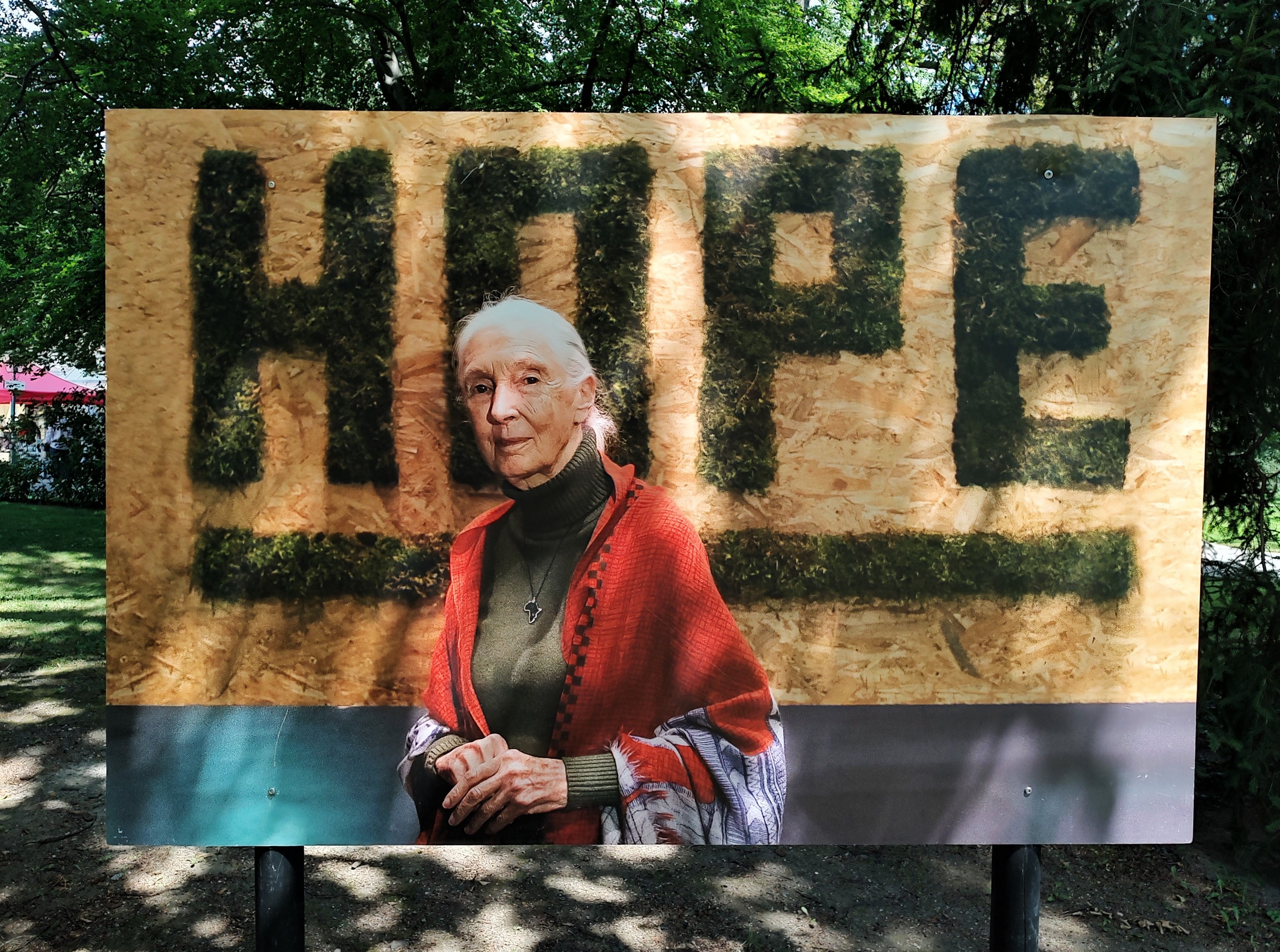
And so, it is no coincidence that the tour culminates in an image of Jane Goodall next to the word “HOPE,” fashioned from living moss. This is not an empty platitude but the logical conclusion of the entire exhibition. Hope arises precisely from seeing the whole picture—from understanding the complex connections, and from recognizing that even in the face of destruction, a deep, primordial beauty and dignity persist.
It is the very hope that Jane Goodall [3] has embodied for decades: the belief that every individual can make a difference through mindful action. The festival may not leave one with easy answers, but it leaves you with the right questions—and the profound feeling that this hope is not only possible, but necessary.

extra:
Note from Misky on my last article “Be Kind” – (And as if by a miracle, Misky, your profound comment fits perfectly with my article today too 🙂 ) “…..you have touched on something very close to my heart — the encircling heart of anima mundi, the belief that all things are interconnected — every kindness, touch, stone, tree, river, whisper of wind, child’s breath — are the soul within the world, but also the soul as the world. Kindness balances one’s soul with the soul of all.
It’s not that a tree simply grows in the forest; it’s that the tree is the forest, just as fog is the air, it’s not apart from it. Kindness, in this vein, isn’t a moral add-on — it’s the body remembering its wholeness. What hurts the river, hurts the fish. What grieves the child, grieves the stars. So yes, I am in full agreement — kindness is not just a virtue, but a recognition of inter-being.
In that way, anima mundi isn’t a vague abstraction or a forgotten ancient belief. It’s a responsibility. It tells us there are no strangers, no throwaway places, no forgotten corners. Even silence has roots, and they are shared.
But admittedly, I don’t perceive things as many do, call it poetic (although it’s not), for me anima mundi murmurs from my knowing that all boundaries are temporary — and the soul, whether of garden or grandmother or loved ones, cannot be fully unmapped or untangled.
In the rustle of late summer vines and the hush of morning coffee, listen: the world speaks in one voice, and we are all part of its breath — therefore: Be kind.”
footnotes
[1] The exhibition’s official title is “Australia and the New World.” Here, the “New World” is strongly represented by the United States, portrayed through striking street photography.
[2] In addition to Beethoven, Emperor Franz I, Emperor Joseph II, Marie Louise of Austria, Wolfgang Amadeus Mozart, Joseph Lanner, Johann Strauss (Father) and other personalities regularly visited the spa park in Baden.
[3] Dame Jane Morris Goodall is an English zoologist, primatologist and anthropologist. She is considered the world’s foremost expert on chimpanzees, after 60 years’ studying the social and family interactions of wild chimpanzees.
Related articles: every-picture-tells-a-story I environment-and-nature-topic I afterthoughts-on-the-yunnan-journey
Explore Friedrich Zettl’s Art and Ideas:


Leave a Reply