
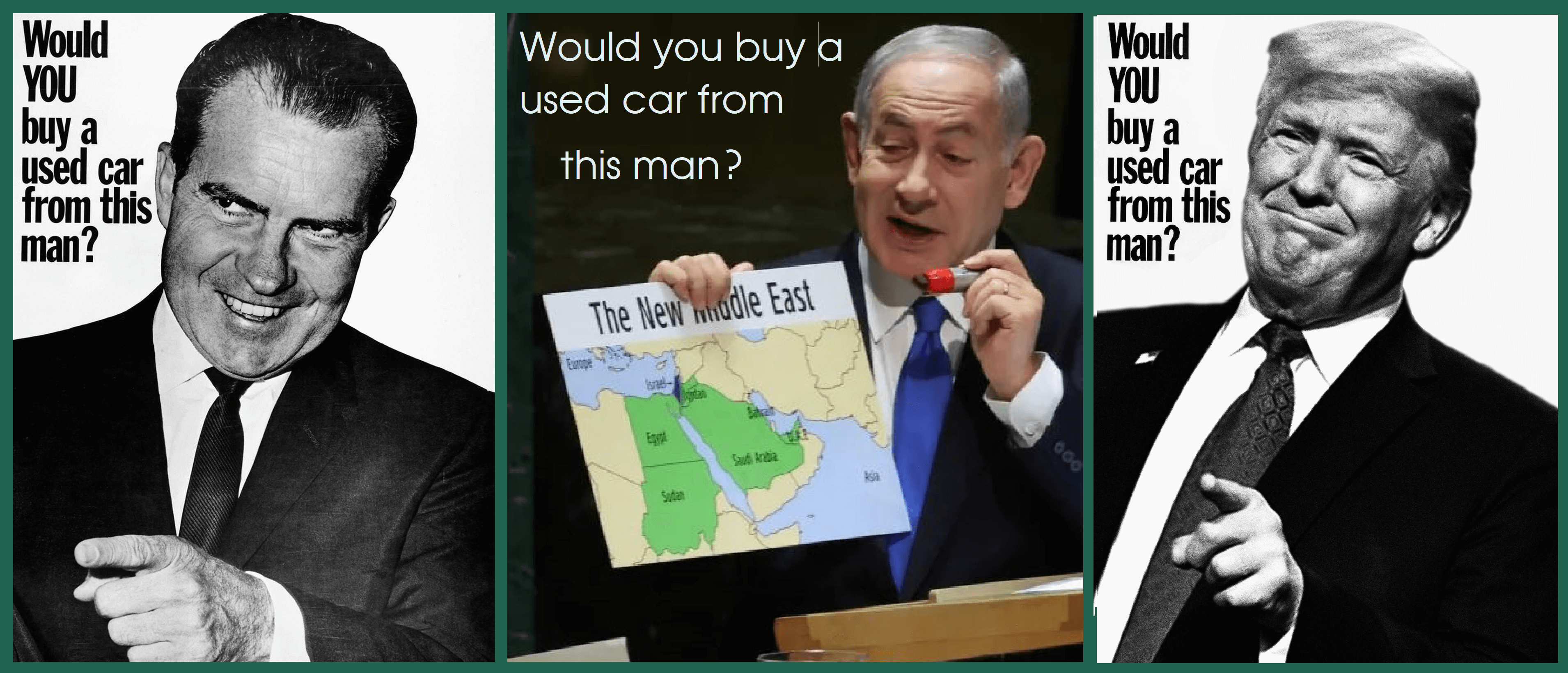
And why I need a Break.
Would you buy a used car from…? is likely my first, and probably last, article focusing on political topics. When I decided to run this blog, my initial resolution was to exclude politics, especially current affairs. However, for certain reasons [1], I drafted an article addressing the US-China question. Even if it had been thoroughly researched, several considerations held me back from publishing it [2]. My second attempt also ended up in the bin.
Finally, I started this article, aiming primarily to focus on the power of images in a political context. Yet again, I encounter the same dilemma. But fundamentally, I believe that when an author has thoroughly considered a subject and formulates their opinion with conviction, they always strike a chord with some readers. So, I’m publishing it anyway. I’m among those who believe art should also be provocative – not exclusively, but in its very essence. The word “provocare” stems from Latin, meaning “to challenge” (something difficult to do, or something one is challenged to do).
My brief collages are designed to visually amplify the text. For widely recognized images, I’ve opted not to provide formal citations.

We simultaneously know, of course, that this topic is too vast to be comprehensively covered, even superficially, in this format.
Times of Uncertainty
Almost all of us sense that we are living in challenging times. Most of us attempt to question these seemingly absurd developments or somehow make sense of them. Just when we think we have explanations, they are stirred up again like a pile of dry leaves, forming a new picture – until the next gust of wind.
Hardly anything that held true yesterday seems to hold true today. What’s more, increasingly, nothing seems capable of offering us stability. This is at least the impression I’ve gained after looking into various social media channels – contrary to my usual habits [3]. But it’s not just there; this topic is, of course, also prevalent among my friends and acquaintances.

“Truth is the enemy of the state” Josef Goebbels.
A Time of Change: Where Do We Stand Today?
When a president uses taxpayer money to install a platform that, in addition to embarrassing things, primarily spreads untruths and names this “truth” or “social”, it raises an intriguing question for me – namely, is George Orwell green with envy, or is he turning in his grave? It gets even more perverse when people use this “information” as the basis for their political views. And it gets even more intriguing when someone actually invests their money – not in a used car, but in that person’s manipulated stock.
A question I’ve been asking myself for quite some time is: What kind of political society are we living in today? A common answer is: a post-capitalist one. I’m not fond of that term. Yanis Varoufakis, who is certainly one of the most important European thinkers and political analysts of our time [4], uses the term “techno-feudal society.” And I like that much better. Not only because, precisely in these days, we’ve witnessed the most massive redistribution of wealth from bottom to top in history, where, for instance, technology companies (Musk – Doge, Peter Thiel – Palantir…) gain executive powers that fall outside the legal framework. But also, as trivial as it may seem, an elite show-off wedding in Venice involving 100 private jets and a significant environmental impact is no longer something to be ashamed of. And certainly not a birthday party that celebrates the greatness of the birthday child. “We do ’cause we can.”

Techno-Feudal Society
In a techno-feudal society, to summarize Yanis Varoufakis, the major tech corporations (like Google, Amazon, Apple, Meta) are the new “lords” or “feudal masters.” They control vast digital platforms and the “cloud”—the entire digital infrastructure we rely on. Even traditional businesses and capitalists have become “vassals” of these tech lords. They are forced to use the tech corporations’ platforms (e.g., a merchant on Amazon, an app developer in the Apple App Store, or even a musician at Spotify) to offer their products or services. This makes them dependent on these platforms and obliges them to cede a portion of their revenues to the tech lords.
In Varoufakis’s terminology, even media outlets like Fox “News” can be considered “vassal-capitalists.” They continue to produce content (their “capital”), but they are compelled to pay “rent” to the “cloud-lords”—whether by accepting their algorithms, using their advertising systems, or surrendering a share of ad revenue. These platforms increasingly dictate which content is visible and how it is monetized. This means they not only assume a role that does not belong to them, but they also become kingmakers. Not enough? They also place their chosen personnel in the government [5].
Show Time!
When I, as a European, follow the US news channels, I notice a few things: The media landscape in the U.S. has basically become a form of entertainment. It’s less about analysis and more about spectacle. Whether it’s a political rally or a breaking news alert, what we get to see is a show, and accordingly follows the rules of the show world.
“Think of the press as a great keyboard on which the government can play.”
― Joseph Goebbels

Politainment
In this “politainment” culture, complex issues are broken down into catchy headlines and emotional sound bites. Viewers are drawn into a cycle of anger, outrage, or quick judgment. This often clouds deeper understanding.
This omnipresent show is supported by a president who acts according to the rules of the show world and thus keeps it running. No show = no attention. But probably he is by no means such a fool, as many would have him portray; he is rather pursuing a plan that has been refined in Washington long before Trump. [6]
Compounding this, a disturbing trend shows increasing numbers disengaging from politics or consuming unchecked information, inadvertently paving the way for conspiracy theories to thrive.
Another key problem I see is a kind of political tunnel vision. U.S. media often presents world events solely through the U.S. American lens. But geopolitics isn’t a show with one hero or villain. It’s a complex web of interests, historical events, and strategies.

“If you’re not careful, the newspapers will have you hating the people who are being oppressed, and loving the people who are doing the oppressing.”
― Malcolm X [7]
The Architecture of Deception: When Truth Becomes Negotiable
A leader caught in a lie once? A scandal! Caught again? It’s an embarrassment. But reach a certain threshold, and the narrative shifts. Suddenly, the office must actively intervene, and we collectively settle on terms like “alternative facts.” When this state of “alternative facts” becomes constant, the moral stigma vanishes. The lies cease to be isolated incidents and transform into a new kind of “truth” – for those who embrace them.
When political discourse prioritizes ratings and public spectacle above all else, traditional notions of integrity, shame, and even basic decency quickly become inconvenient obstacles. This might sound sarcastic, but tragically, it’s becoming an unavoidable principle, a cycle difficult to escape. In the relentless theater of such politics, faces are easily interchangeable; yesterday’s voice shaping the narrative is replaced by another’s tomorrow. And while symbolic red hats may give way to equally contrived white ones, the novelty of such superficial shifts inevitably fades.

The “God Bless the USA” Bibles were made in China for less than $5.
In this context, it becomes disturbingly instructive to study the quotes and methods of the Nazi propaganda mastermind, Josef Goebbels. [7] Examining his insights into mass psychology and information control, not as an endorsement, but as a lens, can reveal striking parallels in the tactics employed to shape contemporary political narratives. How often do we see history’s playbooks repurposed, intentionally or not, to manipulate public perception?
The Unfiltered Lens: From Shocks to Silenced Truths

The raw, visceral power of a single photograph can reshape public consciousness, as tragically demonstrated by the iconic image from the Vietnam War that galvanized anti-war sentiment and burned itself into the global conscience. Yet, the landscape of visual reporting has profoundly shifted. During the Iraq War, embedded journalism offered a controlled, yet intimate, perspective, influencing how conflicts were perceived from within military operations. At least that was roughly the official wording.
Navigating the Narrative: Truth, Power, and the Peril of Reporting

Today, the very act of bearing witness has become unimaginably perilous: photojournalists face unprecedented dangers, including targeted killings, as starkly evident in the escalating violence against reporters in conflicts like the one in Israel. The power of the image remains, but so too does the increasing risk for those who dare to capture it.
According to the Committee to Protect Journalists (CPJ), in the last two years (2023 and 2024), the war between Israel and Gaza resulted in the following total deaths:
2023: 78 journalists and media workers – almost all in the Gaza Strip – killed by Israeli attacks
2024: 85 journalists and media workers were killed – again, almost exclusively in Gaza – as a result of Israeli military actions. [source: cjp.org]
The Enduring Echoes
The images we consume, past and present, hold an undeniable power. They lay bare the uncomfortable echoes of history’s gravest missteps in contemporary realities, illustrating how dehumanization can persist in new forms, from the architectural remnants of atrocities to the stark realities of modern-day detentions and historical, demeaning caricatures. These visuals compel us to confront the cyclical nature of indifference and the enduring consequences of actions driven by a disregard for humanity.
As Friedrich Schiller so poignantly warned:
“That is the very curse of evil,
That it still breeds evil, propagating it.”

While the challenges can feel immense, let’s not allow divisive currents to diminish our spirit. Instead, let’s strengthen our common ground, stay critically engaged, and embrace the beauty and tranquility our world offers.
Enjoy a pleasant summer!
footnotes:
[1] However we approach the issue, there is a risk of hurting the feelings and political beliefs of others, and that is not my intention.
[2] The China-US issue is very complex and requires some prior knowledge to be even halfway well understood. Instead, I would like to point you to a few experts who share my personal perspective on this: Yanis Varoufakis, Jeffrey Sachs, and Kishore Mahbubani are particularly noteworthy.
[3] I’ve tried half-heartedly to use social media for my art, but I’ve come to the conclusion that it’s not for me.
[4] Ioannis Georgiou “Yanis” Varoufakis ( b. 1961) is a Greek economist and politician. Since 2018, he has been the Secretary-General of the Democracy in Europe Movement 2025. He was Greece’s Minister of Finance, negotiating on behalf of the Greek government during the 2009–2018 Greek government-debt crisis.
[5] According to Newsweek, President Trump has selected at least 19 former Fox News hosts, journalists, and commentators for high-level positions during his second term.
[6] For instance, you can find this kind of analytical argument in:
Books by former government officials or political strategists: These often provide insider perspectives on how long-term goals and strategic thinking can persist across administrations, regardless of the public persona of the current leader.
Academic works on U.S. foreign policy or political institutions: Scholars often trace the evolution of specific policies or doctrines over decades, showing continuity despite changes in administration.
Investigative journalism and political commentary: Pundits and journalists who delve into the deeper mechanics of Washington often suggest that apparent chaos might mask a consistent, long-term strategic objective, sometimes attributed to established bureaucratic interests or a “deep state” (though this term itself is highly charged and interpreted in various ways). (source: gemini)
[7] From The Autobiography of Malcolm X, which was published posthumously in 1965 (co-authored with Alex Haley).
[7] Paul Joseph Goebbels (1897 – 1945) was Propaganda Minister in Nazi Germany. About his quotes: https://www.imdb.com/name/nm0324305/quotes/
extra:
And finally, a visual reminder I captured years ago in Moscow. The sign reads “ОХРАННАЯ ЗОНА” (SECURITY ZONE). A stark image of boundaries and control, it echoes the core themes of this article: the unseen forces that define our spaces, limit our access, and shape our perceived realities.

Shops: FriedrichZettl.com – Saatchiart. Media: Blog – Youtube – Instagram


Leave a Reply