
Two Simple Words, A World of Meaning
For years, a journalist’s question to the Dalai Lama has stuck with me: “If you had to summarize the essence of Buddhism in one sentence, what would you say?” A fascinating challenge, considering the thousands of books and interpretations that exist. The Dalai Lama, however, didn’t need a full sentence. He needed only two words, simple enough for anyone on Earth to understand: “Be kind.”
But what does this truly mean? It is not merely a suggestion to be polite. It is a profound principle rooted in a deep understanding of reality, an understanding that changes everything.

The Web of Connection: Why Kindness Matters
The Lesson in a Suit
This principle of kindness is founded on the Buddhist realization that nothing exists in isolation. The Dalai Lama once illustrated this with the simple example of his suit. It is not just a piece of clothing; it is the result of a long chain of connections—from the person who planted the cotton, to those who wove, dyed, and cut the fabric, to the people who produced the buttons, to the salesperson in the store. Every object and every action is a node in a vast, invisible network that connects us all. When we truly grasp this, kindness is no longer a mere gesture but the logical consequence of knowing that we can never separate the well-being of others from our own.
An Echo in Quantum Physics
Fascinatingly, this millennia-old intuition of an all-encompassing connection finds a modern parallel in quantum physics. The scientific verification of quantum entanglement [1] has shown that particles can remain linked in a way that shatters our everyday perception of space and separation. While this is a physical phenomenon, it reminds us that the invisible connections in our lives—in our social fabric, our global ecosystem, and our world society—are more real and profound than we might assume. Our interconnectedness, therefore, goes far beyond the tangible example of a suit; every action we take sends ripples through this complex web, underscoring the profound responsibility inherent in a simple “Be kind.”
The Art of Giving: Beyond Transaction
This understanding of interconnectedness radically changes our perspective on the Western concept of “giving and taking.” We often treat it as a transaction, an unwritten contract where we give something and, consciously or not, expect something in return – pretty soon or later in heaven.
Buddhism breaks with this idea. Here, giving, known as Dāna दान in Pali, is a central virtue and a practice of the mind. The focus isn’t on what is given, but how. The highest form of giving is done without attachment—without expecting thanks, recognition, or anything in return.
So what does the giver “get”? Nothing in a material sense, but they receive something far more profound. Every act of selfless giving is a direct practice against our ego-centricity. It loosens the tight grip of our self, which constantly seeks to possess, control, and secure. It is a practical exercise in mindfulness and letting go. In the moment we give without calculating, we are fully present. We recognize the connection between ourselves and others and experience a form of joy that arises not from receiving but from allowing things to flow. You could say the reward for giving is freedom from the compulsion of taking.
From Theory to Practice: Personal Experiences
For me, this philosophy is not a gray theory but a lived practice that has enriched my life for decades. Nowhere does this become more tangible and real for me than on my travels through the Buddhist-influenced countries of Southeast Asia. There, in direct experience, the profound truth hidden in concepts like mindfulness and compassion reveals itself.

The Wisdom of a Tuk-Tuk Driver
About ten years ago, in Cambodia, the issue of begging was still a tricky one for me. You are warned not to give anything in some countries, lest you be immediately surrounded by a crowd. But how do you act in the face of obvious need? The answer came from someone I least expected.
In Siem Reap, we had a tuk-tuk driver who not only took us to the most remote temples but also usually explored them with us. During the ascent to the sacred site of Phnom Kulen, injured or very poor people sat along the stairs, hoping for alms. I was hesitant, but our driver—far from a rich man himself—stopped for every single one and gave them a small donation.

When I asked him what was appropriate, he smiled. “It’s not about the amount, but about the act itself,” he explained. He added that he couldn’t give much, but his day would be significantly sadder if he didn’t. At the end of our week together, when we gave him a generous tip, he said with a knowing smile that this was surely the reward for his small donations on the mountain.

The Echo of Mindfulness
This experience is not an isolated one. Time and again, I noticed a pattern: the deepest, most authentic experiences were always preceded by a small act of trust, respect, or mindfulness. It was the same in Sri Lanka, where I had booked a driver for eleven days in advance. After just a few emails, a wave of mutual respect was palpable, culminating in an invitation to his brother’s wedding just a day after our arrival—an unforgettable and deeply moving experience.

The Happiest Country on Earth?
Why mention Bhutan as an example? What lies behind its “Gross National Happiness“? It is the antithesis of our Western obsession with Gross Domestic Product (GDP). While GDP measures only material production, the happiness of the Bhutanese is based on four pillars: sustainable development, environmental protection, cultural preservation, and good governance. It is not about short-term, hedonistic feelings of happiness, but about creating the conditions for a meaningful life in balance. For example, the constitution mandates that at least 60 percent of the country must remain forested—a policy of kindness towards nature and future generations. Gross National Happiness is essentially the national implementation of “Be kind”: be kind to the people, to the environment, to your own culture, and to the future.
A Radical Statement in Stone
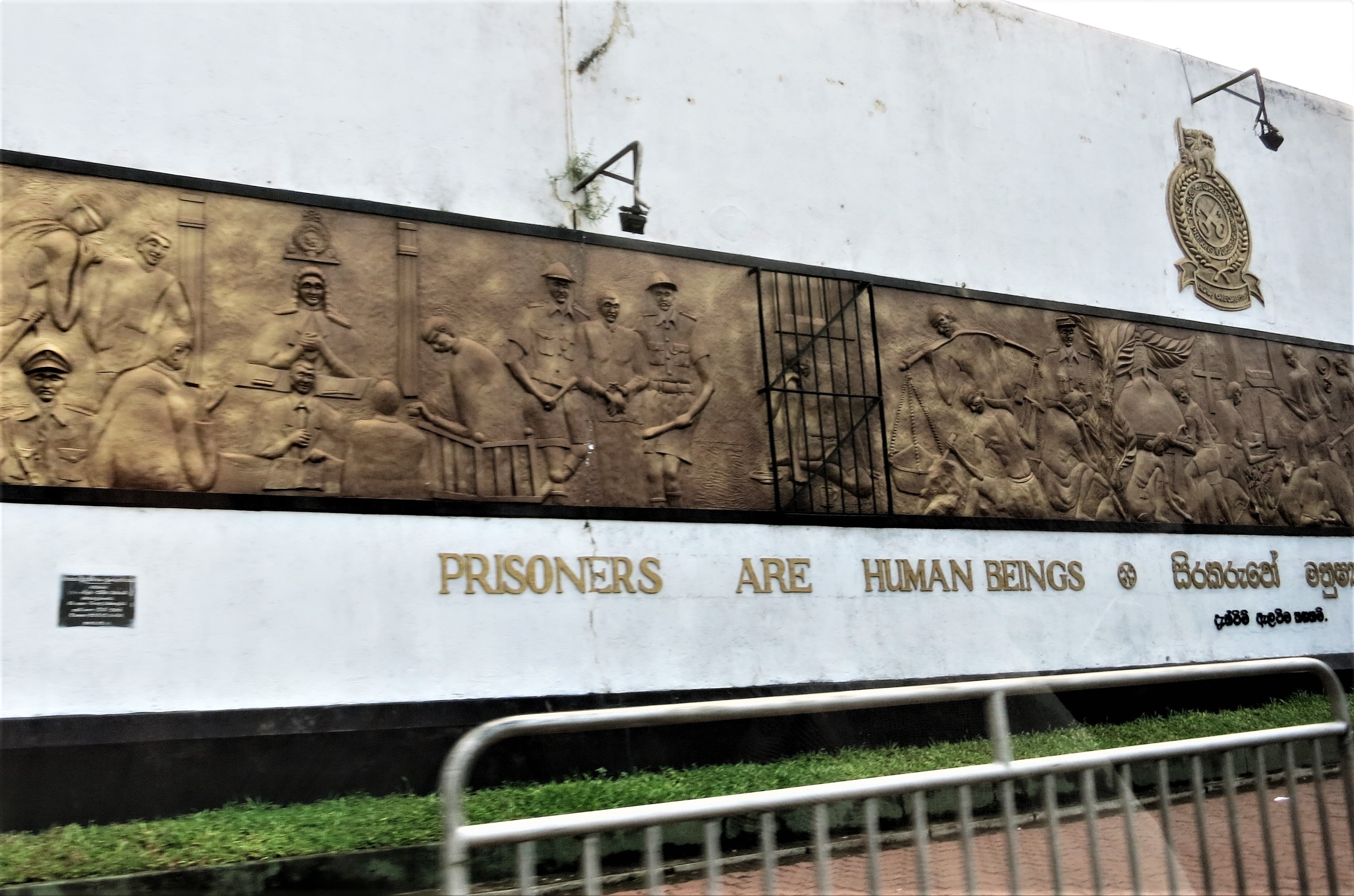
But perhaps the most lasting image on the theme of “Be kind” I also found in Sri Lanka [2], in a completely unexpected place. We were driving through Colombo and passed a high, white prison wall. I know nothing about the conditions inside that prison, but this public declaration, carved in huge letters, moved me deeply:
“PRISONERS ARE HUMAN BEINGS”
These words are a radical statement. They are a reminder that the principle of kindness is universal and knows no exceptions—especially not in places where we find it hardest to grant. It is the recognition of dignity in every person, regardless of their actions.

The Full Circle
From the wall of a prison in Colombo back to the two simple words of the Dalai Lama, the circle closes. Kindness is not a moral duty but a choice for a richer, more connected, and ultimately happier way of life. It is the realization that the act of giving is, in itself, the greatest gift.
Perhaps the final word should belong to a philosopher from an entirely different tradition, who also wrestled with the nature of a well-lived life. Friedrich Nietzsche perfectly captured the paradoxical outcome of this kind, joyful existence when he wrote:
“Whoever possesses abundant joy must be a good man: but he is probably not the cleverest man, although he achieves exactly what it is that the cleverest man strives with all his cleverness to achieve.”
In the end, the simple, heartfelt path of kindness may just be the most profound wisdom of all, effortlessly achieving what cleverness alone never can.

Extra: The Circle Closes Once More
And the circle closes one last time—with wonderful news for me personally. While the core principles of kindness are universal, certain aspects of Buddhism naturally differ across various countries. Due to my deep connection to Chinese culture, I am particularly interested in Buddhist art in China. There, Buddhism has uniquely blended with Daoist and Confucian traditions, resulting in a very distinct style in the depiction of Bodhisattvas and the architecture of its temple complexes.
And so, I am eagerly looking forward to the coming winter, as we plan to spend two months in Yunnan, on the border with Myanmar. At least that’s the plan. This won’t be a hotel stay, but a stay on a small farm, helping with laundry and daily chores. We plan to take trips to the surrounding towns, which are still largely untouched and relatively free of tourists because they are small and not considered hotspots. But they are full of history, ancient architecture, temples, and simple life.

So, I will be traveling with a backpack, and with that, the circle closes back to my youth, when I first discovered Europe with a backpack on my shoulders.
footnotes
[1] I have already addressed this topic in previous posts on Zen Buddhism LINK
[2] In Sri Lanka, Buddhism is the predominant religion, practiced by a very high percentage of the population.
According to the last major census and confirmed estimates, approximately 70.2% of Sri Lanka’s population is Buddhist.
The form of Buddhism in Sri Lanka is predominantly Theravāda Buddhism. It holds a special, foremost status under the country’s constitution and is deeply intertwined with the Sinhalese national identity.
For comparison, here is the distribution of the other major religions in the country:
Christianity: approx. 7.4% Hinduism: approx. 12.6% Islam: approx. 9.7%
Shops: FriedrichZettl.com – Saatchiart. Media: Blog – Youtube – Instagram


Leave a Reply