
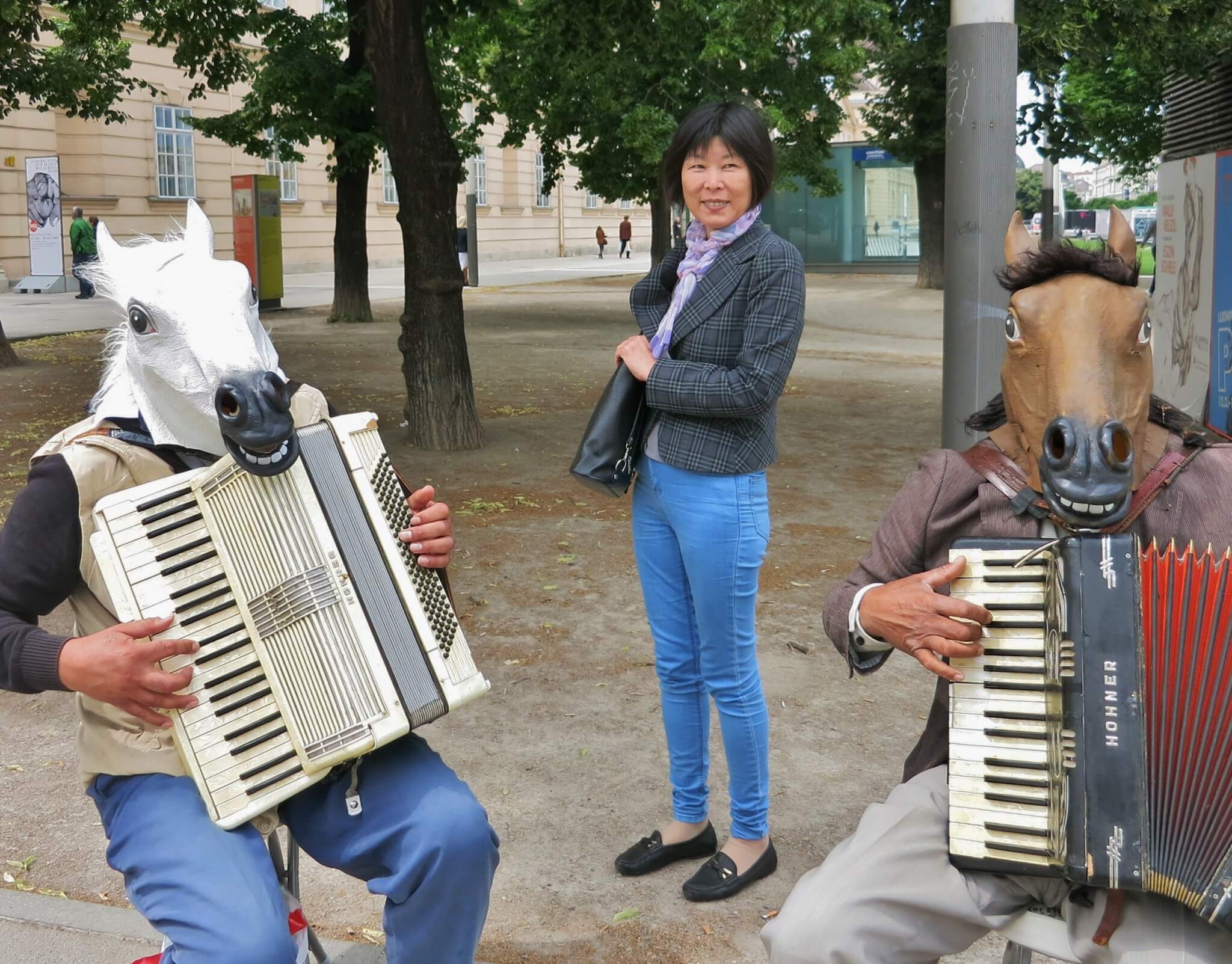
Vienna Calling: No MAGA (Make AUSTRIA Great Again) article.
Vienna calling! [1] Living in the world’s most livable city as blog post might sound surprising coming from me. Don’t worry, I haven’t switched to advertising, nor am I trying to become a tour guide as my fourth career.
And unsurprisingly, slogans like MAGA, regardless of which country it refers to, don’t resonate with me. It’s a matter of taste and of questionable wisdom.
If you follow international news, you’ve probably noticed that Vienna has been voted the most livable city for the 8th time in 10 years. [2] Since I’m the go-to person for many readers in Vienna, I want to clarify a few basics. As expected, from a very personal perspective.
Shortly after Vienna once again claimed the top spot two years ago, an article by an English student was published, harshly criticizing the Viennese. For me, both statements are irrelevant, just like for most Viennese. Recently, a co-blogger, Kulturbowle, introduced a book by a German author that illustrates this quite well. A typical aged Viennese couple sitting at the breakfast table, each engrossed in a newspaper. She says, “Did you hear? Vienna has been voted the most livable city again!” He replies, “Well, probably because it’s even more f&%cked up elsewhere.” If you understand or, better yet, love this attitude and dry humor, you’re well on your way to understanding the Viennese.
Viennese Humor
This type of Viennese humor is known as “Wiener Schmäh” (Wikipedia) and even our German neighbors struggle to understand it, though we speak the same language. A witty remark from the World War I period captures the difference in mind perfectly. In a Berlin Führerbunker, the situation was described by the generals as: “The situation is serious, but not hopeless.” Meanwhile, in Vienna, it was summed up as: “The situation is hopeless, but not serious.” [3]
Billy Wilder, an Austrian director, infused his films with Viennese humor, reflecting his roots. Similarly, another Austrian director, Joseph von Sternberg, (The Blue Angel – Marlene Dietrich) was instrumental in creating film noir.
Sure, most Viennese love their city too – in their own way. Still many don’t even realize what an exceptional city they live in with the best air, as Vienna is surrounded by the Vienna Woods, and high-quality spring water from the tap. A running gag among my foreign friends is that they tell their families at home they now flush their toilets with spring water.

Never underestimate the Austrians
That sounds bold when you consider that the whole of Austria has only 9 million inhabitants (Vienna has 2 Mio). The city of Chongqing alone has 30 million inhabitants. Well, many people cannot find Chongqing on the map – and neither can they spot Austria. If they even know that we don’t have kangaroos. Some people know Austria because they find the film “The Sound of Music” touching. Well, that would be like drawing conclusions about Vladimir Putin based on the personality of Dr. Zhivago.
Anyhow, in my opinion, you never should underestimate us because – and this is hardly found in any history book or other literature – all World Wars to date have been started by Austrians. Well, there were only 2 World Wars, you might argue. I would say we are uncatchable. Country X would have to start 2 more world wars one after the other and would only be in the same place ex equo. And a 5th world war is hardly possible if we all go on like this.
How It All Came About
Vienna was once the heart of one of Europe’s most influential empires, with its reach extending as far as South America. How did this happen? Empress Maria Theresa had 18 children and a clever motto: “Tu felix Austria nube” (You, happy Austria, marry!). [4] Over time, we married our noble children to other countries, gaining a lot of land and influence in the process. A wise move indeed. Organizing aristocratic weddings is not cheap, of course, but in the long run, it is far more economical than waging war – and much quieter.
These centuries of the great Austrian Empire, later the Austro-Hungarian Monarchy, are still evident today in many facets, especially in the street scene.

Eventually, we ran out of offspring and turned to war, leading to World War I and a significant setback. The wounds hadn’t healed when this certain leader with a Charlie Chaplin mustache took over. The rest is history, but perhaps less known is that Austria not only shrank to a small country but Vienna was divided into four by the Allies and was on the brink of dissolution. Game over.
Russia as a midwife – no joke
The decisive factor was the Russians’ decision. We remembered one of our core skills, invited the Russian negotiators to a wine tavern, and drank them under the table. Thus, the new Austria was born – and declared neutral. (The Russian delegation leader was Foreign Minister Vyacheslav Molotov).
By the way, the Russians obviously couldn’t accept the embarrassment of being out drunk by the Austrians. So, years later, instead of sending Foreign Minister Molotov, they sent the head of state, Nikita Khrushchev, himself into the fray.

Since then, we’ve maintained a good relationship with Russia. We don’t e.g. mind Russian spies in Vienna. As a neutral country, they have the same right to spy here as the American, Chinese, or Arab secret services. Honestly, if I were a trained spy and had to choose between Beirut and Vienna as my field of operation, I’d probably pick Vienna too. And if Vienna expelled all the spies, our GDP would drop by several percentage points.
The Third Man
The older readers will still remember Orson Welles‘ Third Man. Essentially, not much has changed since then in terms of Vienna being an espionage hot spot. Especially because Vienna is an important UN location.

Speaking of Russians and Putin: Putin was the guest of honor at our foreign minister’s wedding a few years ago, brought an expensive wedding gift, and was greeted with a curtsy. Today the lady lives in Russia.

Perception abroad
What always amazed me when traveling abroad was how or whether we were even known internationally. In the USA, for example, I hardly met anyone who knew Austria or Vienna straight away. In China, I usually heard, like a shot, “Vienna, the centre of music”. And I heard how many couples danced at the traditional Vienna Opera Ball and how many flowers were hung for decoration.
Mozart, Schubert & Co are of course known everywhere. Better-informed people also know Viennese musicians like Joe Zawinul (Weather Report), Friedrich Gulda, Falco (Vienna calling), and some even Michael Mantler (Carly Bley).
For those interested in fine arts, Klimt, Schiele & Co are of course no strangers, but surprisingly rarely are they immediately associated with Austria.
The list of important Viennese and Austrians who could be included in this series is long, very long, and ranges from Empress Sisi to Sigmund Freud to Nobel Prize winners such as Erwin Schrödinger (1933, quantum mechanics), Bertha von Suttner (1905, the first woman to receive the Nobel Peace Prize) and, more recently, Anton Zeilinger (Physics, 2022).
Speaking of peace. After we learned that waging war doesn’t work for us that well – and of course also because of the resources of a small state, we turned to peace. If someone has too high an IQ or biceps that are larger than the standard size, we drive them away. Like Arnold Schwarzenegger, for example, who only a few people perceive as an Austrian.
An article about Vienna I wrote a couple of years ago: HERE
footnotes for Vienna calling
[1] Vienna Calling is a well-known song by Falco. Like some other Austrians, he understood that it is difficult to gain international attention in Austria and only became world-famous in the USA.
[2] There are various institutes that carry out this ranking. The number with which we lead the ranking can fluctuate slightly.
[3] Situation Hopeless… But Not Serious is a 1965 oddball comedy film shot in black and white directed by Gottfried Reinhardt and starring Alec Guinness, Mike Connors and Robert Redford. It is based on the 1960 novel The Hiding Place by Robert Shaw.
The title is derived from Viennese Alfred Polgar’s quip, “The situation is desperate but not serious.” (Wikipedia)
[4] “Bella gerant alii, tu felix Austria nube.” – “Let others wage war, but you, happy Austria, marry.” This famous saying is quoted when the rise of the Habsburgs is to be characterized by a successful marriage policy.
Related articles: my-ukraine-contribution I article-by-me-in-the-china-report I big-catch
Explore Art & Writing
Art Portfolio → Featured Artworks → Arts & Philosophy Journal → All Articles
Explore Asian Art Essays for writing on Chinese painting, calligraphy, aesthetics and art history.
Available Artworks
Original works are available on FriedrichZettl.com and Saatchi Art


Leave a Reply