
yes, those little red spots.
Delving into the Realm of Seals on Artwork – or just for seals for fun. Since I have been asked about it repeatedly, I would like to go into it in more detail today and share my personal insights into this captivating art form.
Delving into the realm of seals in artwork isn’t just a scholarly pursuit—it’s a vibrant exploration that many find fascinating, especially those with a keen interest in Southeast Asian art.
Seals hold a special place in my life, and I’ve touched on their significance in a previous article about Chinese seals. The world of seal engraving is vast, encompassing historical importance, the intricate art of seal carving—from design to technique—and the diverse materials used by collectors. It’s no wonder that Chinese seals have become highly sought after, commanding seven figure results at auctions.
The rise and fall of a seal cutter – me
But today, I’m sharing a more intimate aspect of my journey with seal engraving, a craft that has long captivated my heart. My fascination began over five decades ago with a book about a Zen calligrapher. One line struck a chord and has resonated with me ever since: “A calligrapher might finish their work in minutes, yet they spend twenty minutes finding the perfect spot for their seal.” This insight was my first direct encounter with the art of seals, and it remains a profound observation.
My inaugural trip to China in 1978 led me straight to a seal stone shop, far removed from the tourist trinkets of today. That initial visit sparked a collection that grew to 2,000+ seals over the years, many of which I’ve since sold, with the core collection now residing in a Chinese museum. Reflecting on this brings a nostalgic tear to my eye. Of the 20 or so trips I made to China over the years, I financed quite a few of them through trading in seals. A fortnight in Shanghai, exploring shops and markets, and acquiring a bunch of seals, I could finance the entire adventure.
After I discovered the subject of seals, it didn’t take long before I started carving seals myself, initially for my artwork. The enthusiasm from my Chinese friends was encouraging, and in July 1983, a prestigious Japanese magazine featured an article about my work, complete with photos of my seals. I sure felt some pride, particularly as I was, to my knowledge, the first non-Asian to grace the pages of this esteemed publication that continues to thrive.

The seal artist Wáng Yōng 王鏞
The following also seems remarkable to me: My quest for mastery in seal cutting led me to seek a mentor during my stay at the academy in Beijing. Among all, only one postgraduate student, Wáng Yōng, shared my enthusiasm for seals and possessed the skill to carve them. It was heartening to discover that he is now a rightly recognized artist. (baidu article)
The admiration of my Chinese friends and mentors was not always mere courtesy and recognition of my dedication. My passion for seal engraving was not mere fascination; it was an intense pursuit that led to a knowledge and understanding that they found remarkable. To illustrate this, I would like to show a seal of Wáng Yōng – the one on the top left in the attached image.
First of all, it should be said that hardly any Chinese can decipher seal script. The inscription reads: 銅石心腸 (tóng shí xīn cháng) copper – stone – heart – intestine
This doesn’t make sense if you don’t know that there was a movement, a renaissance during the Ming Dynasty when artists sought inspiration from the inscriptions on ancient bronzes and stone stele engravings to elevate their craft—a practice that resonates with me profoundly.
So the meaning of seal in question goes: “Bronzes and stones are my destiny.” This phrase encapsulates more than just a preference; it signifies a deep-seated affinity, an intention, and a reflection of one’s innermost inclinations and state of mind. For me, this ‘bronze and stone sentiment’ has woven itself into the fabric of my being, influencing my artistic journey and personal identity.

Little An (xiǎo ān (小安), an exceptional seal carver
My second visit to China introduced me to Xiao An [1], a young woman with whom I shared countless hours discussing the intricate art of seal cutting. My passion ignited her curiosity, and soon, I was teaching her the challenging craft. Her initial attempts were astonishing, leaving me utterly speechless. As she progressed, each seal surpassed the last in craftsmanship.
The end result was that I stopped cutting seals. Not out of envy or jealousy, on the contrary, I was happy for her, but I realized that I was far too traditional and I had no idea how to get to a higher level, I was simply middle class at best. She specialized in picture seals, a genre that has existed in China for over 3,000 years. [2]


The Seal Carver and Calligrapher Cheng Yutian 程与天
Wang Yong, discussed above, was an extremely nice colleague, showed me his treasures, diligently printed his new seals in my seal book – and above all he introduced me to a very remarkable artist: Cheng Yutian. Yutian and I spent a lot of time together. Chinese colleagues at the time could hardly do anything with his work and he was all the more honored by the admiration of a foreigner 😊. I probably have the largest collection of Cheng Yutian’s seal impressions ever. Like Wang Yong he is a well-known artist today.
Yutian’s journey to becoming a calligrapher is as extraordinary as his art. During the Cultural Revolution, he was a construction worker, a job that left little room for artistic pursuits. Brushes, ink, and paper were luxuries beyond his reach. Yet, his passion for calligraphy didn’t wane. Each evening, after the day’s labor, he would practice his strokes using a bricklayer’s brush and the cement residue from washed buckets, turning construction formwork boards into his canvas. This dedication continued for years.
When our paths crossed, Yutian had just completed a seal for Zhuo Lin, the widow of Deng Xiaoping, and had dispatched it to her. His story is a testament to the indomitable spirit of creativity that thrives against all odds.

The swan song of my seal carving
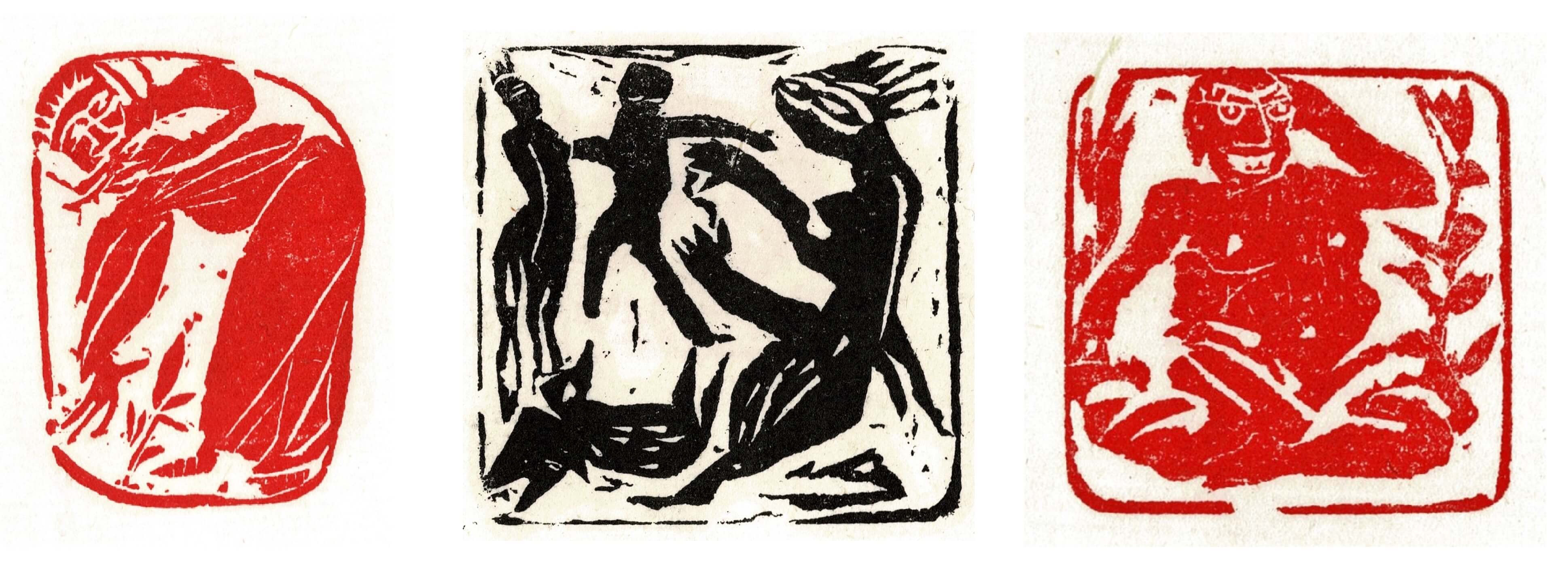
If I’m not mistaken, these are the last 3 seals I cut (image below). Left: name seal for a Chinese friend. Middle: “A window full of sun” (一窗清日 yī chuāng qīng rì). And the right one? “Little An”. I had planned to give Xiao An a seal as a token of my appreciation. But when we met, she surprised me with a seal she had made herself for me. Its beauty was so great that I found my own gift pale in comparison, and I decided not to reveal it. To this day, the seal remains wrapped, a silent testament to the talent that overshadowed it. But with time and distance, it has regained some of its appeal for me. While it cannot compare to Xiao An’s masterpiece, it has a charm all its own.

extra:
In the following section you will find a curated selection of images that bring the theme of seals to life. Seals are not just about the engravings. The stones themselves are also treasures coveted by collectors. The image of the stone drum, which comes from an online community (quora), shows the raw beauty of this genre. The other images show seals that were once or still are part of my personal collection, each with its own story and meaning.


footnotes
[1] I don’t want to use her real name as I didn’t ask for the OK, but I think she would be happy to see her seals shown to a wider audience. I’m afraid she never understood how great her seals are and stopped cutting seals soon after we returned from China.
[2] There are authorities seals, name seals, studio seals, leasure seals, collector seals. Recommended: Wikipedia article on seals
Similar articles can be found in my section Art Theory
Shops: FriedrichZettl.com – Saatchiart . Media: Blog – Youtube – Instagram


Leave a Reply