
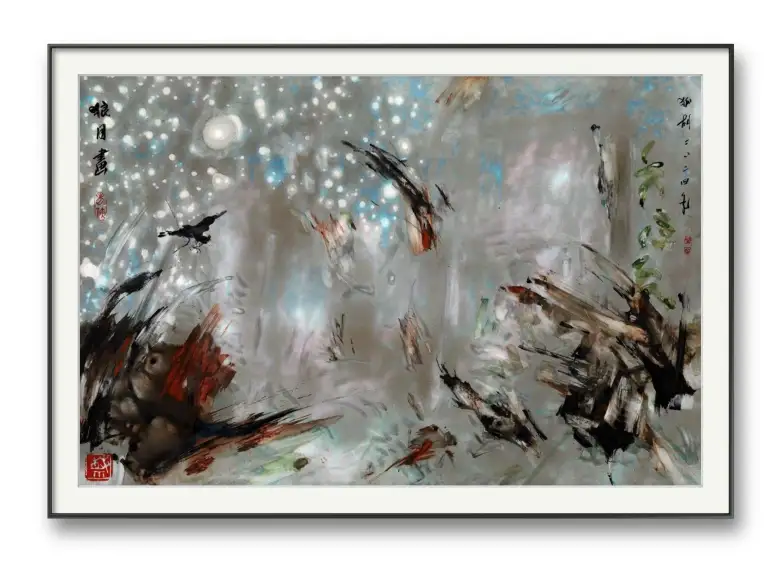
The Inner Landscape
Surrealism has been a recurring element in my work for many years. What interests me is not the familiar imagery of classical Surrealism, but its attempt to reach beyond visible reality and allow unexpected images to emerge.
In my New Surrealism works, this interest meets my experience with Chinese ink painting and calligraphy. Spontaneous brushwork, accidental forms and the fluid behavior of ink create images that hover between landscape, memory and dream. Western ideas of the subconscious enter into dialogue with Chinese concepts of transformation, emptiness and the shifting nature of perception.
From Collage to Flow
My journey began with classical collage and oil painting, inspired by the early French Surrealists. I cut up reality to rearrange it.


Over time, however, collage and constructed imagery gave way to a more fluid process. Chinese ink offered a medium capable of responding immediately to movement, accident and intuition. Instead of assembling an image from existing fragments, I could allow forms to emerge directly from stains, washes and spontaneous brushstrokes.
Automatism, Ink and the Unplanned Image
Surrealist automatism—the attempt to create without a predetermined subject—has an obvious affinity with aspects of my ink practice. I often begin with a gesture, a stain or a movement of the brush without knowing what the final image will become.
Chinese ink is particularly suited to this process. Its flow cannot be completely controlled, and accidental forms often suggest unexpected directions. Rather than forcing an image onto the paper, I respond to what is already beginning to emerge.
This approach recalls techniques developed by artists such as André Masson and Max Ernst, but my own process has been equally shaped by years of working with Chinese brush and ink.
The result is a form of abstract surrealism: landscapes that do not exist on any map, yet can appear strangely familiar.


Landscapes of the Mind
Where Sea and Sky Blur. A recurring motif in these works is an ambiguous space between sea, sky and landscape. Horizons dissolve, forms appear submerged, and recognizable structures emerge only to disappear again.
These are not representations of particular places. They are imagined landscapes shaped by memory, atmosphere and association—spaces in which melancholy, silence and a sense of distance can coexist.


Between Dream and Emptiness
Dream and emptiness introduce another dimension into these works. Some paintings become increasingly reduced, with only a few gestures or fragments remaining within large areas of open space.
Rather than illustrating Zen or Daoist ideas, these works reflect an interest in unstable perception: the moment when an image seems about to appear or disappear, when something recognizable remains suspended between form and emptiness.


Surrealism in a Contemporary Ink Practice
Surrealism remains one of several currents that inform my contemporary ink practice. Its interest in chance, subconscious association and unexpected imagery connects naturally with the spontaneity and unpredictability I experience when working with ink.
At the same time, Chinese painting and calligraphy have changed the way I understand gesture, space and the act of painting itself. The resulting works are therefore neither traditional Chinese painting nor a continuation of historical European Surrealism. They occupy a space between these traditions.
For a broader exploration of dreams, art and perception, see my essay Dreamtellers.


The Ongoing Dream
Ink Surrealism is not a closed chapter for me, but an open question. Every blank sheet of paper offers another opportunity to explore the unknown and to allow images to emerge without knowing in advance where they will lead.
Seen together, these works trace a continuing journey from the assembled fragments of my early collages to the fluid, atmospheric spaces of my more recent ink paintings. Surrealism remains present, but its language has changed: collage has become gesture, constructed imagery has given way to accident, and the dream increasingly unfolds through ink itself.
Explore Friedrich Zettl’s Art and Ideas→
Art Portfolio → Asian Art Essays → Journal → Articles Archive


Leave a Reply